Posts Tagged ‘literature’
THE THREE BODY PROBLEM: For Educators
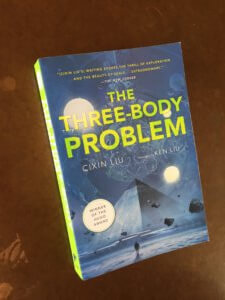
by Cixin Liu
Worthy of a Physics/Calculus Teacher’s Attention particularly high school and particularly for AP or IB Physics students
ALSO instructive for discussions in philosophy and ethics (see bottom paragraph)
High school physics instructors or calculus instructors…this novel would make a great summer reading assignment before your class begins in the Fall. One, the story is entertaining. Two, the story portrays historically some of the greatest physicists to walk planet Earth. Three, The Three Body Problem itself, the actual physics problem, this engages the physicist’s and the mathematician’s mind, Newtonian physics and all that jazz…Not that I understand it all, but I believe these the guys who write on the website: askamathematician.com. The excerpt below is from their website
The Three Body Problem is to exactly solve for the motions of three (or more) bodies interacting through an inverse square force (which includes gravitational and electrical attraction).
The problem with the 3-body problem is that it can’t be done, except in a very small set of frankly goofy scenarios (like identical planets following identical orbits).
The unsolvability of the 3-body problem, rather than being an embarrassing hole in physics, an obvious but unsolved problem, is actually the norm. In physics, the number of not-baby-simple, exactly solvable problems can be counted on the fingers of one hand (that’s missing some fingers), and that includes the 2-body problem.
The dynamics of one body is pretty straight forward, in as much as it travels straight forward.
The dynamics of two bodies, while not trivial, can be reduced by pretending that one body is sitting still, and then restricting all of your attention to the other body. Using that technique, you find (or, at least, Newton found) that the motion of a body under gravity is an ellipse. The same idea can be applied to the quantum mechanics of electrons and protons to find the exact structure of the electron shells in hydrogen (1 proton + 1 electron = 2 bodies). In that case you’re not talking about actual orbits, but the idea is similar.
But, for three bodies, there doesn’t seem to be a fancy trick for finding solutions. As a result, the exact behavior of 3 or more bodies can’t be written down. The exact energy levels and orbital shell shapes in anything other than hydrogen is impossible to find. Even deuterium (hydrogen with one extra neutron)! Can’t be done.
Despite that, we do alright, and happily, reality doesn’t concern itself with doing math, it just kinda “does”. For example, quantum field theory, despite being the most accurate theory that ever there was, never involves exactly solving anything. Once a physicist gets a hold of all the appropriate equations and a big computer, they can start approximating things. With enough computing power and time, these approximations can be made amazingly good. Computer simulation and approximation is a whole science unto itself.
The main actors in THE THREE BODY PROBLEM are almost all physicists and/or mathematicians and they’re nerdy, but not dweebs. Read chapter 5, A Game of Pool if you want a taste of what the novel offers. Then, there is the virtual reality, which unfolds as a puzzle/game and is played often by nanotechnology researcher, Wang Miao. Wang is compelled to understand the mystery introduced in the early chapters of the novel and realizes that the game is key to the revelation he seeks. In the game world, Wang walks through the history of physics with virtual characters like Confucius (our earliest physicists were primarily philosophers…a helpful connection for students to make), Newton and Einstein. Trisolara happens to be grappling with the three body problem. It is a planet in a solar system where there are three suns. The game players, along with the philosophers and physicists throughout history try again and again, in a systematic way, to solve the problem of the planet’s impending destruction. To go through each game level, Wang encounters physicists who have furthered the thinking regarding the problem. It’s like taking a course called The Intro to Physics…all this learning while the reader hurtles toward the big reveal at the end of the novel. Ah…to be entertained while learning…tis a wonderful thing. At the very least, THE THREE BODY PROBLEM ought to raise the curiosity level of your students and give them a glimpse of the relevance of physics and math to their everyday lives.
For the ethicist/philosopher, THE THREE BODY PROBLEM raises interesting issues about elites thinking they know best for all. The Cultural Revolution in China drives the narrative in the early chapters. Many elites are driven out of their positions of authority, killed or exiled by the communist party as it takes power. The author calls this a madness. (Chapter 1’s title is: The Madness Years). However, within the communist party, a new breed of elites rise to the top. Later, toward the final chapters of the novel, a group of environmental activists, along with men and women Liu specifies as elites across the globe, use their power to set in motion what they hope will be Earth’s salvation (knowing that saving the planet may come at the expense of most or all human lives). This small group of people have become judge, jury and executioner for humanity. Moreover, their hope for saving the Earth might not evolve the way they imagine. The stage is set for a discussion about power, elitism, environmental degradation and what might be ways to stem our self-destructive/planet-destroying tendencies.
To read a No-Spoiler review of this novel, click THREE BODY PROBLEM, Book Review
To buy THE THREE BODY PROBLEM, click here.
FEED, For Educators
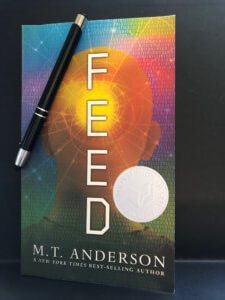
Discussion Questions for Educators
Appropriate for Middle Schoolers and High Schoolers
What a potent book and an important topic. If you are an educator, please assign this short novel to your kids. I have tested it on more than a few middle and high schoolers and they liked it, even felt captivated by it and knew there was truth in the story that they needed to pay attention to.
Five discussion questions for your students
- How is the feed similar to the way we connect to our devices?
- How is the feed different from the way we connect to our devices?
- How would you describe Titus and his friends?
- How would you describe Violet?
- Who is more of a hero? Violet or Titus? Explain why…
To read a no spoiler review of the novel, click here.
To buy, FEED, click here.
FEED, A No Spoiler Book Review
 Feed
Feed
By M.T. Anderson

A Book Review Without Spoilers
My daughter took a Dystopian Young Adult Literature class at her university a few years back. She took it for fun because though she was an architecture student, she loved to read fantasy, science or dystopian fiction. FEED was on the syllabus and after reading it for class, she handed it to me. “Mom, you have to read this book.”
When your kid hands you a book with that recommendation, you ought to respond, so I began to read…The first line of this novel grabbed me. It has to be one of the best EVER in the history of YA or scifi…
We went to the moon to have fun, but the moon turned out to completely suck.
However, after that first line, I almost didn’t make it past the first chapter. The narrator grated on me. The story is told from the first person point of view of a spoiled and entitled older teen male. Initially, I wasn’t sure I wanted to read his story, but I kept on, glancing a glimmer of hope for this character as I pushed through my angst. I saw how MT Anderson was using this vantage point to get under my skin…after all, much of the western world falls into the category of entitled, wealthy and spoiled. I decided that rather than distancing myself from this character, I ought to learn from his journey.
FEED is mostly a YA dystopian novel, but spills over into science fiction because of the futuristic tech and those initial scenes on the moon.
In recent months, I have recommended this story to more people than any other book I have read in the last 10 years. Why? FEED is good enough to hand over to a 13-year-old and a 52-year-old and if you are a parent, please read it and discuss it with your teen. Talk honestly about how we are connected to our devices.
FEED projects a future where children are connected to the web via the brain at a very early age. In the story world, the connection is called the feed. The practical science of how this takes place is never detailed, but it becomes clear that those with the feed maintain major economic, educational and social advantages. The story also shows the consequences of our planet devastated by greed and consumption. Oceans are dead, meat is genetically grown without the need for an actual animal and those who have money spend it on pure entertainment.
Titus, the teen protagonist and the narrator, lives at the top of this food chain. Initially, Titus seems utterly narcissistic. He and his friends battle boredom by pursuing short bursts of entertainment in whatever form available (almost always for purchase and provided by the feed). Titus slowly emerges as a deeper character, as someone hoping for authentic intimacy and friendship. Within his social class, it seems there are no guides to help him. Even his family is devoid of warmth and affection. For example, Titus never calls his little brother by his name, but refers to him throughout the story as Smellfactor. He treats his brother as an object of inconvenience, someone to ignore and avoid. Within Titus’ social circle, there is every indication that his family is normal.
While on the Moon, Titus meets Violet. Initially, physical attraction drives his desire to be with her, but when an event disconnects Titus, his group of his friends and Violet from the feed for a few hours, their bond takes on a deeper hue. Violet is not from his social class and was not connected to the feed at the earliest age possible. Her hippy, intellectual parents resisted putting the feed in her brain for as long as they were able, homeschooling her for a time (since education happens via the feed). As a result, Violet knows about the world in ways Titus and his friends don’t. She has developed critical thinking skills and keeps current on news, including the broad unrest that is taking place across the globe.
Violet isn’t lost without her feed like Titus. She asks questions, she makes observations, she opens Titus’ eyes to the way the feed manipulates, limits and traps those who are connected. Titus finds her views compelling and true, yet he resists her as well. Titus is less of a hero than we might hope, but he does attempt in his own way to move toward knowledge and depth. This makes for a potent story.
FEED poses so many questions that are worth asking. I won’t spoil the finale, but there is a poetic vision that lends itself to pondering and, as I said…a great discussion.
This book is a quick read. Do hand it out to your children and grandchildren. Do give it to your nieces and nephews. Do read it yourself, so you can draw out the conversation that needs to take place in our society…TODAY if not yesterday.
If you need questions for starting a discussion, see my post FEED, by M.T. Anderson Discussion Questions for Educators
To buy this amazing book, click here.
THE MARTIAN, Book Review
The Martian
Review of the Novel
By Andy Weir
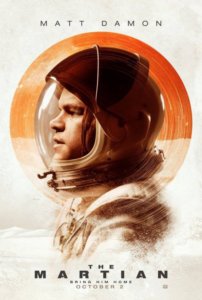
THE MARTIAN became a must-read science fiction novel a few years ago. Not only did the book go mainstream, but the story captured the imagination of Twentieth Century Fox. Under Fox Entertainment, Drew Goddard adapted the book to screen and Ridley Scott was hired to direct. In 2015, THE MARTIAN became Scott’s top grossing film. Mark Watney, the hero of the story, became a household name as did many of his quips, like:
- In the face of overwhelming odds, I’m left with only one option: I’m gonna have to science the shit out of this.
- I don’t want to come off as arrogant here, but I’m the greatest botanist on this planet.
- They say once you grow crops somewhere, you have officially colonized it. So, technically, I colonized Mars. In your face, Neil Armstrong!
THE MARTIAN in novel form
THE MARTIAN tells the story of an astronaut stranded on Mars. He is a member of NASA’s third mission to the red planet, having traveled on Hermes, a one-of-a-kind craft that has the capability to reach Mars. The story is set in the year 2035. While the crew is on day 5 of their 30-day mission and living in a tent-like research structure, a 175 mph sandstorm erupts on Mars. This leads them to abort the mission, but while Watney and the rest of the crew rush out of the tent and are on their way to the ship that will take them back to the Hermes, Watney’s suit is penetrated by a blowing antenna. All of his fellow crew members know this to be a death sentence in the harsh Martian environment and in the confusion of the storm, they lose contact with him and make the tough decision to leave his body behind, assuming he is dead. But, Watney survives.
The rest of the story unfolds as part survivor tale, part rescue mission. The tension is palpable throughout. Watney is the main narrator, making journal entries about every challenge and every Mars-life-hack he performs to survive. He is an engineer and a botanist, so his skill-set comes in handy. He needs to make water, grow food and figure out a way to contact NASA to let them know he is alive. He meticulously details the science in his journal entries and they are funny, while being brilliant. When he does finally reach NASA and his former ship mates, the rescue mission begins, but not without its own challenges/impossibilities.
The narrative broadens in vital ways when NASA is contacted. Now, the reader sees new characters and just in time. It might not have been so compelling a read without the new voices and the new motivations. Watney’s story continues to be mainly told in his journal entries. The NASA folks come into the story via omniscient narrator. Very quickly, NASA tells Watney’s crew (still en route back to Earth) that Watney is alive. Now they become a part of the story, trying to figure out a way (if there is one) to rescue their fellow crewman…These characters are all interesting and are making decisions that ramp up the tension. Saving Watney is going to be extremely costly and potentially fatal for the Hermes and its crew. There are a million reasons to let Mark Watney die.
This story succeeds in capturing the unique voice of a space hero. Mark Watney cannot fly around like Ironman (a reality he bemoans at one point in the story), but his superpower is his ingenuity, his intelligence and his sense of humor in the face of the slimmest of odds. He is matched by NASA’s creative problem solving and his crew mates, who show themselves to be people of courage and sacrifice.
I laughed aloud reading this book (actually consumed it via audio book with my family while on a road trip…all four of us love a good scifi story and Weir’s first person narration does make for a great audio experience). Watney’s voice rings in one’s brain following a good listen.
I highly recommend this novel and will write another post for educators, as the science-inspired story potentially gets kids revved up about their studies.
To buy the Martian, click here.
THREE BODY PROBLEM, Book Review
The Three-Body Problem by Cixin Liu
The Three Body Problem
By Cixin Liu, Translated by Ken Liu
Last month, my science fiction book group tackled THE THREE BODY PROBLEM. We used our 1.5 hours of group time discussing story-telling and physics. (We’re lucky to have a physics PhD in our midst. We’re luckier still that he makes a mean brew and brings us amazing pints of his beer creations each month.) Next time we meet, I’ll post a photo.
Short Review…
5 Reasons To Read THE THREE BODY PROBLEM
- Fascinating view into 20th century Chinese history
- Interesting and well-drawn characters
- A story with tension
- Physics, math problems, a virtual reality problem-solving game (nerd meter is tapped here!)
- A chance to read a Non-Western narrative
What ought I say about this epic tale? THE THREE BODY PROBLEM portrays a number of characters, most of them well-drawn. The story unfolds with tension, there is a mystery to be solved and the complicated physics concepts embedded in the tale are true science. A virtual reality in the form of a game played by one of the main characters, becomes a key to solving the mystery. The world the game introduces is imaginative and entertaining.
The characters do not look like white westerners, nor do they think like white westerners. I see that as a plus for the western reader. The characters are primarily Chinese Nationals, with a handful of others thrown into the story stew. (See the handy List of Characters page at the beginning of the book and refer to it when needed).
This novel is originally written in Mandarin Chinese, which means (unless you’re a fluent reader of Mandarin) you will read a translation of the original. Welcome to the 21st century, where story-telling centered around the English language will likely diminish, but not to our detriment. As story consumers, we’re living in the best of times.
And, in case you wonder about this tale’s place in the science fiction universe, THE THREE BODY PROBLEM won the Hugo Award in 2015. Moreover, Amazon has recently purchased the rights for adapting this novel for the screen (and the two that follow it) for 1 BILLION dollars. Yes…you heard me, 1 BILLION dollars and yes, this is the first of a trilogy (so far). Here is the link that tells the tale of the Amazon deal for those of you interested.
According to various entertainment news sites, Amazon is looking for the next Stranger Things or Game of Thrones that will add them to the mix of superior content providers. They are competing with Netflix, Hulu, HBO and now Disney Plus et al. for content. THE THREE BODY PROBLEM and its subsequent novels define superior content. Moreover, the trilogy so far (maybe it will expand as GOT did?) maintains a devoted fan following in China and across the globe, many, many millions of potential viewers who might become Amazon Prime members. You can begin to see the appeal to Amazon’s dealmakers.
So…with all that hype…what is my review of this story?
The Storytelling and Teasing out Who is the Main Character:
First, I will say that most of the members in our book group loved the novel overall. Some liked the story-telling, others did not like the style. The narrator is omniscient in a way that is sometimes disorienting, at least for the western reader. There are jump around moments when the point of view shifts somewhat abruptly from one character to another, from one time period to another, even to one solar system to another…I consumed the book on audio while on a road trip, so it’s possible I was more disoriented than if I had had the book in hand. The chapters often mark the dramatic scene/world/time changes. I was hearing them and not seeing them. There is something stark about viewing the blank page and a chapter heading. It triggers the eye, therefore the brain to prepare for the change. In the free-flow of audio, I don’t think my brain was always cluing in. I hope to write a post about audio books and their rise in our book consumption in the coming days.
Here is an example of the point of view shifts that will take place in this story. At the end of chapter 12, the reader moves from Red Coast Project site 1970s to chapter 13, where a series of selected documents are flatly divulged to the reader at a time in the future, as if the story-teller is showing us files, giving information about Red Coast Project, previously top secret…then, back to chapter 14, present day novel time, when a main character Wang Miao interacts with Professor Winjie, someone who worked for many years at Red Coast Project.
Wang Miao, a nano-tech researcher, is caught up in the mystery and trying to understand a complicated tangle of events taking place in the scientific community around him, including a number of prominent physicists committing suicide. He interfaces often with Ye Winjie throughout the novel, a retired physics professor, whose daughter is one of the physicists who has committed suicide. Ye and Miao are both primary characters. Miao is the most relatable character. He is trying to solve the mystery. I won’t call him THE main character only because from a story standpoint I understood Professor Ye Winjie to be the main character. The book begins and ends with scenes that involve her and/or her family, but Wang Miao is central to the unfurling of the mystery. He performs many acts that are crucial to the plot development, including, he plays the virtual reality game. The reader sees the game world and game characters through his eyes. So, who is the main character? It’s debatable…but between these two, I think it is Ye Winjie.
The main actors in THE THREE BODY PROBLEM are almost all physicists and/or mathematicians and they’re nerdy, but not dweebs. Read chapter 5, A Game of Pool if you want a taste of what the novel offers. The virtual reality world and the three body problem puzzle played often by Wang Miao make known the game planet of Trisolara. In the game, the reader walks through the history of physics because Trisolara has three suns and has to solve that problem or else, face destruction (which happens a number of times as Miao plays the game). The game players, along with physicists throughout history try again and again, in a systematic way, to solve the problem. Regarding the game and how it serves the story, I will leave that for your discovery.
Another aspect of storytelling that might disorient or bother the reader is the information dump that seems to happen periodically, like in chapter 13 as I mentioned above…also in chapter 25. An interrogation of professor Ye in this portion of the narrative ends up explaining a whole lot of back story. It’s not an awful dramatization, but so much information is divulged in one convenient scene, it would likely be deemed sloppy writing by many authors/literary critics…but hey, the question is…will you quit reading because of the way the information is delivered to you? I’m guessing the answer is no, you won’t quit. These info dumps happen throughout the novel and answer pieces of the mystery. The style of writing is probably not enough to stop the average reader, though one may be tempted to skim these sections.
Overall, THREE BODY PROBLEM is an entertaining and important read for the science fiction consumer, with a few new twists on an old scifi story that surprises and deepens the global tome that tries to envision humanity’s future.
For ideas on how to use this novel in class with students of math, science, philosophy or ethics, see my post: THE THREE BODY PROBLEM, For Educators or click here.
To buy THE THREE BODY PROBLEM, click here.
To buy the second book in the trilogy: THE DARK FOREST, Remembrance of Earth, click here.
To buy the third book in the trilogy: DEATH’S END, click here.
To buy the paperback boxed trilogy, click here.
To save yourself a bundle of dollars and shelf space, buy the trilogy on Kindle here.