Posts Tagged ‘trilogy’
SILO, A Review of Novel #1
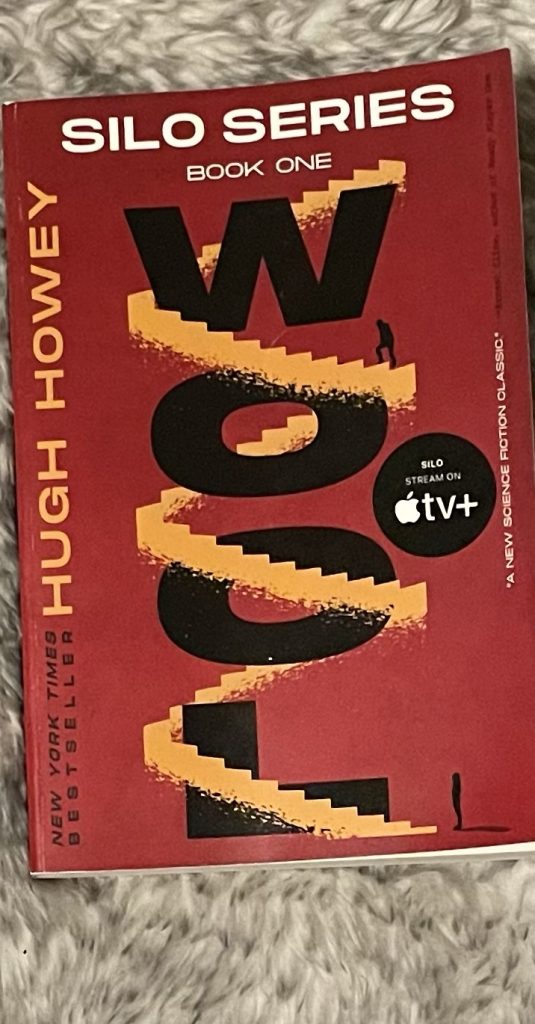
SILO is an Apple+ series that is about to release a second season. Recently, I began reading the novels. The first installment is called WOOL, and follows pretty closely the first season of the Apple+ version. This novel is rated PG-13 for adult themes. There is little or no explicit violence and no explicit sex scenes.
Hugh Howey first wrote this novel as a series of short stories/novellas. He put those stories together and indie published WOOL as a novel around 2012.
First, The Short No-Spoiler Review
Three reasons I recommend this novel, and one reservation:
- WOOL puts forward an interesting concept of post apocalyptic human existence that feels unique within the dystopian genre
- well-drawn characters overall
- enough mystery to keep the reader turning pages
My one reservation, some parts of this novel are too long and boring.
The Longer Review:
A potential issue with self-published novels is that the editing process is not well done. The author cannot afford to hire a top-notch editor and the consequence is either lots of typos or poor writing.
Overall, Howey did an amazing job self-publishing…could not find any typos, but he overwrote parts of the novel. As a reader, I sense this when I start skimming text. There is too much nitty gritty detail about everything that is transpiring. These are details the writer might need to know, but the reader does not. All that detail slows down the action, the excitement. In the worst case scenario, the reader stops reading. I did not stop reading because I actually cared about the characters and wanted to know the outcome of the story because Howey did not give me the answer to my questions until the end. So I needed to skim a few parts, but I did read until the final page.
Toward the end of the novel, when there are a couple of events that involve long scenes where I actually knew what the outcome would be, I skimmed the equivalent of about 50 pages of text.
I think most readers will know when they hit those sections. There is just too much detail and when the reader in essence already knows what is going to take place, we want to get to the next part of the action ASAP, so we skim. I have skimmed text while reading indie published novels, but I have also skimmed tradtionally published novels a few times. In theory, the great editor will catch these slow spots and help the writer edit them out. In practice, this is not always the case.
Regarding WOOL, the core of the story is good enough that most readers will overlook the overwritten parts. And the Apple+ TV people are certainly tightening everything up in a ways that is not boring. Season 2 just began (Jan of 2025)…and looks promising.
The House of the Scorpion, A Novel Review With a Few Spoilers

THE HOUSE OF THE SCORPION by Nancy Farmer
Nancy Farmer’s first of of three novels, following the life of Matteo (Matt) Alacrán, is a story worth reading to or with your kids. The primary moral challenge centers around cloning, but there are many other ethical questions that will arise in the reading. Farmer’s writing creates real characters, despite the fantastical nature of the world. She takes on complicated relationships. power dynamics, and even religion as she draws the readers toward an inevitable reckoning. She stays close to the child, Matt, who grows up in the oddly luxurious world that is Opium. Matt is a young child at the start of the narrative, a teenager by the end. The story is told in close third person.
Matt is a clone of the wealthiest drug Lord in the world, an elderly Mexican man who dragged himself out of poverty to become one of the wealthiest men in the world. He is known as El Patrón. El Patrón is well over 100 years old. He rules his nation through fear and raw power and on its land he produces enough Opium, legal and illegal, for those who need the product. The land of Opium is both a place of horrors and an ecological oasis. Nothing is simple in Opium, as the reader will slowly discover.
THE HOUSE OF THE SCORPION deals with extreme wealth versus extreme poverty as well as power, ecological degradation, leadership, friendship, loyalty, religion and meaning. All of this subject matter is delivered in an impactful way to the young reader through relatable characters.
Farmer uses a style of writing that does not explain too much too early, but for those details that are difficult to fathom, they get repeated many times throughout the book, almost like a chorus. For example, the story of how El Patrón’s siblings perished, is told and retold. The story reveals the condition of poverty endured by his family, his town, his people and how desperately powerless he had been at one time. El Patrón is an old man…of course he would repeat himself again and again, but there is more to that story. The tale is part of the legend and a defining trauma in the life of the old man. The story also reminds the reader that Matt, though he is an exact replica of El Patrón on a cellular level, his life experiences will have been completely different. That memory of losing his family is El Patrón’s, but not Matt’s. The nature versus nurture debate looms in the background of this narrative and is worthy of a hearty discussion with your child.
Many other issues are introduced in THE HOUSE OF THE SCORPION There is more great storytelling and ethics to unearth as the narrative progresses. Nothing is black and white in Matt’s world, but this is why I would recommend the book. Farmer has put forward a character and a world with the kind of complexity that leads to memorable discussions. My next post will cover a short audiobook review of THE HOUSE OF THE SCORPION.
To buy THE HOUSE OF THE SCORPION, click here.