Posts Tagged ‘Consider Phlebas’
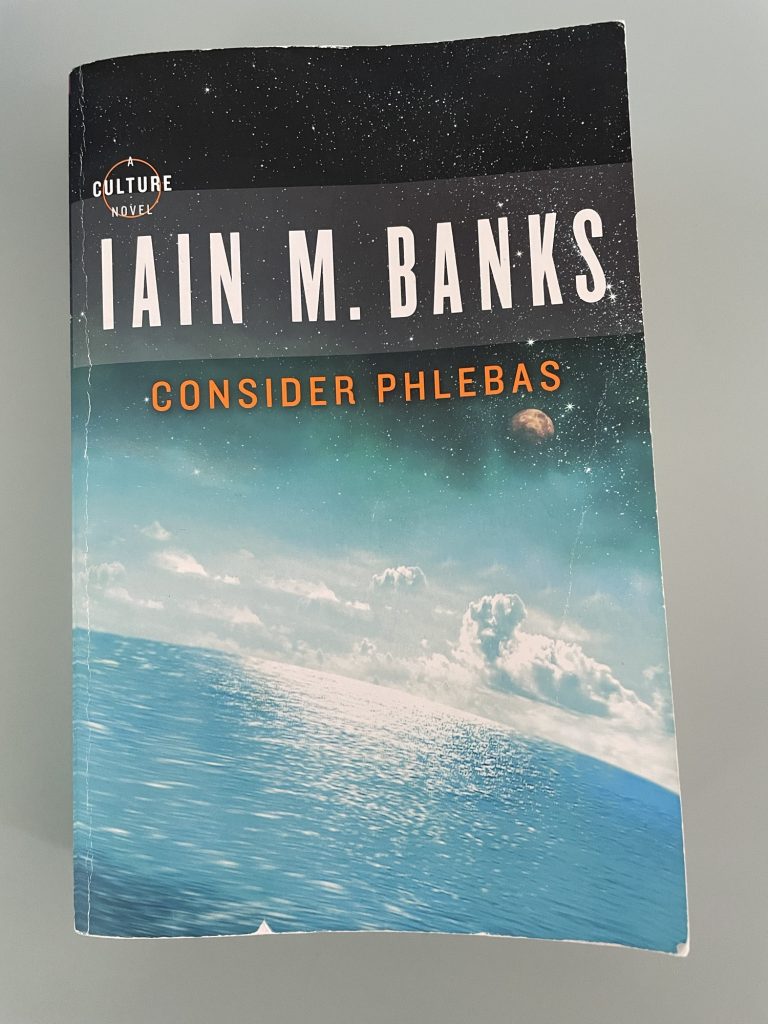
CONSIDER PHLEBAS, A No-Spoiler Review
I highly recommend CONSIDER PHLEBAS, an epic space opera written by the great Iain M. Banks. See below for the details, but suffice it to say: You MUST read Banks (especially books in the Culture Series) before you die…and don’t wait too long. You’ll need the brain-power to absorb the complexities of his broad, beautiful and sometimes terrifying future.
Iain Banks wrote literary fiction and science fiction. His literary fiction was written under the name: Iain Banks. CONSIDER PHLEBAS, and all his subsequent science fiction novels were written under the name Iain M. Banks. Banks, a Scottish writer, was born in 1954 and died at age 59 in 2013. I rate this novel PG-13. A sensitive person might not appreciate the violence (this is a space opera, with battles and alien species and robots/drones. Think, Star Wars.) A bit of sex, but no explicit sex scenes.
First, The Short Review
Four reasons I recommend this novel:
- Banks is a talented and careful writer, so the world building is new, weird, but not overwrought
- Compelling characters, unique in that they inhabit a future unknown to us, but relatable in their “humanity”
- Broad/epic adventure story, but a focused and well-crafted arc that follows one character
- The philosophical underpinnings of this first in the Culture Series is a must read for anyone who considers him/herself a scifi aficionado.
The Longer Review
CONSIDER PHLEBAS is not only the first of Banks’ scifi novels, it is the first of several in the acclaimed Culture Series. I’ve referred to this article in my review of FEERSUM ENDJINN, but to understand Banks and his philosophy around the future, tech, especially AI, and the massive impacts of “culture” on the future, this article by Professor Joseph Heath is a must read.
I also recommend 5 blogposts by the folks at: The Quill to Live. This is the most thorough review of each book in the series I have ever encountered, all on one easy to navigate and well-written site.
Here is an excerpt from the first post called: Why You Should Read the Culture: Part 1 — The Hub
“The two pieces of worldbuilding that really drive home how different The Culture is from your typical fare are how Banks approaches humanity and AI. When I first started the series I was so surprised to find that the humans aren’t Terran (from Earth). That is to say, this isn’t a story about our humanity or even our Earth, and there is absolutely none of the baggage that would come with a narrative built in our history. At first, it feels weird. I thought Banks was just trying to make his world ‘special’ or ‘original’ by calling the Terrans something else. But I quickly realized that really isn’t what’s happening. Banks removed the “humanity” element because he wanted to build something new. A tabula rasa. A fresh canvas on which to showcase ideas. It means that the reader has a lot more leg work than your average science fiction story, but that you will get to see the birth of something completely new.”
There are reasons to read books in a series, especially when it comes to genres like science fiction and fantasy. Most of you who read these genres know what I’m going to say…you read in a series because it’s so pleasurable. Once you fall in love with a place, you want to dwell there for a time.
Often a narrow piece of the world is captured in the first book, so that the many books or films that follow can hone in on or add new details that if included in the first novel would have bogged it down. Think about Herbert’s Dune and the incredibly complex societies that exist within that first universe. Then, read Dune Messiah and Children of Dune and one begins to see how narrow the scope of the original story was. An author often holds these details and nuances in her/his head but resists (in part because it is impossible to do so) revealing everything there is to know about the world in the first story. It’s the way we operate as humans as well…we take in information, absorb our environment and over time our picture of a place changes over time. Similarly, a reader can have a relationship with a fictional place. Many Millenials (and others) in our society have had that experience with the world of Harry Potter. Reading the Potter Series is in part travel adventure. We crave the familiar locales at Hogwarts, like the dining hall, or the cozy Gryffindor common room. In the novels, the first kiss takes place between Ron and Hermione in this lovely space.
“The common room was a circular room where Gryffindor students could relax after a long day of studying. It was full of squashy armchairs, tables, and a bulletin board where school notices, ads, lost posters, etc. could be posted.”
But we delight in discovering new places in and around Hogwarts, like The Room of Requirement, which comes about in book 5 of the series thanks to Dobby, the elf.
So, I am making the case that the series is probably worth reading, though I haven’t read it myself. I’ll have to figure out if I want to read it now and at once. My “to-read” book pile is large and includes Emily St. John Mandel’s Station Eleven, which I want to read soon.
However, even if you don’t want to read the entire Culture Series, dipping into it by reading CONSIDER PHLEBAS is a worthy pursuit. The novel stands alone and is entertaining in its own right. Then, make sure you pay attention to Professor Heath’s article that I linked to above. That much analysis will get you close to being able to have an intelligent conversation with most of Banks’ most devout fans.