Posts Tagged ‘fiction’
SHIFT, Book Two of the SILO series, A No-Spoiler Review
SHIFT is book two in a trilogy, so beware of spoilers as you read this in regard to book one or in regard to the first season of the tv series. I may mention details that will spoil book one/season 1, so stop reading now and click on WOOL to read my review of book one of the SILO series. This novel, like the first is rated PG/PG-13.
SILO is currently showing on Apple tv+. You can view the first and second season now. I recommend the first season for sure, but am still wading through the second…it’s excellent so far, but I’ve only watched the first couple of episodes.
I’m guessing this series would make a great audiobook. It’s not so complex as a story, follows few characters and takes place primarily in the silo, a setting that becomes very familiar by the middle of book 1.

The Short Review: 4 Reasons I Recommend SHIFT
- If you liked WOOL and are curious about how the world fell apart and the silos were conceived of and created, you’ll want to read this novel. It contains a lot of backstory.
- While some questions are answered, there are many unknowns and therefore more page-turning tension
- This story follows two characters, two different narrative voices who so far have not met/do not interact. One of the characters was a peripheral character in WOOL and one is new (almost) to the reader.
- All the characters are flawed in different ways, but relatable and trying against many odds to do good…or at least to make things right
Note: If you loved Juliette as a character, know you’ll see very little of her in this novel, but based on how this book ends, I have the feeling she will take center stage again in book 3. It’s a guess, but an educated one.
The Longer Review:
The SILO series so far has been a fast read, despite the number of words. Don’t let size fool you. If you’re like me, you’ll be turning pages quickly and staying awake too late at night so you can figure out what is happening. Also, I skimmed less of the text in this novel, but still read it quickly.
Regarding the order in which you do this…reading first or viewing first, one thought: I watched the first season of SILO without knowing about the books. Once I posted my review, I did receive notes from some of you encouraging me to read the books. Just know, that the series follows the books very closely, so some of the tension and mystery (either when you read or when you watch) may be diminished because you will know in advance what takes place. It changes the experience a little, though I am determined to do both and realizing the tension will come one way or the other, either on the page or on the screen. I do like the combo though. I like seeing what the screenwriter chooses to put into the script, what to leave out, or what to change. So far the series SILO, has few deviations from the novels, but there is one BIG ONE. At the end of season 1 of the SILO series, Juliette has been sent out to clean and the audience does not know what will happen as she refuses to clean, then walks over a hill and disappears from sight.
It’s a perfect season-ending cliffhanger that the screenwriter exploits, so I don’t blame him for constructing the story in this way. However, in the novel, Juliette’s next hours and days are right there in the last chapters of WOOL. So…it could be strategic to watch season 1 and 2 on Apple+ before even reading the first book, WOOL. The mystery might be more satisfying that way.
Whatever, the case, the series is fun and I’m enjoying reading it. The writing is not perfect, but it’s perfect enough to engage me (and I’m really picky) and fan the flames of my imagination. I can’t comment on the overall themes and human story yet because I’m still figuring out what Hugh Howey is saying about humanity. Maybe the third novel will give me a window into his worldview.
SILO, A Review of Novel #1
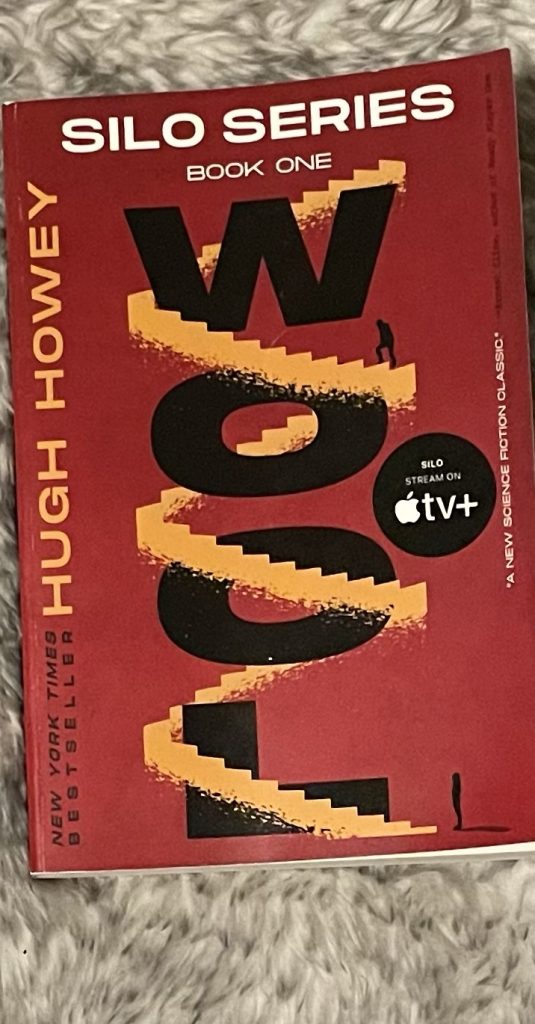
SILO is an Apple+ series that is about to release a second season. Recently, I began reading the novels. The first installment is called WOOL, and follows pretty closely the first season of the Apple+ version. This novel is rated PG-13 for adult themes. There is little or no explicit violence and no explicit sex scenes.
Hugh Howey first wrote this novel as a series of short stories/novellas. He put those stories together and indie published WOOL as a novel around 2012.
First, The Short No-Spoiler Review
Three reasons I recommend this novel, and one reservation:
- WOOL puts forward an interesting concept of post apocalyptic human existence that feels unique within the dystopian genre
- well-drawn characters overall
- enough mystery to keep the reader turning pages
My one reservation, some parts of this novel are too long and boring.
The Longer Review:
A potential issue with self-published novels is that the editing process is not well done. The author cannot afford to hire a top-notch editor and the consequence is either lots of typos or poor writing.
Overall, Howey did an amazing job self-publishing…could not find any typos, but he overwrote parts of the novel. As a reader, I sense this when I start skimming text. There is too much nitty gritty detail about everything that is transpiring. These are details the writer might need to know, but the reader does not. All that detail slows down the action, the excitement. In the worst case scenario, the reader stops reading. I did not stop reading because I actually cared about the characters and wanted to know the outcome of the story because Howey did not give me the answer to my questions until the end. So I needed to skim a few parts, but I did read until the final page.
Toward the end of the novel, when there are a couple of events that involve long scenes where I actually knew what the outcome would be, I skimmed the equivalent of about 50 pages of text.
I think most readers will know when they hit those sections. There is just too much detail and when the reader in essence already knows what is going to take place, we want to get to the next part of the action ASAP, so we skim. I have skimmed text while reading indie published novels, but I have also skimmed tradtionally published novels a few times. In theory, the great editor will catch these slow spots and help the writer edit them out. In practice, this is not always the case.
Regarding WOOL, the core of the story is good enough that most readers will overlook the overwritten parts. And the Apple+ TV people are certainly tightening everything up in a ways that is not boring. Season 2 just began (Jan of 2025)…and looks promising.
SCOTT PILGRIM VERSUS THE WORLD, A No-Spoiler Film Review
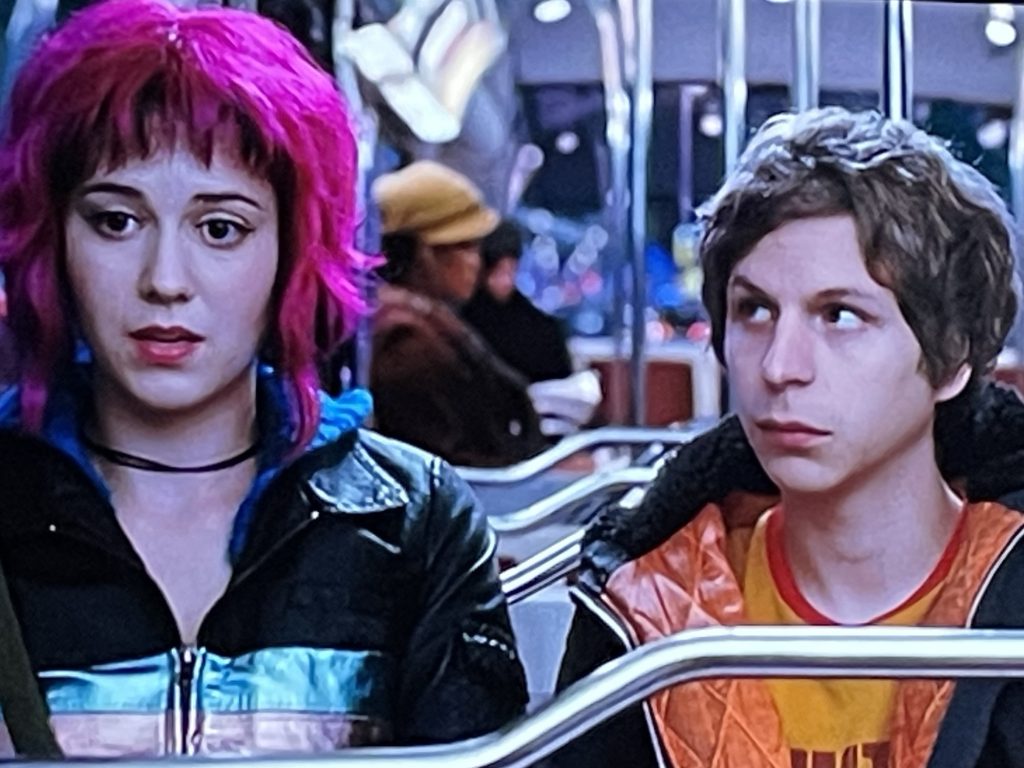
SCOTT PILGRIM VERSUS THE WORLD, a 2010 film starring Michael Cera as Scott Pilgrim and Mary Elizabeth Winstead as Ramona Flowers, dishes out a nerd meets cool girl story and takes it to the videogame/superhero plane, right into transmedia storytelling. This is an entertaining and funny PG13 story, full of teen angst, youthful lust and the longing for true love.
The Short Review…6 Reasons I Recommend this Film
- Pleasing visuals and interesting action sequences…I would watch it for this alone
- Surprising and entertaining turns with the characters and the story, many of which will make you laugh
- Angsty youth longing for connection
- Vibrant characters, like the melancholy Wallace Wells (Kieran Culkin) and the spunky Knives Chau (Ellen Wong)
- A mix-up/mash-up of reality and virtual reality in the story world
The Long Review…
SCOTT PILGRIM VERSUS THE WORLD is a film co-written, produced and directed by Edgar Wright. It is based on the graphic novel series, Scott Pilgrim, by Bryan Lee O’Malley. The film plumbs issues surrounding a young man longing for love. Scott Pilgrim is in his mid 20s and coming off a breakup. He finds himself in a relationship with Knives Chau, a highschooler who adores him, then meets Ramona Flowers, a captivating twenty-something cool girl. To win her, he has to contend with Knives as current girlfriend as well as Ramona’s ex boyfriends.
We carry our romantic histories with us and they are not always easy to shed. This is true about Scott letting go of his ex girlfriend and Ramona figuring out how to move on from her controlling ex-boyfriend(s). Both characters carry wounds and the strange action sequences in the end are a fantastical outworking of how they need to slay those old demons that might keep them from true love.
I really like this film. It’s different, quick-paced, visually gorgeous and spins a good yarn.
ALIEN CHILD, A No Spoiler Review of the YA Novel
Pamela Sargent, prolific middle grade scifi writer, wrote ALIEN CHILD in the 80s. I recommend this book as a thought-provoking vision of a possible dystopian future.

The Short, No-Spoiler Review: 4 Reasons to Read this Book with your Middleschooler/Young Adult
- ALIEN CHILD delivers a story that unfolds like a mystery, rated PG
- the characters are young, the aliens are unique
- the world is both bleak and surprising
- the questions that arise around “species extinction” are worth pondering, even for a young person
Novels like ALIEN CHILD give a parent or educator a reason to read with a teen. This is an entertaining book that has the potential to give rise to great discussion. I highly recommend this story for parent or educator/child consumption.
I also recommend the audio version.
CONSIDER PHLEBAS, A No-Spoiler Review
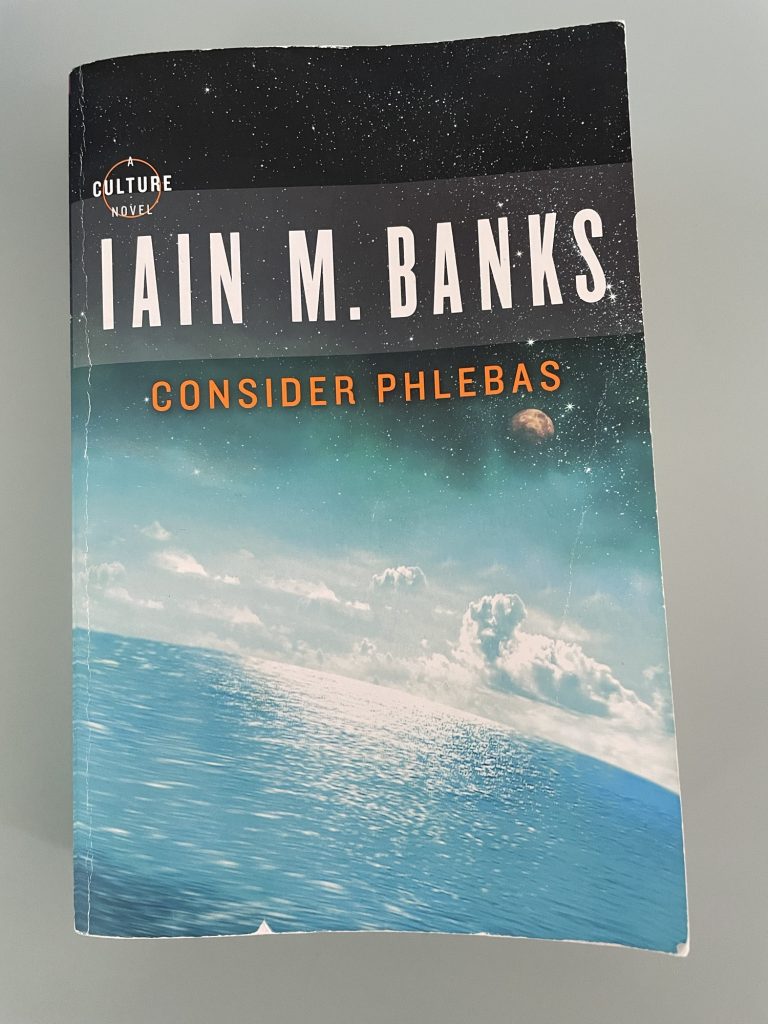
I highly recommend CONSIDER PHLEBAS, an epic space opera written by the great Iain M. Banks. See below for the details, but suffice it to say: You MUST read Banks (especially books in the Culture Series) before you die…and don’t wait too long. You’ll need the brain-power to absorb the complexities of his broad, beautiful and sometimes terrifying future.
Iain Banks wrote literary fiction and science fiction. His literary fiction was written under the name: Iain Banks. CONSIDER PHLEBAS, and all his subsequent science fiction novels were written under the name Iain M. Banks. Banks, a Scottish writer, was born in 1954 and died at age 59 in 2013. I rate this novel PG-13. A sensitive person might not appreciate the violence (this is a space opera, with battles and alien species and robots/drones. Think, Star Wars.) A bit of sex, but no explicit sex scenes.
First, The Short Review
Four reasons I recommend this novel:
- Banks is a talented and careful writer, so the world building is new, weird, but not overwrought
- Compelling characters, unique in that they inhabit a future unknown to us, but relatable in their “humanity”
- Broad/epic adventure story, but a focused and well-crafted arc that follows one character
- The philosophical underpinnings of this first in the Culture Series is a must read for anyone who considers him/herself a scifi aficionado.
The Longer Review
CONSIDER PHLEBAS is not only the first of Banks’ scifi novels, it is the first of several in the acclaimed Culture Series. I’ve referred to this article in my review of FEERSUM ENDJINN, but to understand Banks and his philosophy around the future, tech, especially AI, and the massive impacts of “culture” on the future, this article by Professor Joseph Heath is a must read.
I also recommend 5 blogposts by the folks at: The Quill to Live. This is the most thorough review of each book in the series I have ever encountered, all on one easy to navigate and well-written site.
Here is an excerpt from the first post called: Why You Should Read the Culture: Part 1 — The Hub
“The two pieces of worldbuilding that really drive home how different The Culture is from your typical fare are how Banks approaches humanity and AI. When I first started the series I was so surprised to find that the humans aren’t Terran (from Earth). That is to say, this isn’t a story about our humanity or even our Earth, and there is absolutely none of the baggage that would come with a narrative built in our history. At first, it feels weird. I thought Banks was just trying to make his world ‘special’ or ‘original’ by calling the Terrans something else. But I quickly realized that really isn’t what’s happening. Banks removed the “humanity” element because he wanted to build something new. A tabula rasa. A fresh canvas on which to showcase ideas. It means that the reader has a lot more leg work than your average science fiction story, but that you will get to see the birth of something completely new.”
There are reasons to read books in a series, especially when it comes to genres like science fiction and fantasy. Most of you who read these genres know what I’m going to say…you read in a series because it’s so pleasurable. Once you fall in love with a place, you want to dwell there for a time.
Often a narrow piece of the world is captured in the first book, so that the many books or films that follow can hone in on or add new details that if included in the first novel would have bogged it down. Think about Herbert’s Dune and the incredibly complex societies that exist within that first universe. Then, read Dune Messiah and Children of Dune and one begins to see how narrow the scope of the original story was. An author often holds these details and nuances in her/his head but resists (in part because it is impossible to do so) revealing everything there is to know about the world in the first story. It’s the way we operate as humans as well…we take in information, absorb our environment and over time our picture of a place changes over time. Similarly, a reader can have a relationship with a fictional place. Many Millenials (and others) in our society have had that experience with the world of Harry Potter. Reading the Potter Series is in part travel adventure. We crave the familiar locales at Hogwarts, like the dining hall, or the cozy Gryffindor common room. In the novels, the first kiss takes place between Ron and Hermione in this lovely space.
“The common room was a circular room where Gryffindor students could relax after a long day of studying. It was full of squashy armchairs, tables, and a bulletin board where school notices, ads, lost posters, etc. could be posted.”
But we delight in discovering new places in and around Hogwarts, like The Room of Requirement, which comes about in book 5 of the series thanks to Dobby, the elf.
So, I am making the case that the series is probably worth reading, though I haven’t read it myself. I’ll have to figure out if I want to read it now and at once. My “to-read” book pile is large and includes Emily St. John Mandel’s Station Eleven, which I want to read soon.
However, even if you don’t want to read the entire Culture Series, dipping into it by reading CONSIDER PHLEBAS is a worthy pursuit. The novel stands alone and is entertaining in its own right. Then, make sure you pay attention to Professor Heath’s article that I linked to above. That much analysis will get you close to being able to have an intelligent conversation with most of Banks’ most devout fans.
FEERSUM ENDJINN, A No-Spoiler Review
Iain M. Banks is a Scottish writer who produced literary and science fiction. He is a must read for all scifi fanatics. I only say this to the purists because if you are not a scifi purist, you might find Banks challenging. This is a review of FEERSUM ENDJINN, one of his scifi books. I have no idea if his lit fiction is easier to consume. That is not my genre. He wrote his literary fiction under the name: Iain Banks…without the “M” middle initial.
The Short Review
I recommend FEERSUM ENDJINN with reservations. Yes read for these reasons:
- If you want to gather the fathers and mothers of scifi into your knowledge base, you need to read Banks. Some would say, start with Consider Phlebas (the first novel of his Culture series). I will read that one next. Review will follow.
- Banks writes honestly in that he is someone who sees technology in his story as a power that infects every aspect of culture (will explain more in the longer review)
- You find a story thread in this novel that creates tension. The mystery is embedded in the story and characters and even the style of writing, but the reader has to work to figure out the narrative.
My reservations:
- Very little of the arc is made plain to the average reader, the story is a nut to crack. Not everyone wants to work that hard.
- 4 points of view give the narrative its shape, not all of those POVs are created equal
- One POV is told from the perspective of a creature, probably a bird of some type. It does not know traditional spelling so the reader will have to endure paragraphs that are confusing…reading sentences like this: That woz how we used 2 reech our hoam, 1 ov thi birdz tells me. The narration written in this form is about 1/6 of the book and it was very unpleasant for me to read…even though I knew Banks was doing something experimental and interesting. I wanted to like it, but didn’t.

The Longer Review:
FEERSUM ENDJINN is a story, rated PG or PG-13…Regarding the PG-13 rating, there is a reference to a character in bed with two women…and a couple of other random references to sexual desire that might deem the book PG-13…however, those references reveal character and were not given much airtime overall. For the most part, the characters are not interested in, or engaging with sex. Violence is also not prominent in this story.
The mystery lies in how a future earth exists and in what form it is inhabited. Four characters give the sense of what this reality might be. Seemingly, Earth is really messed up. People are living underground and there is a battle between AI and a computer program that gives human beings their existence. I didn’t fully understand this dynamic from the text, but read a few articles to help me grasp the full meaning. The story was imaginative and made me wonder about the world, but overall…I found it difficult to connect with any of the characters. Maybe Gadfium (one of the POV characters), but even he/she only sometimes evoked my empathy. I call Gadfium he/she because of the story world that brings characters back from death, but sometimes in male or female or even animal form.
A book that requires this much work to understand is not a joy for everyone. However, if you want to read the really nerdy people on Banks like Professor Joseph Heath you might begin to understand how groundbreaking was Banks’ vision of the future.
When I read Consider Phlebas later this year, I’ll comment on this more, I hope. For now…you have to read one Banks novel if you’re a fanatic and this one could be the one for you.
HOOD, by Stephen Lawhead, A No-Spoiler Review
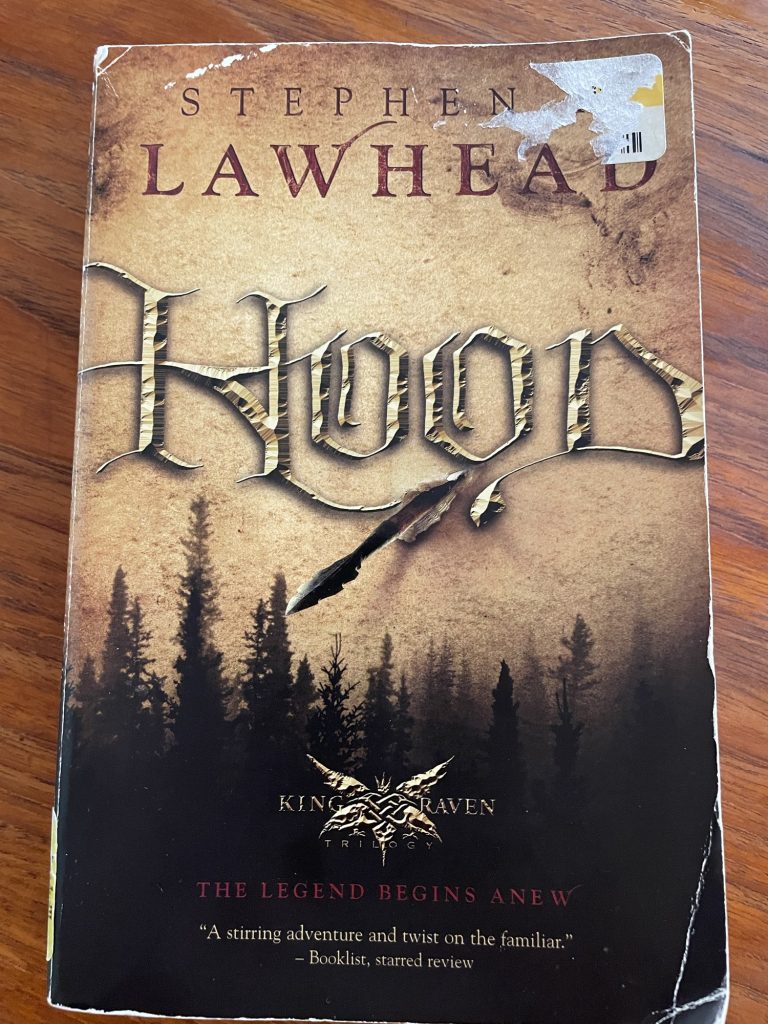
Last fall, I needed to restock my Little Free Library, so headed to the local Goodwill to see what sci-fi, fantasy or dystopian fiction they had on hand. (My LFLibrary is filled with these genres only). I did find some great treasures, including this Stephen Lawhead book that I had never heard of. I began reading it sometime in the winter and got hooked. I knew of Lawhead because of reading the Pendragon Cycle sometime in my 20s. HOOD is book one in
HOOD is the first book in the King Raven Trilogy, a story that follows a character based on the Robin Hood myth/legend.
Short Review of HOOD
I highly recommend this novel. Here’s why:
- Stephen Lawhead (author of The Pendragon Cycle…a version of the Arthurian Legend) is an accomplished writer who knows how to capture the voice of medieval and pre-medieval Brits.
- His world-building feels rooted in history, authentic
- The language engages…everything from the quirky colloquialisms, to the names of characters
- The characters are well developed, even the evil ones, and draw you into their world of struggle and heroism
- Woven into the story are Christian themes and prayers, which some won’t like, but I absorbed as authentic
- Rated PG (for medieval violence, think swords and bow and arrow…but no graphic sex or sexual violence)
The Longer Review:
If you’re reading this novel, I recommend flipping to the back of the book and reading his essay: Robin Hood in Wales? It’s past the epilogue (don’t read the epilogue or you will spoil the story).
In this essay, Lawhead discusses why he sets HOOD in Wales, playing with the idea that the legend of Robin Hood had been around and circulating through the British Isles for a very long time before the general population associated him with Sherwood Forest. Here is a bit of that essay:
It will seem strange to many readers, and perhaps even perverse, to take Robin Hood out of Sherwood Forest and relocate him in Wales; worse still to remove all trace of Englishness, set his story in the eleventh century, and recast the honourable outlaw as an early British freedom fighter. My contention is that although in Nottingham, the Robin Hood legends found good soil in which to grow, they must surely have originated elsewhere.
The character we now know as Robin Hood can be traced as far back as the early 1260s. By 1350, the Robin Hood legends were well-known, if somewhat various, consisting of a loose aggregation of poems and songs plied by the troubadours and minstrels of the day. These poems and songs bore little relation to one another. The first written references to and carried titles such as “Robin Hood and the Potter,” “Robin Hood’s Chase,” “Robin Hood and the Bishop of Hereford,” “the Jolly Pinder of Wakefield,” The “Noble Fisherman,” “Robins Whood Turned Hermit”…
So, Lawhead poses the possibility that Robin Hood (or Rhi Bran Hud, as he is called by his Norman enemies) is a deposed Prince/King who is rallying his people to push back against the Norman Invasion? He fights a guerilla war with long bows and hides in the wild forests of the March, attacking and tormenting the French who cannot defeat this clever and courageous rival.
A comment about the Christian themes in this novel. The church and state are intermingled throughout Europe during this time in history. The Norman Kings are closely aligned with church. In 800 CE, Charlamagne is crowned by the pope as the Holy Roman Emperor. Kings are seen and dubbed as God’s holy vessels to lead the people. The church holds much power in this system and therefore becomes the vehicle for distributing blessing but also horrible injustice. Lawhead has been careful to look at source material as he weaves church and state together in his books. He also doesn’t sugarcoat the evil that was perpetrated by the church.
If you can enter into the world Lawhead has created and withhold judgment, realizing how different most of Europe was from the Post-Modern West, you can begin to understand something of the mindset of those who lived in this time period. Why did kings, for example, pay the church from their own treasury to atone for their sin of killing enemy soldiers and potentially damning them to hell? Why did priests go out with fighters to give them last rites before a battle? Reading Lawhead will put some of these questions into context. The link between the church and the king cannot be understated in a book that is attempting to portray authentic medieval culture.
Therefore, when I read HOOD I felt like I was reading historical fiction. It’s a kind of escape into fantasy, but not quite. Lawhead is so fluent in the language and history of this time period in Britain, that he transported me back a thousand years. This is an aspect of world-building that felt extremely enjoyable to me, which is why I recommend this book to readers of all ages.
THE CHILDREN OF MEN, A No-Spoiler Review of the novel by PD James
If you’re a person born before 1990, you’ve probably seen the film Children of Men, based on the novel by PD James. I recommend this scifi novel without reservations. This book is rated PG and appropriate for young adults. The rating is due to adult themes and some violence. I’m guessing it would make a great audiobook…especially if you enjoy listening to British voice actors.
The Short Review. Why read when you can watch the film instead?
- I recommend you do both! I loved the film which adopted the premise of the book, but the novel is unique and interesting in a different way
- Beautifully written
- Decent tension and a mystery to solve
- Subtle ideas about Christianity (Anglicanism in particular) that only partially made it into the film

The Longer Review
Phyllis Dorothy James, Baroness of Holland Park, was a much beloved writer of primarily detective novels. Her first was published in 1962. It was later in her career, in 1992, that she wrote THE CHILDREN OF MEN. While this book is not exactly a detective novel, James unrolls the story with a similar template. She tells the story from the perspective of one man, Theodore Faron. Theo, as he is mostly called in the novel, is a fifty-year old professor of History at Oxford University. More importantly, the backdrop or the world in which he is living is aging and sterile. In the story (all set in England), no one has had a child for over twenty-five years.
The story opens with Theo’s journal entry about the violent death of the “last born” child on earth.
Early this morning, 1 January 2021, three minutes after midnight, the last human being to be born on earth was killed in a pub brawl in a suberb of Buenos Aires, aged twenty-five years, two months and twelve days. If the first reports are to be believed, Joseph Ricardo died as he had lived. The distinction, if one can call it that, of being the last human whose birth was officially recorded, unrelated as it was to any person virtue or talent, had always been difficult for him to handle. And now he is dead.
This book was an interesting read for me as a writer for a couple of reasons, one of which is the wobbly point of view part-way into the novel. First person journal entries in chapter 1-5. At the beginning of chapter 6, Theo grapples with his journal writing as a task in his overly-organized life that gave him no pleasure. So, in this chapter, Theo is still the primary “voice” of the story, but now telling the tale in 3rd person. In chapter 7, he’s back to a journal entry, therefore first person, and in chapter 8 and from here on out, the tale is a close 3rd POV, all from Theo’s perspective. I don’t think the average reader is disrupted by these slight shifts because Theo is still the storyteller. I noticed mainly because novice writers will sometimes shift like this accidentally and most editors would discourage these shifts. James pulls it off because of the “journaling” aspect of the beginning. I think she is using this to show Theo’s passivity. He observes and writes, but does not act. By chapter 8, he has fully made the decision to be a part of the story, not just an observer. He acts as a character in the unrolling narrative and will continue to do so until the end.
Another aspect of James’ writing that I enjoyed were her vibrant descriptions of faces and clothing. Long descriptions seem to be Theo’s favorite way (James’ favorite way) to judge/describe character. Of course, given the descriptions are coming from Theo, they also tell the reader about him. Regardless, I found myself enthralled by some of the descriptions, their length and detail…like this description of Jasper, a minor character and one of Theo’s older colleagues.
He was the caricature of the popular idea of an Oxford don: high forehead, receding hairline, thin, slightly hooked nose, tight-lipped. He walked with his chin jutting forward as if confronting a strong gale, shoulders hunched, his faded gown billowing. One expected to see him pictured, high-collared as a Vanity Fair creation, holding one of his own books with slender-tipped fingers.
Here is Miriam, a midwife and one the primary characters in the second half of the novel.
The woman was the only one to come forward and grasp Theo’s hand. She was black, probably Jamaican, and the oldest of the group, older than himself, Theo guessed, perhaps in her mid- or late fifties. Her high bush of short, tightly curled hair was dusted with white. The contrast between the black and white was so stark that the head looked powdered, giving her a look both hieratic and decorative. She was tall and gracefully built with a long, fine-featured face, the coffee-coloured face hardly lined, denying the whiteness of the hair. She was wearing trousers tucked into boots, a high-necked brown jersey and sheepskin jerkin, an elegant, almost exotic contrast to the rough serviceable country clothes of the three men. She greeted Theo with a firm handshake and a speculative, half-humorous colluding glance, as if they were already conspirators.
Science fiction is not always well-written in the literary sense, so it’s a pleasure to read a book like THE CHILDREN OF MEN, with literary flair on top of a good story.
Regarding the Anglican tidbits. I am a practicing Anglican as of 2018, so I was keying into the references. Theodore (whose name means God-lover) has a distant relationship with the faith of his people, but the reader encounters him coming more alive to this faith even as he moves toward more actions. In the world in which he is living, taking risks and acting, symbolize hope. Hope for a future is what the whole world has given up on. No science and knowledge has been able to solve the problem of humankind’s infertility. The idea of extinction and of God’s abandonment of his creation are stark in Theo’s understanding of the world. There is a beautiful moment, later in the story where a prayer is given from the Anglican book of common prayer over a dead friend.
Theo does the reading.
At first, his voice sounded strange to his own ears, but by the time he got to the psalm the words had taken over and he spoke quietly, with confidence, seeming to know them by heart. “Lord, thou hast been our refuge: from one generation to another. Before the mountains were brought forth, or ever the earth and the world were made: thou art God from everlasting, and world without end. Thou turnest man to destruction: again thou sayest, Come again, ye children of men. For a thousand years in thy sight are but as yesterday: seeing that is past as a watch in the night.”
Theo has awakened to the religion of his youth. It will play a large role in how he manages the final chapters of this gripping story.
THE FERRYMAN, A No-Spoiler Review of the Novel
Published in 2023 and still in hardback only, THE FERRYMAN, a novel by Justin Cronin, was a surprise find. My friend tipped me off. She is a serial reader, but normally reads lit fiction. She knows I read science fiction and speculative stuff. This book is science fiction and I’m not spoiling here. The first hint of a future/science fiction reality comes in the prologue. For the beginning half of the of the novel I was captured by the beauty of the writing. However, it’s always difficult to write a great ending, and THE FERRYMAN’s story/plot is complicated, very complicated and I’m not sure Cronin pulled it off.
First the Short Review: I Recommend THE FERRYMAN with Reservations
- Overall, lovely writing
- Suberb mystery and tension
- Interesting world-building
My Reservations:
- This is a long book, many words. Did it need to be this long?
- The last 1/3 of the book is a lot of explaining…the mysteries are not easily unwound and I’m still not sure I really get the ending
But still…it was a fun read. Here is one example of lovely writing in an early chapter:
“It came as a pleasant shock to me, how the man I’d known as a rather dry intellectual transformed himself so completely into a craftsman–a man who actually made things that the world could put to practical use Which only goes to show that people are more complicated than they let on and that even tragedy (sometimes only tragedy) can open the door to who we really are.”
This idea that tragedy opens up doors to identity is a theme that runs through the novel.

The Longer Review:
THE FERRYMAN’s setting is the fodder for much of the good writing. Prospera, a temperate island utopia, is home to a class of people known as Prosperans. Think Brave New World. Its inhabitants not only live and eat like royalty, they never die. In this world a technology exists that transfers the consciousness of an elder individual into a new body. Much of this process is surrounded in mystery because when the transfer takes place, memories are also wiped.
The new consciousness in a new body is in theory “the same person” being reborn, but without the baggage of memory. So is it really the same person? The reader wonders. For example, the main character, Proctor Bennet, dreams, and his dreams indicate a previous life, perhaps? Mysterious, though Prosperans are not supposed to dream. Something is amiss with Proctor Bennet.
Moreover, all is not well in Prospera. This becomes clear early in the story and drives much of the tension. There are other oddities in this world. Children with the re-inserted consciousness come from across the water on ferries at an older age, not as babies. All Prosperans have monitors inserted into their arms that measure their health and well-being. More importantly, an underclass of people perform the menial work on the island. These people have children naturally, live in a slum called the Annex, and do not seem to have access to the life-preserving technologies of the Prosperans. However, they make great art…an interesting discovery along the way, that those living in the Annex (as opposed to the Prosperans) live deeper lives, even though they are the underclass in society.
Proctor Bennet is a ferryman. He assists elders in the society who are ready to “end” their current lives. All this is done calmly, with signed contracts and quiet ceremony. When his own father is ready to board the ferry, Proctor is called and escorts his father to the ferry until his father unravels. A “scene” at the ferry is exactly what the Properans hate. Proctor’s experience around his father’s ugly departure across the sea thrusts him on a fact-finding mission. Clues emerge all around him. It’s around this section of the novel that I got the feeling there was glitch in the Matrix.
Except, the Matrix did the explaining soooo well. Maybe, this was because the Matrix was a film and not a novel. The backstory that unfolds in THE FERRYMAN is convoluted and complicated. The layers upon layers eventually are revealed, but the revelation felt forced to me, and so much less interesting than the setup. There was also a degree of cliche that felt disappointing to me. Same old, same old villains. Same old, same old catastrophe that set the thing in motion. All this is revealed by lots of explaining and lots of people having conversations with one another. Certainly, there needed to be some of this, but I felt there was too much. The style reminded me of Asimov, who loves to put two “smart” people (usually dominant white males) in a room together talking about and therefore telling the audience what’s going on. I’m not a fan of the style. So…those are my hangups. I think many will love this book. I know folks who adore Asimov for his ideas (if not his writing), but if I were you, I would maybe wait for the paperback, or pick up the audiobook…THE FERRYMAN could be fun to enjoy on a very very long road trip.
THEY CLONED TYRONE, A No-Spoiler Review
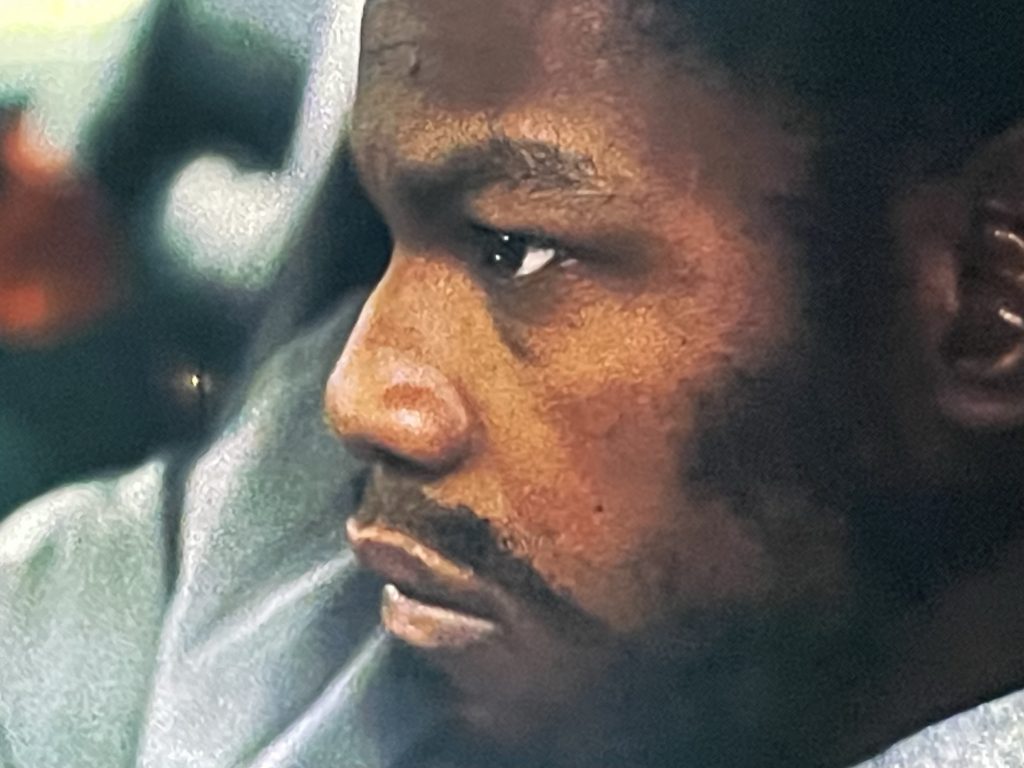
Tudum, Neflix’s official fan site, calls THEY CLONED TYRONE a gonzo sci-fi caper. I watched it with my son last week, a second time with my husband last night. Here’s my review. I enjoyed this caper at least as much the second time through. THEY CLONED TYRONE is rated R for violence, nudity and language. This film is streamable on Netflix.
The Short Review
5 Reasons I recommend this film
- starring John Boyega, Jamie Foxx, Teyonah Parris, a fantastic trio, absolutely dynamic in all good ways
- authentic and gritty including design elements wonderfully contrasted in the 2 versions of “the Glen” portrayed
- a story that surprises…even knowing a clone is involved (see title), there are still some fantastic mysteries to solve
- THEY CLONED TYRONE was laugh-out-loud funny in parts, I found the dialogue and characters delightfully entertaining
- a serious social commentary worth contemplating

The Longer Review
When Jordan Peele decided to get into the film creation business and write/direct Get Out, Hollywood (and the general audience) sat up and took notice. Not only was Get Out entertaining in so many compelling ways, it was the fleshing out of an urban myth that a racially charged society like the US understood, even feared. Peele broke the mold with Get Out and then deepened his creative impact with Nope and Us, paving the way for creators like Juel Taylor. Taylor wrote and directed THEY CLONED TYRONE.

One of the things I loved about THEY CLONED TYRONE is that the narrative puts forward an allegorical reality in which systemic racism can be discussed in the real world. Moreover, it does this in an entertaining and thoughtful way. There is a scene early on, a face-off between the Slick, played by Jamie Foxx, and Fontaine, played by John Boyega, where Slick expresses his frustration about black on black violence in The Glen (the story’s setting–a poor black neighborhood of unknown location). To hear the phrase black on black violence verbalized in a narrative by a black character from the hood is a bold move by the filmmaker. He has to know that this idea has been taken up and championed by many conservative politicians, but rarely with appropriate context and compassion. However, when the Foxx character says it, I felt the sadness of the filmmaker’s commentary. It felt appropriately like a cry into the void. 
Taylor didn’t overplay his hand with that line, but did leave the phrase vibrating throughout the rest of the narrative. By the finale of the film, the idea is turned upside down. I hesitate to say more because *spoilers*, but there are so many good questions posed in this film, I might just have to watch it a third time.