Comics
SHIFT, Book Two of the SILO series, A No-Spoiler Review
SHIFT is book two in a trilogy, so beware of spoilers as you read this in regard to book one or in regard to the first season of the tv series. I may mention details that will spoil book one/season 1, so stop reading now and click on WOOL to read my review of book one of the SILO series. This novel, like the first is rated PG/PG-13.
SILO is currently showing on Apple tv+. You can view the first and second season now. I recommend the first season for sure, but am still wading through the second…it’s excellent so far, but I’ve only watched the first couple of episodes.
I’m guessing this series would make a great audiobook. It’s not so complex as a story, follows few characters and takes place primarily in the silo, a setting that becomes very familiar by the middle of book 1.

The Short Review: 4 Reasons I Recommend SHIFT
- If you liked WOOL and are curious about how the world fell apart and the silos were conceived of and created, you’ll want to read this novel. It contains a lot of backstory.
- While some questions are answered, there are many unknowns and therefore more page-turning tension
- This story follows two characters, two different narrative voices who so far have not met/do not interact. One of the characters was a peripheral character in WOOL and one is new (almost) to the reader.
- All the characters are flawed in different ways, but relatable and trying against many odds to do good…or at least to make things right
Note: If you loved Juliette as a character, know you’ll see very little of her in this novel, but based on how this book ends, I have the feeling she will take center stage again in book 3. It’s a guess, but an educated one.
The Longer Review:
The SILO series so far has been a fast read, despite the number of words. Don’t let size fool you. If you’re like me, you’ll be turning pages quickly and staying awake too late at night so you can figure out what is happening. Also, I skimmed less of the text in this novel, but still read it quickly.
Regarding the order in which you do this…reading first or viewing first, one thought: I watched the first season of SILO without knowing about the books. Once I posted my review, I did receive notes from some of you encouraging me to read the books. Just know, that the series follows the books very closely, so some of the tension and mystery (either when you read or when you watch) may be diminished because you will know in advance what takes place. It changes the experience a little, though I am determined to do both and realizing the tension will come one way or the other, either on the page or on the screen. I do like the combo though. I like seeing what the screenwriter chooses to put into the script, what to leave out, or what to change. So far the series SILO, has few deviations from the novels, but there is one BIG ONE. At the end of season 1 of the SILO series, Juliette has been sent out to clean and the audience does not know what will happen as she refuses to clean, then walks over a hill and disappears from sight.
It’s a perfect season-ending cliffhanger that the screenwriter exploits, so I don’t blame him for constructing the story in this way. However, in the novel, Juliette’s next hours and days are right there in the last chapters of WOOL. So…it could be strategic to watch season 1 and 2 on Apple+ before even reading the first book, WOOL. The mystery might be more satisfying that way.
Whatever, the case, the series is fun and I’m enjoying reading it. The writing is not perfect, but it’s perfect enough to engage me (and I’m really picky) and fan the flames of my imagination. I can’t comment on the overall themes and human story yet because I’m still figuring out what Hugh Howey is saying about humanity. Maybe the third novel will give me a window into his worldview.
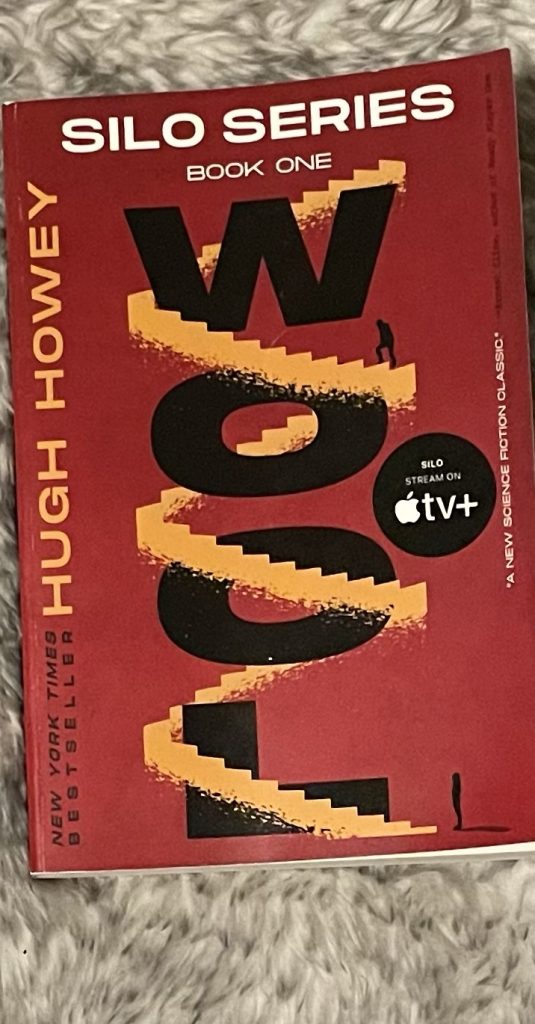
SILO, A Review of Novel #1
SILO is an Apple+ series that is about to release a second season. Recently, I began reading the novels. The first installment is called WOOL, and follows pretty closely the first season of the Apple+ version. This novel is rated PG-13 for adult themes. There is little or no explicit violence and no explicit sex scenes.
Hugh Howey first wrote this novel as a series of short stories/novellas. He put those stories together and indie published WOOL as a novel around 2012.
First, The Short No-Spoiler Review
Three reasons I recommend this novel, and one reservation:
- WOOL puts forward an interesting concept of post apocalyptic human existence that feels unique within the dystopian genre
- well-drawn characters overall
- enough mystery to keep the reader turning pages
My one reservation, some parts of this novel are too long and boring.
The Longer Review:
A potential issue with self-published novels is that the editing process is not well done. The author cannot afford to hire a top-notch editor and the consequence is either lots of typos or poor writing.
Overall, Howey did an amazing job self-publishing…could not find any typos, but he overwrote parts of the novel. As a reader, I sense this when I start skimming text. There is too much nitty gritty detail about everything that is transpiring. These are details the writer might need to know, but the reader does not. All that detail slows down the action, the excitement. In the worst case scenario, the reader stops reading. I did not stop reading because I actually cared about the characters and wanted to know the outcome of the story because Howey did not give me the answer to my questions until the end. So I needed to skim a few parts, but I did read until the final page.
Toward the end of the novel, when there are a couple of events that involve long scenes where I actually knew what the outcome would be, I skimmed the equivalent of about 50 pages of text.
I think most readers will know when they hit those sections. There is just too much detail and when the reader in essence already knows what is going to take place, we want to get to the next part of the action ASAP, so we skim. I have skimmed text while reading indie published novels, but I have also skimmed tradtionally published novels a few times. In theory, the great editor will catch these slow spots and help the writer edit them out. In practice, this is not always the case.
Regarding WOOL, the core of the story is good enough that most readers will overlook the overwritten parts. And the Apple+ TV people are certainly tightening everything up in a ways that is not boring. Season 2 just began (Jan of 2025)…and looks promising.
THE LAST OF US, A No-Spoiler Review of the First 3 Episodes
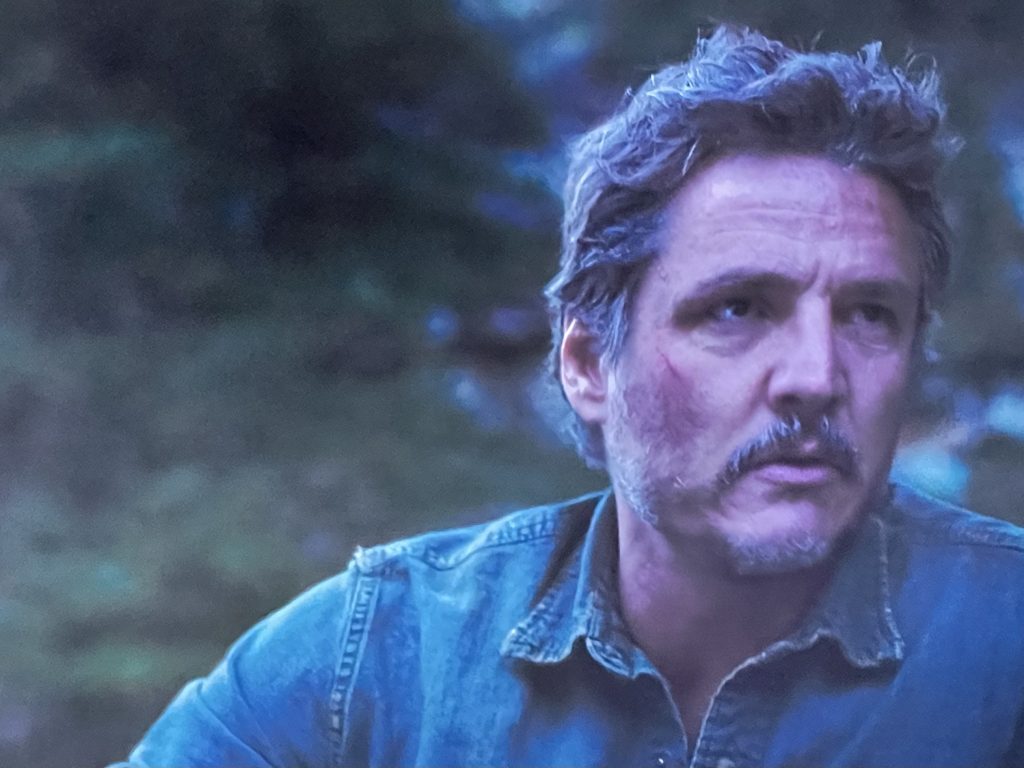
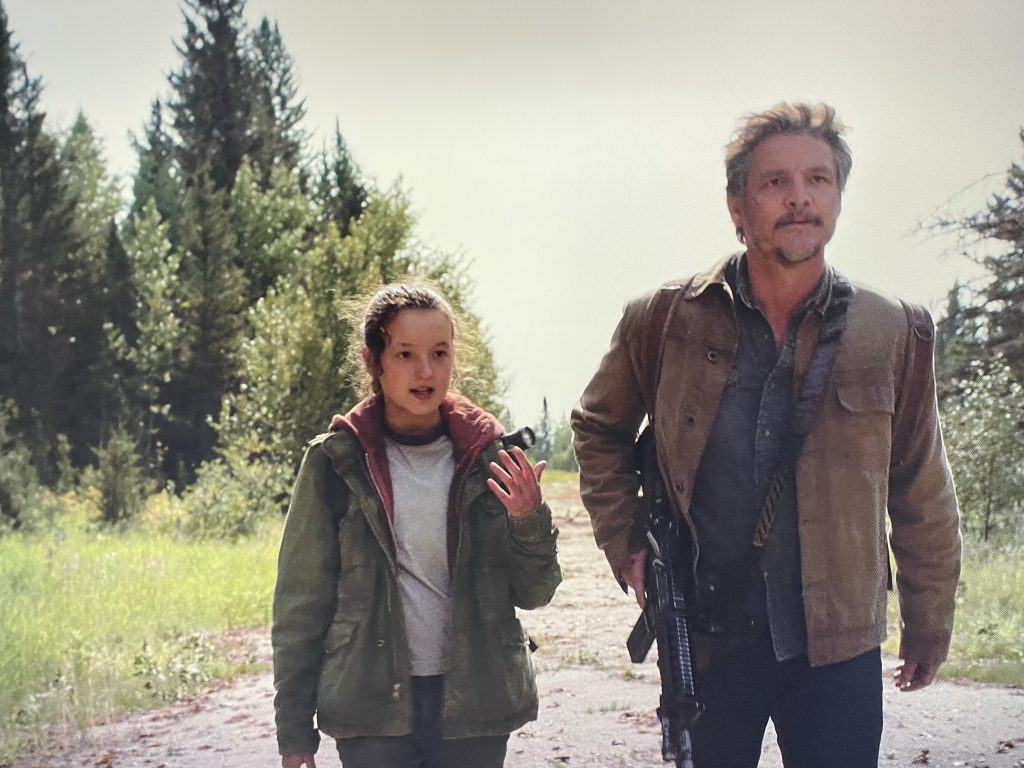
THE LAST OF US, an HBO Max series is streaming now, but the release of episodes is drip…drip…The third installment arrived on Sunday (1/29/23) and now, like old fashioned tv watching, the audience waits a week, and so on. It’s an interesting choice that some streaming services have made, to hook viewers over a long period and keep them paying the monthly streaming charge. Does it work? I’ll comment more on that in the longer review.
If you’re a gamer, you probably know that the heart of this story is based on the video game, The Last of Us, an action-adventure survival horror game franchise created by Naughty Dog and Sony Interactive Entertainment. The series is set in a post-apocalyptic United States ravaged by cannibalistic creatures infected by a mutated fungus in the genus Cordyceps. The game is rated R for violence and some sexually explicit scenes. At this point, 3 episodes in, the series is probably between a PG-13 and R rating, for violence.
For Educators: In biology class, give the gamers among you a treat by validating their hobby and teaching a lesson at the same time. Show the first 2 episodes (that’s all you’ll need) to discuss the nature of a fungus.

Is THE LAST OF US worth watching and perhaps more importantly, would you pay for an HBO subscription for this series alone? I recommend this series, with reservations. Short and long no-spoiler reviews will explain why.
The Short Review…Yes, watch
- If you love end-of-the-world zombie stories, this one has a couple of new twists to love
- Cool monsters and fast unlike the mostly ambling creatures in The Walking Dead
- Well casted (also, actors with talent that aren’t in every other show you’ve seen)
- If you play this game/love this game…it’s a new and perhaps fun way to interact with the world
The Short Review…Meh…don’t watch, or perhaps it’s too early to tell
- Overall and so far, this story feels less compelling than The Walking Dead or even Cormac McCarthy’s novel The Road, which I just finished reading. You’re better off spending your time reading or watching something else.
- Beware of attaching to key characters because the chances of them dying are really high (for many viewers, I realize this is a plus)
- In episode 3, spent a lot of time with a couple of characters who seemed peripheral to the heart of the story. If more episodes are like this one, not sure if I’ll want to keep watching
- Lastly, this series alone would not warrant paying for an HBO Max subscription. However, overall HBO content for science fiction, fantasy and dystopian viewing is decent. For example, you can stream DUNE Pt 1 and I loved Station Eleven, a mini-series based on the novel. Click to read my review of Station Eleven. Those are just a couple of examples of HBO’s excellent content.
The Longer Review
The Last of Us game in numerous iterations, has received critical acclaim and has won awards, including several Game of the Year recognitions. As of January 2023, the franchise has sold over 37 million games worldwide. Strong sales and support of the series led to the franchise’s expansion into other media, including a comic book in 2013 and this television adaptation. So…there is a built-in audience for the series, THE LAST OF US.
That’s a good thing for HBO, but from game to screen…has it ever been done well? I’m not an expert on this one, but I can’t think of a really great film or series that emerged from a game. Pretty good or fun shows…like Tomb Raider…those I could cite, but great? I don’t think so. Does anyone want to counter me here? This series has potential to say something new about the post-virus world, or in this case, post-fungus world (not a spoiler by the way…scene 1 of the series shows a scientist surmising about what would happen if a certain type of fungus evolved and could take over the human brain/body.)
In three episodes, the viewer gets a sense of one post-apocalyptic region in the US, an area around Boston. There is an allusion in episode 1 and 2 to world-wide catastrophe. There is a huge time jump between 1 and 2. The outbreak takes place in 2003 in episode 1. The rest of the series looks like it will take place 20 years later in 2023, with flashbacks to fill in the gaps here and there. The fungus shows up first in Jakarta, Indonesia…but we learn in episode 3 that the fungus probably went global simultaneously because it was in the food supply, in something like flour or sugar. That idea is unique, moveover, the zombies are weird and fast and hard to kill (bullet to the brain seems to do the job, similar to other zombie narratives). The fungus infested monsters are portrayed in a fuller way in episode 2.
In the era of binge watching, it’s possible a series such as THE LAST OF US will draw in fresh consumers to HBO streaming, but my guess is it won’t. The buzz that drives everyone to want to watch Stranger Things, because of the “event” of binging the entire season and sharing that experience with millions of fans, that is absent from the HBO and other streaming services’ business model. FoMO associated with binge watching fuels the marketing machine for Netflix. Millions are driven to want a subscription. Some buy, maybe thinking they’ll pay for a short time, and wind up staying longer or forever. Others do pay for one month and then quit…which is better for Netflix than those who use or steal a password to get their fix.
I am feeling a little frustrated by the drip…drip model. I don’t binge all in one day, but I like to watch the same show night after night. I hate waiting a week. It’s probable I will lose interest or get fixated on another show. I can’t be alone on that. So, if you’re a binge watcher and you think you might like this series, you might wanna wait for another couple of months so you’ll have more content. Subscribe to HBOMax in May, an you’ll have a whole lot of Game of Thrones: House of the Dragon and perhaps the first season of THE LAST OF US

Tales of the Walking Dead: EVIE/JOE, A No-Spoiler Review
4 Reasons I recommend EVIE/JOE, The Short Review
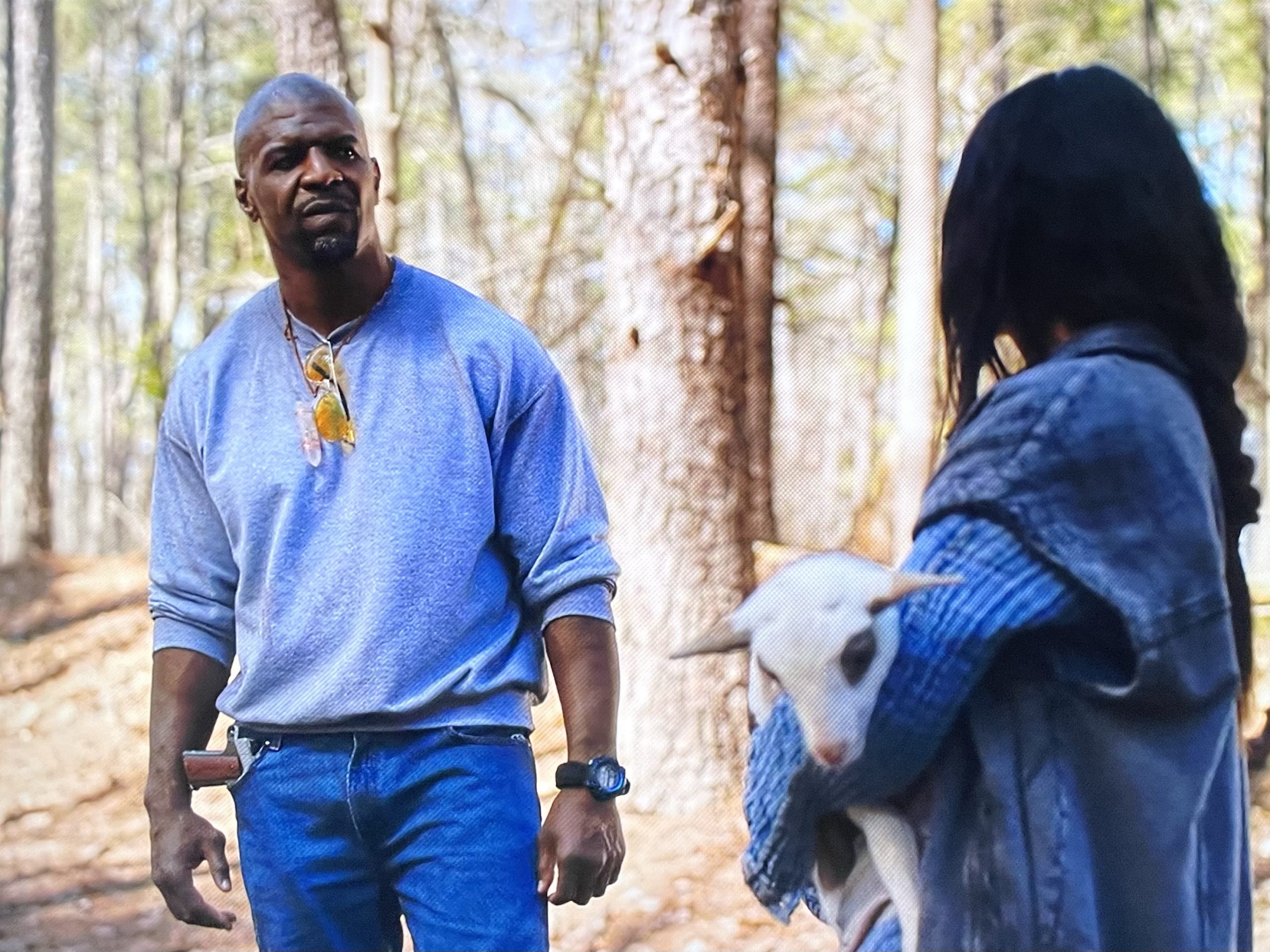
EVIE/JOE is first installment of The Walking Dead’s anthology series: Tales of the Walking Dead. Basically all of these tales will be in short-form, focusing on different characters each time, contained in one 45ish minute episode. EVIE/JOE is set in The Walking Dead universe which means there is a lot of gore, so consider this a PG-13 or R-rated flick. It’s not for everyone! You can watch this for free on Amazon Prime and possibly YouTube TV…still figuring that out.
I loved this short, but I love zombie films/stories and maintain a special fondness for The Walking Dead version of a post-zombie reality. Why might you want to watch?
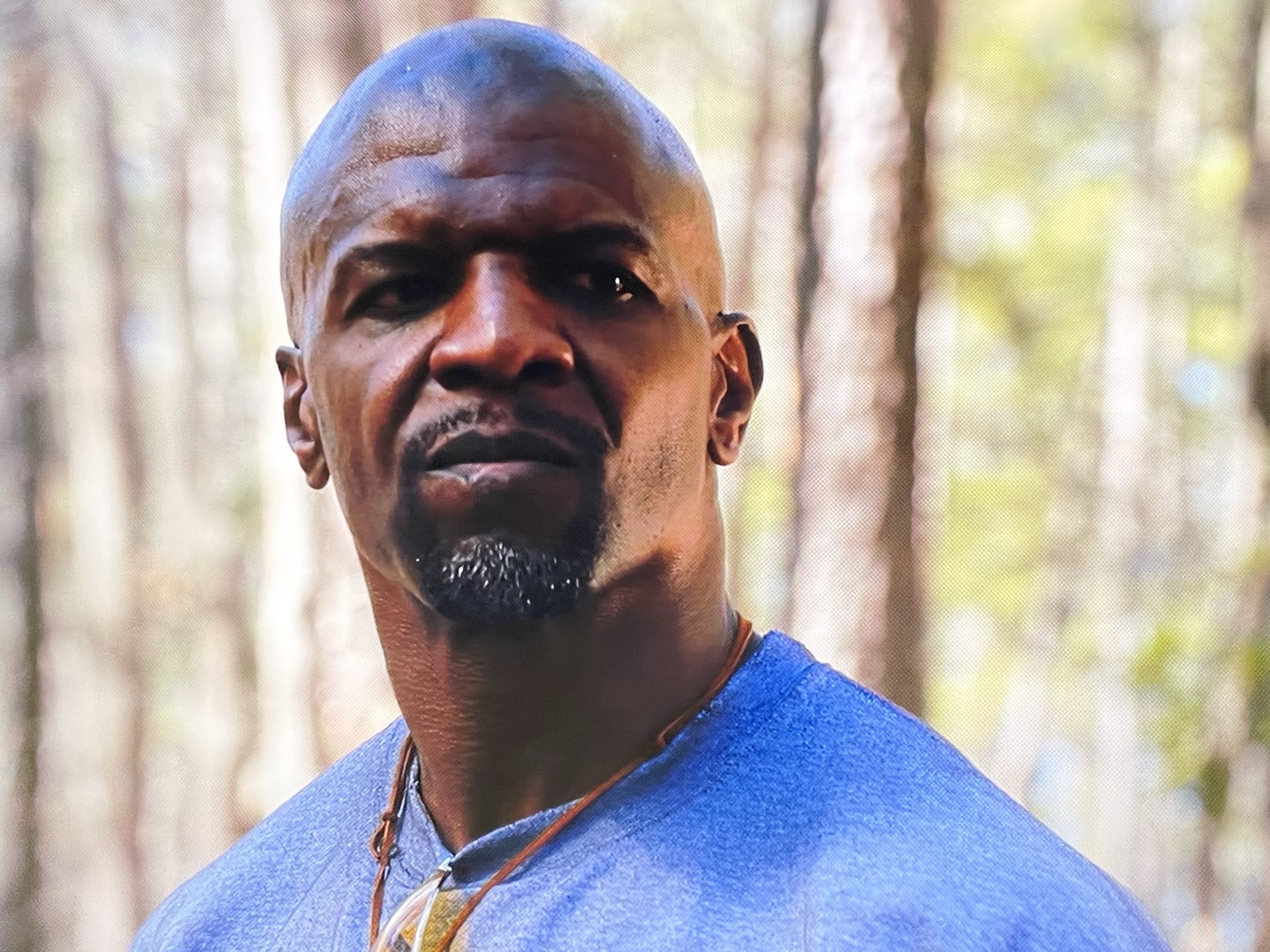
- Believable and likeable characters (played by actors, Olivia Munn and Terry Crews)
- Well-done shorts like this must be targeted in its “one thing” it tries to do well and this short succeeded in doing that
- A familiar world, where context needs not be explained
- Decent tension and a surprising twist in the end
The Longer Review
First, I’ll say a little about the short form. There are a few reasons I appreciate shorts like EVIE/JOE. One is that I find it pleasurable to see a story, beginning, middle and end in one sitting. As a kid I loved The Twilight Zone for this reason. Second, the short form forces the story-teller to focus. My family members have heard me complain many times about a number of the more recent Marvel Universe films when there are way too many characters to properly give them all meaningful story arcs with the overall effect feeling flat and superficial (and for me, unsatisfying). There are three characters in this story. Four, if you count the dog. Third, the short form draws in amazing actors who want the chance to play a different/unique character but without the huge commitment of the series actor, who has to put the rest of his/her acting career on hold while the series is ongoing. This was an issue for Andrew Lincoln (Rick Grimes of The Walking Dead).
You could say the same about “guest” directors/writers. One short attracts very interesting directors and writers. I’m assuming some of these artists are fans of TWD universe but see room to add to that universe. Their vision can be surprising and wonderful.
EVIE/JOE begins with Joe, a survivalist living alone with his beloved Doberman. When the story opens, Joe is rewatching a football game. Civilization as we know it disappeared over a year before (see the carefully placed whiteboard in the first scene). Joe lives underground and seems to have enough electricity and food to stay happy and alive, but when his dog becomes lame, he must carry him up to the ground to go the bathroom and eventually, a group of zombies attack. The pup is bitten, dies and is buried by Joe. The subsequent flashes of Joe become increasingly depressing. A new level of suffering has entered into his life. Grief around his dog’s death and the reality that there is no one and nothing to really live for pushes him to venture out of his hole and seek another survivalist, someone he had contacted at a date when communication outside his hole was possible. That is when he meets Evie.

Their relationship becomes the focal point and draws out the true characters of them both. Both are lonely. Both are searching. There is a question about whether or not they will trust each other and whether or not they will succeed in finding what they most hope for. Evie is a hippy, who learned how to survive. Joe is a true survivalist. Their banter is funny and revealing.
It’s pleasurable to see a new setting here as well (in regards to The Walking Dead). This is the Upper Midwest, primarily Ohio and Michigan. There is evidence of survivors and evidence of death. The zombies aren’t the primary threat, but they’re around. As the audience learns pretty quickly in The Walking Dead universe, the zombies are way less scary than the hyper-terrified humans. This story is consistent on that front.
Eventually, there is an ultimate choice…choosing sides, choosing to trust or not trust and there is a moment of facing death. EVIE/JOE will not disappoint if this is the humanity you’re looking for.
THE BATMAN, God and Justice. Warning: So Many Spoilers

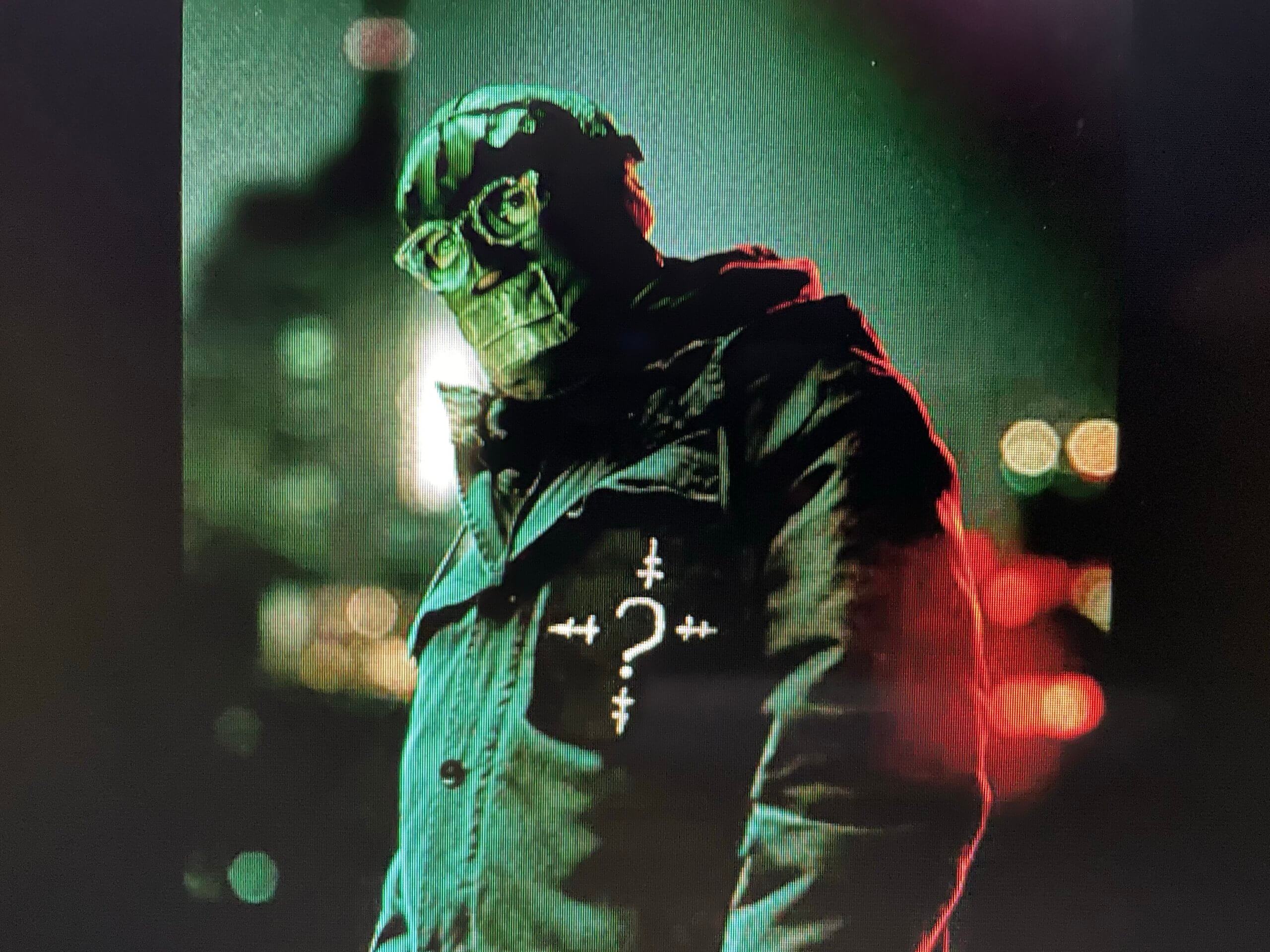
Last night I had the privilege of watching Matt Reeve’s THE BATMAN. I enjoyed the film, though it was tough to watch, a tense experience. Graphic violence is implied more than shown, but evil and darkness are palpable in every scene. Not that the film isn’t a beautifully crafted story…the dingy special effects are stylized to evoke the brokenness of Gotham. They reveal a failing society in every frame. It’s pouring rain and night during most of THE BATMAN, and of those scenes shot in the day, the skies are gray.
Of course, this is a familiar setting for our comic book hero, the Dark Knight, but what is less familiar is the tone of utter hopelessness associated with that darkness. Violence plagues the city of Bruce Wayne. In the opening sequence, it is Halloween night and masked hoodlums run wild across Gotham causing mayhem, and at one point a gang of them threaten an Asian American man in a subway station, hitting too close to home for many of us. Halloween is also the night the Riddler commits his first murder.
The brutality of humanity is on display in THE BATMAN, begging the question: When is a society so corrupt, so evil, so far gone, there is no hope of renewal and it must be destroyed? This film earned a PG-13 rating. It’s possible a mature teen could watch this and grapple with the question posed above. It’s a hard question, but one that ought to be pondered by all of us.
The rivalry between Batman and the Riddler draws out themes of righteousness versus justice. In certain respects, both men are the same. Both are trying to root out corruption, Both are straining toward a just society. Batman roots out injustice by defending the good guys and working within the system. Though outside the formal police force, his link to Lt. Gordon cannot be denied, nor can anyone doubt his insider status as Bruce Wayne, the orphaned son of a beloved city father. The Riddler however, also an orphan, stands on the outside. He roots out evil by exposing it, by punishing via execution and making a public example of those who have betrayed justice. The Riddler’s first murder is the mayor of the city and subsequently other politicians and law enforcement, those caretakers of Gotham who have made their beds with the mob. Because of these assassinations and the attention he draws to corruption, Batman along with the audience are forced to focus on what is a massively broken system at the highest levels of the city.
The audience wonders whether ANY politicians or police are clean in Gotham, and can such evil be undone when the gatekeepers of justice have become those who perpetrate injustice? The Riddler sees no way out but total destruction.
On the narrative journey, Batman faces truths about his own father. The idealism with which he has viewed his parentage is shattered, evoking for me the psalmist’s words from Psalm 14, text lifted by the Apostle Paul and placed in his letter to the Romans.
The fool says in his heart, “There is no God.”
They are corrupt, they do abominable deeds;
there is none who does good.
2 The Lord looks down from heaven on the children of man,
to see if there are any who understand,
who seek after God.
3 They have all turned aside; together they have become corrupt;
there is none who does good,
not even one.
Why do I include this? In the film, I think Reeves is trying to make a theological point. I bend toward theological rather than philosophical because the powerful reality (loaded imagery) at the end of the film is a flood…as in Noah and the Biblical account of the destruction of evil.
In THE BATMAN, the Riddler has set up bombs that line the seawall on Gotham’s perimeter. The Riddler has determined that Gotham is irredeemable. Gotham must die, drown and be cleansed of its evil. Only then will it be reborn. A flood to destroy evil? This is as old a tale as humanity, understood within Judaism, Islam and Christianity. There comes a time when a civilization is so broken, every living thing has to be destroyed in order for evil to be rooted out. The Riddler sets himself up as God and judge. He determines that Gotham is a total loss. Total destruction is the ONLY remedy for its evil.
Batman represents another side of this argument. Don’t miss the fact that Selina (the Catwoman character wonderfully portrayed by Zöe Kravitz), tries to coax Batman to remove himself permanently from Gotham. I can’t recall her final words to Batman precisely, but they were something like…staying here and trying to save Gotham will kill you.
That comment is an homage to a redemptive sacrifice and Batman as Christ figure…sort of…The audience already knows how much life has been sapped out of the young Bruce Wayne because of his mission to avenge his father, but also to help Gotham. Batman’s motives are often mixed here. Interestingly, this Batman, the Reeves’ Batman grows. He realizes that vengeance is not the full story of how he must respond to evil. To truly honor his dead father and mother, he must do more. He must minister good to the people of Gotham. Two images of Batman in the final scenes make my point. One is him diving into the abyss, lighting his flare and leading innocent people by hand, out of the flood, out of judgment. The other is him helping a wounded girl on a stretcher and holding her hand as she seeks his assurance and is flown away to safety, to healing. Reeves connects the hero, the savior, to humanity with that touch. Redemption in this case is a touch that is gentle and personal, the opposite of violence. Batmas has crossed over from vengeance to love.
The Russia Ukrainian War is raging as I write. Yesterday, Russian planes targeted a shelter in Mariupol, a place holding hundreds of children and women. On the ground on either side of this structure, the Ukrainians had written in Russian the words “children” in very large script, large enough to see from the air. How does one grapple with the bombing of this place, with the destruction of so many innocents? (The number of dead is still undetermined…I will correct this when the fog of war has dissipated.)
Update: on March 25, it was believe that 300 had died in the bombing. In early May, after a thorough AP investigation, it was revealed that 600 likely died in Mariupol theater airstrike.

So, I end with this image, Jesus of Sinai, Pantocrator, an icon from the the 6th century. For Christians of the 6th century, most of whom were illiterate, icons like this were essential to their faith because embedded within each icon are theological truths. For them, looking at an icon was like reading a holy text. With Jesus of Sinai, notice the weird lighting on his face, one side darker and one side lighter. That is intentional. Why? The post-modern viewer might not discern what his face represents but to early Christians, they represent two sides of the creator as God looks out over humanity. If you put up your hand and cover one side of the Messiah’s face, you see a bright and compassionate mouth and eye. When you cover the other side, you see a darker eye, an angry glare. The iconographer and the theologians of that time understood that both are sides of God and both are legitimate responses to evil. The story as laid out in the Bible is of God grappling daily with a society gone wrong. On one hand, he is merciful and forgiving, on the other, he is vengeful and ready to punish, to eradicate evil.
Current people of faith, people like me, struggle with that darker view of God, but we might do well to ponder it. Noah and the flood tell the story of God as do Jesus and the cross. And here we see the author of the new Batman film exploring both reactions to evil, but favoring mercy in the end.
We live in a complicated world, but some truths/questions find their way into our art, even if that art is embodied by a comic book character.
Kudos to Reeves for attempting something really big in his portrayal of THE BATMAN.
When Science Fiction Brings History Alive

Cover Art
I love science fiction, dreaming about the future, imagining what our life in outer space might look like someday, but my passion for the genre has as much to do with the past as it does with the future. Science fiction shows us the future but also has the ability to teach us about our past and often does so without the baggage of politics and biases. The stories below are launch pads. Their portrayals of history through story are not by any means comprehensive, but rather snapshots into the lives of people encountering challenges that may be imagined by the author, but mirror history.
Here are a handful of scifi stories that bring the reader face to face with the past:
- Superman Smashes the Klan
- The Man in the High Castle
- Colony
- An Excess Male
- Kindred
History Lesson #1. SUPERMAN SMASHES THE KLAN. Launch a discussion about the Ku Klux Klan (it’s inception and impact on US race relations).
In this three-issue Superman Comic, Gene Luen Yang gives historic tidbits at the end of each issue. You can read my review of the series here.
In issue 1,Yang highlights the 13th amendment to the constitution (abolition of slavery) and the 1882 Chinese Exclusion Act
Following issue 2, Yang discusses the Jewish immigrants who created Superman.
Following issue 3, Yang discusses the challenges of his own parents, both of whom were immigrants from Taiwan
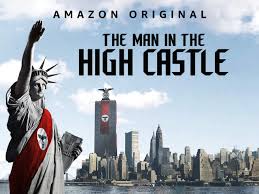
History Lesson #2. Watch or read, THE MAN IN THE HIGH CASTLE (book by Philip K. Dick. The Amazon Prime TV series was produced by Dick’s daughter, Isa Dick Hackett). Discuss and learn about World War II.
This series is a great way to understand the Axis powers and that tentative alliance that almost took over the globe. You’ll find yourself or your student understanding the world that was inhabited by those who lived under occupation during that war. The French, The Koreans, and many others were forced to survive under Nazi or Japanese rule. Some made compromises, others rebelled. Can you imagine who you would have become to survive an occupation? That question is a great way for students to enter into and understand history.
Josh Holloway, Sarah Wayne Callies
History Lesson #3. Watch COLONY on Netflix to begin to grapple with the reality of living under occupation.
In the case of COLONY, the true enemy is an alien race that has invaded Earth, but some of the darkest villains are the human beings who have allied themselves with this conquering force.
Living under occupation, whether under the Greeks, Romans, The Islamic Caliphate, the Brits, the USSR, it requires turncoats, or those who will help to subdue the masses for the sake of the little bits of power and privilege that are doled out by the occupying power. The tv series COLONY does an amazing job of capturing this reality. A longer review can be found here.
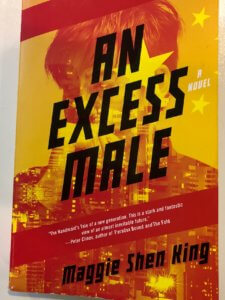
Maggie Shen King
History Lesson #4. Read AN EXCESS MALE, by Maggie Shen Chen, to begin to understand 20th century Chinese history.
Although this book imagines a future China, this story highlights what is perhaps the most disastrous public policy mandate of all time, THE ONE CHILD POLICY. For my review of this novel, click here. To read my guide for educators, click here.

Octavia Butler
History Lesson #5. KINDRED, by Octavia Butler. Read this book (fictional) and one of the other historic slave narratives like, MY LIFE AS A SLAVE, by Frederick Douglass. Discuss the ways slavery dehumanizes all those who participate in its reality.
KINDRED, by the late and great Octavia Butler, gives the reader a taste of the slave-inhabited South of yore. The brutality is evident and palpable. Lessons are brought so close…it’s hard to read this book, yet it is valuable for those trying to understand slavery in 18th and 19th century US. Here is my longer review of Kindred
SUPERMAN SMASHES THE KLAN ISSUE 3, A Review Without Spoilers
Read All Three Issues of SUPERMAN SMASHES THE KLAN You Won’t Be Sorry
 Short Review: Here’s why you need to read all three…
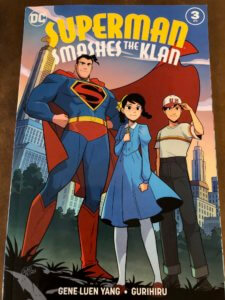
- Comic book action and a great story
- Relatable kid characters who make poor or good choices and learn from them
- Even Superman grows and changes
- History lesson combined with Gene Luen Yang memoir tidbits in the final pages of each issue are perfect for spurring deeper conversations about racism in the US
- I can’t get enough of Gurihiru’s lovely art
Longer Review:
It’s a sad season for many of us on planet Earth who are living under the threat of COVID19 spread. Schools have been shuttered, so many activities cancelled and parents are left trying to figure out how to keep their kids off screens and at least somewhat engaged in their education. Great books, ones your kids will be motivated to read without any of your coaxing, are the home-school parent’s best friend.
On my website, you can use the menu bar for educators to see what science fiction books might appeal to your student. It’s not an exhaustive list, but there are more than a few gems you’ll want to check out. When I review a book, I give the story a movie type rating…G, PG, PG-13, etc.
If you want to read a review of issue 1 of this series, click SUPERMAN SMASHES THE KLAN, A No Spoiler Review

Superman makes peace with his identity
If you want to read a review of issue 2, click here
In the case of issue 3, I have no reservations in recommending this book to all kids and adults, though you might give it a PG rating for the serious topic it tackles, racism and violence.
The story (as portrayed in all three issues) is accessible to a child. He/she might need to be old enough to engage in a basic conversation about race, justice and belonging, but my experience in having two kids who attended public schools in California, they were ripe for the beginning of that conversation by kindergarten. I would recommend you don’t shield your young ones from starting this conversation early.
In this third issue of SUPERMAN SMASHES THE KLAN, the story climaxes with a confrontation between Superman and the Klan of the Fiery Cross. Superman has befriended the Lees, an Asian American family that has moved out of Chinatown and into the suburbs. They are the focus of the Klan’s animosity and Superman is defending them against the Klan’s violence. Author, Gene Luen Yang does not pull punches. There is a real portrayal of race hatred in this comic series, but that is what makes this story all the more powerful…it delivers truth.
Roberta, the young sister in the Lee family plays a crucial role in helping Superman beat back injustice. She will appeal to both girls and boys with her quirks (in the opening sequence of the first issue, she gets car sick and has to throw up while her family is driving out of Chinatown) and her bravery (she confronts evil and injustice head on, even though she can’t always defend herself). In this issue, Lois Lane takes Roberta under her wing and encourages her to research a mystery for the Daily Planet as a cub reporter. Roberta is a wonderful hero.
Given the talented writer that he is, Yang draws out a number of characters on both sides of the conflict who have depth. The bad guys are more than just foils. Likewise, the good guys are not always perfect. Even Superman is grappling with flashbacks around his own childhood, trying to make sense of his alien nature. It’s one of a number of great storylines that will please the Superman fanatic and add much to the themes that emerge in SUPERMAN SMASHES THE KLAN.
A bonus delight in all the issues are the final pages where Gene Luen Yang puts forward a bit more history of his own immigrant story and that of the Klan…In a vulnerable and testimonial way, he reflects on both the challenges and the beauty of our mixed cultural nation.

The Klan of the Firey Cross
SUPERMAN SMASHES THE KLAN is a story in three issues. One issue every other month released since October. This is something comic book readers understand. You buy one issue, read about your favorite hero and wait in anticipation for the next issue to come out. Comic book adventures are serial-styled stories. Each comic book usually contains one story arc and always ends with a cliffhanger. That is one reason why readers buy the next issue. There is delight in this way of consuming a story, but it requires more patience than most of us are used to.
In case that style does not appeal to you or your child, buy all three. All three SUPERMAN SMASHES THE KLAN issues contained in one book, a story that will grab your child and keep him or her reading. The three will be released together on May 12. To preorder the story in one paperback instead of 3 separate issues, click here.
My advice in case you plan to discuss race with your child, make sure you read the story too. The education that will come out of the reading will benefit parent and child.
To buy SUPERMAN SMASHES THE KLAN, ISSUE 3, click here.
To buy the previous issues, click
SUPERMAN SMASHES THE KLAN, Part 2
Cover Art
SUPERMAN SMASHES THE KLAN Part 2 hit comic book stores in December. It’s over a month old and I have been delinquent in reviewing it, until today. This story is appropriate for just about all readers. Rated PG.
For a review of Part 1, see this no spoiler review
Warning: This review will have spoilers if you have not read the first installment.
Inspired by the 1940s radio series Clan of the Fiery Cross, Gene Yang picks up the cliff-hanger from part 1. In part 1, Tommy Lee, a Chinese-American boy has been abducted by a white supremacist group, Klan of the Fiery Kross.

Yang does not sugarcoat the violence of the Klan
The aim of the Klan is to tar and feather Tommy, therefore teaching his parents a lesson. They resent the Lees moving out of Chinatown and into their white neighborhood. The Lee family has made this move because Dr. Lee, Tommy’s father, has been offered a job in a nearby lab.
All the storylines ratchet up a notch in Part 2.
Worth noting:
- Superman backstory: Superman continues to have flashbacks of his parents, aliens who look very different than humans. He is grappling with his own “alien” identity. His journey parallels the journey of the immigrants and their children in the story
- A little bit of romance: Yes, it’s a bit comedic and fun to see the budding affection between Superman and Lois and a little flare between Jimmy and Roberta, the main character in the story, the Lee’s spunky daughter.
- A community undergoing change: Yang captures an aspect of American life that rings true…especially, second generation immigrants moving out of the inner cities, out of enclaves and integrating into white America, changes that have historically led to tension. As in Part 1, Yang treats the “bad guys” fairly, always grappling with their feelings and their perspective. Not excusing their views or actions, but giving all his characters humanity.
- Another history lesson/bio on race relations in the US: At the end of the comic, a memoir section called Superman and Me describes Gene Yang’s childhood relationship with Superman and other comic heroes. Underneath Yang’s love affair with comics is the power of story and how they provided a sense of identity and empowerment for the author. In case you’re enamored by the history lesson, consider Yang’s early graphic novel masterpiece, American Born Chinese Definitely worth owning and passing around to friends, especially young teens.
Overall, this is a great middle to the story. I look forward to reading the finale, Part 3 when it is released on February 19, 2020.
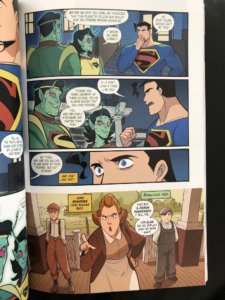
Superman’s Flashbacks
A note on the art: The art in the series, created by Gurihiru, is colorful, capturing a blend of retro and anime. It seems apropos that this Japanese female duo would create the artwork for a comic grappling with some of the first Asian-American characters portrayed in a sympathetic way in the American Comics Universe.
To buy Part 1, click here
To buy Part 2, click here
SUPERMAN SMASHES THE KLAN, A No Spoiler Review

Same comic, two versions of the cover art. I bought both.
SUPERMAN SMASHES THE KLAN, written by Gene Luen Yang and drawn by Gurihiru was released exactly one week ago, Wednesday the 16th of October and understandably, it is moving off the shelves fast. I highly recommend this first installment in the three part series. I rate this series PG and would encourage parents to read it with children and discuss the many aspects of the story that are rooted in history.
Short Review: Five Reasons to Own and Read SUPERMAN SMASHES THE KLAN:
- Be a collector! Only 3 installments to buy. Keep this historic series forever while using only an inch of space on your bookshelf!
- The drawings and colors are beautiful and stylized to deepen the reading experience.
- Learn history. There are historic truths woven into the story. Yang also adds autobiography relaying the story of how he has experienced racism and historical facts about the Ku Klux Klan at the end of the comic.
- The characters are well-drawn (literally and figuratively), avoiding cliches that sometimes populate comic book fiction
- The story is full of action, suspense, but doesn’t paint an overly simplified view of good vs. evil. This is one Gene Luen Yang’s strengths…the empathy he feels for all his characters, even the very broken ones.

Centerfold
To buy this book, Part 1 of 3, you’ll need to visit your local comic book store or click here. Also, if it’s been a while since you entered a well-stocked comics store, you owe yourself the treat. Go now and browse the shelves!
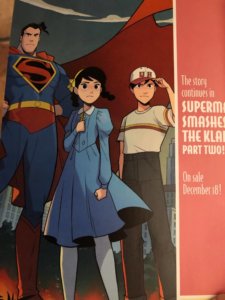
The art, rendered in fantastic color
Most science fiction fans love comics, but not all. I know a few who have avoided them in favor of novels, television and film, but the comic format has proven its heft in recent years with literary stories like American Born Chinese. Gene Luen Yang, the author of American Born Chinese, also wrote the much-acclaimed New Super-Man, in which an Asian American young man emerges as the Superman in the story. It is no surprise Yang was DC’s choice to bring SUPERMAN SMASHES THE KLAN to life. The story is an adaptation of a 1946 smaller story arc within a radio series called The Adventures of Superman. In it, an Asian-American family is threatened by the Ku Klux Klan and Superman is inspired to protect the children of this family from racist terror.
Fighting Screen Addiction and Getting Your Teen to Read
 It’s August, which means we’re almost done with summer, but it is not too late to steer your teen away from screens and toward reading. I have a soft heart for parents of teens. I have two kids and know well the battle parents wage relentlessly to engage their teens with anything other than their devices. (Truth…we parents have an addiction as well…which is why tackling this issue is so tricky!).
But why even fight? Why fight the powerful riptide that sucks our kids into the digital universe?
I interviewed reading specialist, Dr. Marnie Ginsberg, who focuses on training teachers of early readers and has two teenagers of her own. Even she is familiar with the struggle! This is what she says about teen reading…
“Good teen readers read hundreds of hours more each year than average readers. As a result of this reading practice, they keep developing their reading achievement. And reading achievement is strongly correlated with so many positive outcomes for teens and their future selves that one can hardly count them all…”
Dr. Ginsberg’s list included these: “Higher reading achievement leads to…
- better school achievement–in all subject areas, including math
- stronger oral and written language knowledge and skills
- better job prospects
- higher wage earnings
- better health; and even better life expectancy!
- Besides these long-term benefits, time spent reading helps in immediate ways, too, such as mood regulation and stress reduction.”
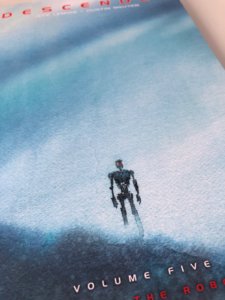
RISE OF THE ROBOTS
Yet, Dr. Ginsberg said that most teens today are not reading enough to enjoy these varied benefits of high reading achievement. Multimedia usage instead, soaks up most of the typical teen’s day–upwards of 8 hours a day.
If you are an educator and want to learn more about how to better teach young readers the skills that will help them succeed at reading, check out her website. ReadingSimplified
Discovering Great Stories Your Teens Will Love…
The challenge for parents and teachers is to help the teens in their life discover great stories. Our kids still love stories, but they tend to take them in via the screen. Stranger Things, the Netflix hit, is one example, which became a must see event each season for most of our teenagers. Another must-see event, the latest Avengers’ blockbuster. Who will stand in line for a ticket and a seat? Those who want to engage the current story and amazingly, our teens want to do that in community. Great stories bring communities together.
Stories still matter us and they matter to our kids. Let this be your best ammunition as a parent. If you work hard at finding good stories in the books you are putting in front of them, your kids have a much better chance of actually reading.
Compelling stories are waiting to be uncovered by you/your teen, but how do you find them? Try going to Goodreads (book review site) or googling something like The Top 10 New Novels for Teens. Also, follow the lead of your teen who might have a favorite author or genre. I would advise heading to a library over a bookstore when looking for the right story because librarians are golden when it comes to know what is the latest great story for teens.
A goot librarian is like a matchmaker. Librarians read enough to know the answer to a question like this…What is the best Middle Grade book with a female protagonist who isn’t an orphan that is under 300 pages. A great librarian will be able to give your teen one or two books that fit that description.
However, if you’re in a hurry and a little stuck, check out reviews on my website (not all are teen appropriate), but here are a few I would put forward that are…
All these books except for AMERICAN BORN CHINESE are speculative fiction or sci-fi. To find out if the book is right for your teen, all of these books (with the exception of DOGSBODY) are reviewed on my site. You can find them via the search function.
- FEED, by MT Anderson. To buy the audiobook, click here.
- THE HOUSE OF THE SCORPION, by Nancy Farmer. To buy this audiobook, click here.
- DOGSBODY, By Dianna Wynne Jones. Click here to buy.
- DESCENDER SERIES (graphic novel series), by Jeff Lemire and Dustin Nguyen (See below for links to purchase)
- AMERICAN BORN CHINESE (graphic novel), by Gene Luen Yang. Click here to purchase.
Cover Art for Machine Moon

DESCENDER, Volume 2, Machine Moon
DESCENDER, Volume 3 Singularities
DESCENDER, Volume 4 Orbital Mechanics
DESCENDER, Volume 5 Rise of the Robots
DESCENDER, Volume 6 The Machine War
In addition to finding the right stories. Here are a few strategies that will encourage teen reading
- Take a road trip where screens are forbidden in the car and listen to an audiobook that everyone has agreed on. Bonus…if you pick the first book in a series (and there are many of those out there), your teen might pick up the subsequent books on his/her own.
- Make it a summer tradition (or an all-year tradition) to read aloud together as a family before bed each night. I know a few families that practice this habit and their kids cherish the time. Think of it in a similar category as watching television together…
- Don’t despise the graphic novel. There are sophisticated stories, characters and lengthy dialogue to be had in the modern graphic novel.
- Go on a phone-free, screen-free vacation where every member of the family gets to take his/her own book of choice This NY Times article gives tips on how to best unplug in case one phone must come along.
And…GOOD LUCK!