Media
The Phantom Tollbooth, Twenty Possible Discussion Questions for Educators
The art of a good question is always to draw out the thoughts and feelings of the one being questioned…(and for the most part…to avoid yes/no answers).
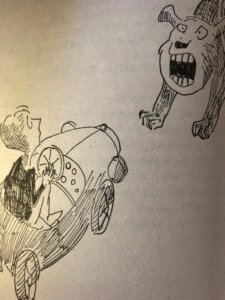 Here are 20 questions to get your student chatting up a storm (of course the student must have read the book closely in order to answer them, so you’ll find that out too.)
To read a review of THE PHANTOM TOLLBOOTH, click here
To order THE PHANTOM TOLLBOOTH, click here.
- What is Milo like in Chapter 1. How would you describe him?
- Would you want to be Milo’s friend, the Milo of Chapter 1? Why or Why not?
- When Milo sees the mysterious gift, he makes a pretty big effort to put it together (the tollbooth) and then decides to use it. Does this surprise you? Why or Why not? Would you go through all the trouble to put the tollbooth together and use it?
- In Milo’s initial travels, he gets stuck in the Doldrums. Who helps him get out? What does Milo have to do to get his car moving again?
- How would you describe Dictionopolis?
- In chapter 6, we learn about two Princesses. What are their names and how did they get banished?
- Milo starts thinking about the idea that he will rescue the Princesses. Where are the Princesses being held and what hardships will Milo face if he tries to rescue them?
- How would you describe the banquet in Dictionopolis? Did any of the foods make you laugh? Which one(s)?
- Chapter 9 introduces us to a boy called Alec and the idea of Point of View…How would you define “point of view” based on the discussion Alec and Milo have?
- In Chapter 10, the chapter that features Reality, Milo realizes “…the many times he’d done the very same thing; and, as hard as he tried, there were even things on his own street that he couldn’t remember…” What was Milo’s mistake? How has he made the same mistake people in Reality made long ago?
- Alec tells Milo in Chapter 11: There’s a lot to see everywhere, if only you keep your eyes open. What do you think Alec means when he says this to Milo? What is Milo supposed to see?
- Are noises and sounds important to you? Which ones and why? What do you think it would be like to live in a place where there was no sound?
- Milo steals a sound from the Soundkeeper…How does he do it and what are the results?
- Is the Island of Conclusions a good place to jump to? Why or why not?
- Who helps Milo reaches Digitopolis (see Chapter 14)?
- How does Milo outsmart the Mathemagician?
- What does the Demon of Petty Tasks and Worthless Jobs, Ogre of Wasted Effort and Monster of Habit ask Milo, Humbug and Tock to do?
- What are the demons that protect Ignorance? Come up with a list of the demons in this book, to the best of your ability (hint…end of Chapter 16 to middle of chapter 19)
- Which demon scares you the most and why?
- Look back to your Chapter 1 answer…How has Milo learned from his adventure? How would you describe him now? Would you want to be Milo’s friend, the Milo of Chapter 20?
The Phantom Tollbooth, A Review for Parents and Educators (with a few spoilers)
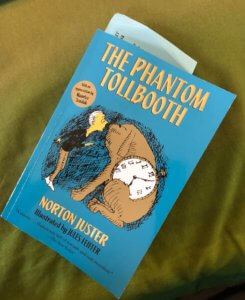
THE PHANTOM TOLLBOOTH is a Gateway Book for Digging into a Values Discussion with your Children or Students
To order this classic, click here.
To access 20 questions on the book, click here
This post is especially (but not only) for folks who have kids or teach kids. I loved my re-read of THE PHANTOM TOLLBOOTH. Here are four reasons why you ought to read this book with a child today (or tomorrow if the child is already asleep). And, for the record, this story does NOT fall into the category of sci-fi…more aligning with fantasy than science fiction.
- The story introduces ideas that unearth values we have (or need) about education and learning.
- The main kid character starts out flat and plain, but makes simple choices that thrust him into hero status…In many respects, he reacts to problems in a childlike way…he is very relatable…he also wants to do what is right. He discovers that doing what is right will require courage. He relies on his friends to accomplish the heroic task. These are all important values put forward by THE PHANTOM TOLLBOOTH.
- Imaginative characters, whose names reflect an aspect of their character, that you can discuss with your child, thus leading to more thorough discussions on everything from friendship to politics. This is a timely story for our kids. (No, really…you CAN talk with your kids about politics after reading this book…In fact, you should!)
- Lovely illustrations by Jules Feiffer scattered throughout.
Now for the longer review and musings about stories that provoke discussions…which is a very old way to teach deep lessons.
How does one discuss serious real-time issues with kids? Stories help a lot. I remember showing our children (and at a pretty young age) the Star Wars trilogy…at the time it was episode 4, 5 and 6. Star Wars is an archetypal good versus evil narrative. It features a character, Darth Vader, who though evil, still has the potential for redemption. This was an idea my husband and I wanted our 6 and 8-year-old kids to understand. The story raises the issues: What is evil? The Empire shows what evil looks like in a variety of ways. What is good? The rebellion shows us good and what it’s like when good battles evil. The force is a neutral entity in the universe, but seems to be used most powerfully (ultimately) by those who are good. Star Wars also raises this important question: Can a person be pure evil without the possibility for reform? This story tells us about Luke, Darth Vader and the deep power of love (sometimes love that costs us our lives, as it did for Anakin, Darth Vader) and how that love counters evil…(not to mention the sacrificial love of the friends, Han, Leah, R2-D2, C-3PO and Chewie.) This is a friendship story as much as it is a family story.
For me and my husband, the above ideas were important to us in particular because of our values that also have to do with our faith. We wanted to discuss the reality of evil with our kids, but also help them understand that people ALWAYS have the possibility of breaking free from the evil that grips them and as they do so, help themselves and others achieve goodness…much as (spoiler alert) Darth Vader does at the end of Return of the Jedi.
THE PHANTOM TOLLBOOTH is definitely less scary than Star Wars, but the reader still finds a good versus evil narrative. Milo, a boy, disinterested in life and education is our protagonist. This is how the reader sees him in Chapter 1.
“It seems to me that almost everything is a waste of time,” he remarked one day as he walked dejectedly home from school. “I can’t see the point in learning to solve useless problems, or subtracting turnips from turnips, or knowing where Ethiopia is or how to spell February.” And since no one bothered to explain otherwise, he regarded the process of seeking knowledge as the greatest waste of time of all.
Milo is given the gift of a magic tollbooth that takes him into an imaginary world, a place that will transform him. While there, he learns that words sustain life. He learns that numbers too are essential to life and he learns that the conflict between two brothers (the king of words and ruler of numbers or the Mathmagician) cannot be solved until he helps them bring back their sisters from banishment. They are the Princesses Rhyme and Reason. In the world Milo is visiting, there is currently no rhyme nor reason to anything that takes place and it that has caused much misery across both kingdoms.
Milo isn’t a bad kid…initially, he’s just bored and disengaged…In today’s world…Milo might be a tv junkie or video game addict, but in the 60s…he was simply lethargic, lying around and doing nothing because nothing seemed interesting to him. In the new world where he travels, he is confronted with an adventure that captures his passion. Milo then begins to appreciate and notice the world around him, including the importance of education and learning. Milo’s transformation is an example of a child who decides to be curious and walks toward/into an adventure. That little step opens him to a world of learning. He even gains friends along the way.
A key for Milo is that he figures out his purpose. He decides to rescue the two princesses. He persists until he achieves the goal, despite many challenges.
The evil characters (Juster calls them demons) in this story resonate with today’s evils and dare I say…some of our current events. The demons live on the Mountain of Ignorance and include monsters such as Compromise, Hopping Hindsight, the Gorgons of Hate and Malice, Overbearing Know-It-All, Gross Exaggeration and Threadbare Excuse. Each creature described on the mountain could spur a conversation about values. Parents, consider yourself primed for a discussion of politicians, ad agencies, media or news organizations and grownups, in general…We adults could all use a refresher course on the “demons” that dull our wits in postmodern society. Good lessons for all.
Milo is a relatable kid character, even for kids today. He starts out bored and boring until he accepts the invitation to enter the tollbooth. His curiosity spurs him forward. He emerges into the new world and continues to be curious. He learns along the way that he must engage his senses and make friends. He slowly grows in appreciation of beauty around him and all the goofy characters he meets who are passionate about one thing or another. However, Milo’s own passion is not fully engaged until he decides to rescue the princesses. Then, his journey takes on a new vitality and without being fully conscious of it, he has stepped into the hero’s journey. His purpose, which has become his passion enables him to persist.
Through his determination and action, Milo is healed of his boredom…At the close of the story, Milo grieves that he (spoiler alert) no longer has access to the tollbooth, but he notices that
…the sky was a lovely shade of blue and that one cloud had the shape of a sailing ship. The tips of the trees held pale, young buds and the leaves were a rich deep green. Outside the window, there was so much to see, and hear, and touch–walks to take, hills to climb, caterpillars to watch as they strolled through the garden. There were voices to hear and conversations to listen to in wonder, and the special smell of each day.
*For a suggested list of questions for teachers, see my post on THE PHANTOM TOLLBOOTH, discussion questions for educators.
Lost In Space, 2018 Netflix Series, a Review

Danger Will Robinson?
Let’s say you’re a single male/female scifi fan or no-kids couple and both of you are scifi fans. I say…YES, watch this. Let’s say you’re a family that likes scifi or even…you just like great stories, I say…ABSOLUTELY, YES! Watch LOST IN SPACE together. This series is totally fun and so far, it is blowing my socks off.
I couldn’t wait to give this review. I confess, I have not watched the entire first season of LOST IN SPACE, but I’ve watched enough to give an initial review.
In particular, I want parents to see this review early in the summer. It’s fun to find a tv series that the entire family can watch together. Summer is the perfect time to take on such a community watching experience. I’ve seen five episodes of season one and feel confident this one is worthy of our attention. If you’re comfortable with a PG-13 rating, LOST IN SPACE is fantastic and here’s why…
This series contains:
- Action packed storylines, kid-centric in a good way, but still entertaining for adults.
- Deft story-telling, internal family tension, external forces that threaten the family and their survival…characters that are smart, but also clunky in their own ways and real-seeming (ok…those kids are all brainiacs, but they were chosen for the journey because of their intelligence).
- Perfect villains. Two main villains so far: Parker Posey as Dr. Smith and the robot(s). Posey plays a great devil within. Is she a time bomb waiting to go off, or is she on the road to becoming a more balanced human being? Stay tuned for that one. The great thing is, she creates tension in the system and has potential to draw out the best or worst of the characters around her.
- The robot character is wonderfully mysterious and yet lovable. Its relationship with Will is going to win over children of all ages not only because it is super cool, with the strength of a super hero and the loyalty of a dog, but she/he/it is also a mystery. The robot truly feels obliged to protect young Will…the relationship emerges in the pilot (first episode).
- Non-stop adventure. Thousands of potential storylines exploring a new world and learning how to survive…plus characters that have the potential to grow and in doing so, grow on us.
Congratulations to Netflix for re-imagining this beloved series in a way that honors the original and surprises us with the new. The stories are imaginative, the characters feel real and the special effects are soooo much better than the original!
ANNIHILATION, Book Review

Book 1 of the Southern Reach Trilogy
ANNIHILATION, Review of the novel
By Jeff VanderMeer
“When you see beauty in desolation it changes something in you. Desolation tries to colonize you.”
The above observation comes to the reader early in ANNIHILATION and is a good representation of the reflective narration of this creepy science fiction novel, a book I highly recommend to the scifi lover.
Here’s the short review on why I recommend the novel. If you want to read the longer review…it follows immediately after the list.
To buy this book, click here.
- This is an all-female cast for a change
- A Biology-centric alien mystery
- Eloquent narrator/main character. Gorgeous writing overall.
- Very creepy vibe and tension all the way through to keep you reading
- Short and sweet, but not too short. (Plus, if you love it, there are two novels that follow. See The Southern Reach Trilogy).
ANNIHILATION tells the story of an all-female expedition into an alien eco-system that has planted itself on a stretch of coastal Northeastern US. The reader learns quickly that most of the people within previous expeditions have disappeared into this anomaly, a place labeled by the government as Area X. Only a few have returned, including the protagonist’s husband, who was on the 11th expedition and died from cancer soon after his return.
The primary narrator, also the protagonist of the story, writes the account in her journal. She is the biologist and is never named. None of the primary characters are named, but exist in the story via their function. We see all of Area X through the biologist’s eyes. In addition to her, this 12th expedition into Area X is made up of a psychologist, a surveyor (former military) and an anthropologist. The story opens with the expedition already underway. The four women are hiking to a basecamp that had been established by previous expeditions.
There are two prominent story-lines woven together artfully by author, Jeff VanderMeer.
One is the slow-building and always tense journey into the center of Area X, where a tunnel (or as our protagonist insists on calling it, a tower) and a lighthouse need to be explored. Discoveries are made about both, as well as the environment which is filled with strange hybrid vegetation and creatures. Those discoveries deepen the mystery.
The second storyline, which gave me much pleasure, was the unveiling of the main character. As a narrator, the biologist’s observations are keen, and her attempt to understand what happened to her husband lends itself to a natural telling of her backstory. There is a love tale here, subtle, but steady. It progresses with the first storyline, marching toward the climax and a revelation on par with a religious epiphany.
In writing this review, I did want to understand the word itself, Annihilation. In part I kept looking it up because I was always misspelling it. (I was forgetting that second “n”).
Annihilate comes from two Latin roots: an and nihil, annihilare means: to bring to nothing. In Middle English and later within the church, you find the same roots in the word annulment. An annulment was a legal/religious term that ended a marriage (in essence, turned the marriage into nothing, as if it never existed).
However, the coolest definition of the word is found in physics. Annihilation is the reaction in which a particle and its antiparticle collide and disappear. Energy is then released. I’m not a physicist, so when I started reading articles on annihilation and saw the terms Higgs Boson and Quarks…I realized I was out of my league. However, it would be safe to say…that when the process of annihilation takes place there is destruction and creation. I’m assuming VanderMeer, the author of ANNIHILATION, knows exactly how this definition frames the narrative.
THE THREE BODY PROBLEM: For Educators
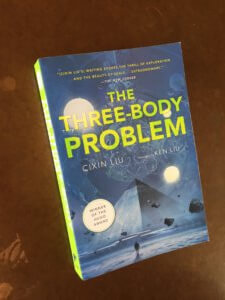
by Cixin Liu
Worthy of a Physics/Calculus Teacher’s Attention particularly high school and particularly for AP or IB Physics students
ALSO instructive for discussions in philosophy and ethics (see bottom paragraph)
High school physics instructors or calculus instructors…this novel would make a great summer reading assignment before your class begins in the Fall. One, the story is entertaining. Two, the story portrays historically some of the greatest physicists to walk planet Earth. Three, The Three Body Problem itself, the actual physics problem, this engages the physicist’s and the mathematician’s mind, Newtonian physics and all that jazz…Not that I understand it all, but I believe these the guys who write on the website: askamathematician.com. The excerpt below is from their website
The Three Body Problem is to exactly solve for the motions of three (or more) bodies interacting through an inverse square force (which includes gravitational and electrical attraction).
The problem with the 3-body problem is that it can’t be done, except in a very small set of frankly goofy scenarios (like identical planets following identical orbits).
The unsolvability of the 3-body problem, rather than being an embarrassing hole in physics, an obvious but unsolved problem, is actually the norm. In physics, the number of not-baby-simple, exactly solvable problems can be counted on the fingers of one hand (that’s missing some fingers), and that includes the 2-body problem.
The dynamics of one body is pretty straight forward, in as much as it travels straight forward.
The dynamics of two bodies, while not trivial, can be reduced by pretending that one body is sitting still, and then restricting all of your attention to the other body. Using that technique, you find (or, at least, Newton found) that the motion of a body under gravity is an ellipse. The same idea can be applied to the quantum mechanics of electrons and protons to find the exact structure of the electron shells in hydrogen (1 proton + 1 electron = 2 bodies). In that case you’re not talking about actual orbits, but the idea is similar.
But, for three bodies, there doesn’t seem to be a fancy trick for finding solutions. As a result, the exact behavior of 3 or more bodies can’t be written down. The exact energy levels and orbital shell shapes in anything other than hydrogen is impossible to find. Even deuterium (hydrogen with one extra neutron)! Can’t be done.
Despite that, we do alright, and happily, reality doesn’t concern itself with doing math, it just kinda “does”. For example, quantum field theory, despite being the most accurate theory that ever there was, never involves exactly solving anything. Once a physicist gets a hold of all the appropriate equations and a big computer, they can start approximating things. With enough computing power and time, these approximations can be made amazingly good. Computer simulation and approximation is a whole science unto itself.
The main actors in THE THREE BODY PROBLEM are almost all physicists and/or mathematicians and they’re nerdy, but not dweebs. Read chapter 5, A Game of Pool if you want a taste of what the novel offers. Then, there is the virtual reality, which unfolds as a puzzle/game and is played often by nanotechnology researcher, Wang Miao. Wang is compelled to understand the mystery introduced in the early chapters of the novel and realizes that the game is key to the revelation he seeks. In the game world, Wang walks through the history of physics with virtual characters like Confucius (our earliest physicists were primarily philosophers…a helpful connection for students to make), Newton and Einstein. Trisolara happens to be grappling with the three body problem. It is a planet in a solar system where there are three suns. The game players, along with the philosophers and physicists throughout history try again and again, in a systematic way, to solve the problem of the planet’s impending destruction. To go through each game level, Wang encounters physicists who have furthered the thinking regarding the problem. It’s like taking a course called The Intro to Physics…all this learning while the reader hurtles toward the big reveal at the end of the novel. Ah…to be entertained while learning…tis a wonderful thing. At the very least, THE THREE BODY PROBLEM ought to raise the curiosity level of your students and give them a glimpse of the relevance of physics and math to their everyday lives.
For the ethicist/philosopher, THE THREE BODY PROBLEM raises interesting issues about elites thinking they know best for all. The Cultural Revolution in China drives the narrative in the early chapters. Many elites are driven out of their positions of authority, killed or exiled by the communist party as it takes power. The author calls this a madness. (Chapter 1’s title is: The Madness Years). However, within the communist party, a new breed of elites rise to the top. Later, toward the final chapters of the novel, a group of environmental activists, along with men and women Liu specifies as elites across the globe, use their power to set in motion what they hope will be Earth’s salvation (knowing that saving the planet may come at the expense of most or all human lives). This small group of people have become judge, jury and executioner for humanity. Moreover, their hope for saving the Earth might not evolve the way they imagine. The stage is set for a discussion about power, elitism, environmental degradation and what might be ways to stem our self-destructive/planet-destroying tendencies.
To read a No-Spoiler review of this novel, click THREE BODY PROBLEM, Book Review
To buy THE THREE BODY PROBLEM, click here.
FEED, For Educators
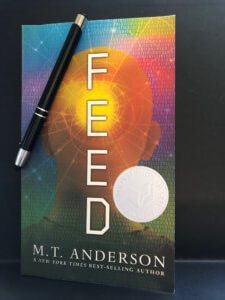
Discussion Questions for Educators
Appropriate for Middle Schoolers and High Schoolers
What a potent book and an important topic. If you are an educator, please assign this short novel to your kids. I have tested it on more than a few middle and high schoolers and they liked it, even felt captivated by it and knew there was truth in the story that they needed to pay attention to.
Five discussion questions for your students
- How is the feed similar to the way we connect to our devices?
- How is the feed different from the way we connect to our devices?
- How would you describe Titus and his friends?
- How would you describe Violet?
- Who is more of a hero? Violet or Titus? Explain why…
To read a no spoiler review of the novel, click here.
To buy, FEED, click here.
FEED, A No Spoiler Book Review
 Feed
Feed
By M.T. Anderson

A Book Review Without Spoilers
My daughter took a Dystopian Young Adult Literature class at her university a few years back. She took it for fun because though she was an architecture student, she loved to read fantasy, science or dystopian fiction. FEED was on the syllabus and after reading it for class, she handed it to me. “Mom, you have to read this book.”
When your kid hands you a book with that recommendation, you ought to respond, so I began to read…The first line of this novel grabbed me. It has to be one of the best EVER in the history of YA or scifi…
We went to the moon to have fun, but the moon turned out to completely suck.
However, after that first line, I almost didn’t make it past the first chapter. The narrator grated on me. The story is told from the first person point of view of a spoiled and entitled older teen male. Initially, I wasn’t sure I wanted to read his story, but I kept on, glancing a glimmer of hope for this character as I pushed through my angst. I saw how MT Anderson was using this vantage point to get under my skin…after all, much of the western world falls into the category of entitled, wealthy and spoiled. I decided that rather than distancing myself from this character, I ought to learn from his journey.
FEED is mostly a YA dystopian novel, but spills over into science fiction because of the futuristic tech and those initial scenes on the moon.
In recent months, I have recommended this story to more people than any other book I have read in the last 10 years. Why? FEED is good enough to hand over to a 13-year-old and a 52-year-old and if you are a parent, please read it and discuss it with your teen. Talk honestly about how we are connected to our devices.
FEED projects a future where children are connected to the web via the brain at a very early age. In the story world, the connection is called the feed. The practical science of how this takes place is never detailed, but it becomes clear that those with the feed maintain major economic, educational and social advantages. The story also shows the consequences of our planet devastated by greed and consumption. Oceans are dead, meat is genetically grown without the need for an actual animal and those who have money spend it on pure entertainment.
Titus, the teen protagonist and the narrator, lives at the top of this food chain. Initially, Titus seems utterly narcissistic. He and his friends battle boredom by pursuing short bursts of entertainment in whatever form available (almost always for purchase and provided by the feed). Titus slowly emerges as a deeper character, as someone hoping for authentic intimacy and friendship. Within his social class, it seems there are no guides to help him. Even his family is devoid of warmth and affection. For example, Titus never calls his little brother by his name, but refers to him throughout the story as Smellfactor. He treats his brother as an object of inconvenience, someone to ignore and avoid. Within Titus’ social circle, there is every indication that his family is normal.
While on the Moon, Titus meets Violet. Initially, physical attraction drives his desire to be with her, but when an event disconnects Titus, his group of his friends and Violet from the feed for a few hours, their bond takes on a deeper hue. Violet is not from his social class and was not connected to the feed at the earliest age possible. Her hippy, intellectual parents resisted putting the feed in her brain for as long as they were able, homeschooling her for a time (since education happens via the feed). As a result, Violet knows about the world in ways Titus and his friends don’t. She has developed critical thinking skills and keeps current on news, including the broad unrest that is taking place across the globe.
Violet isn’t lost without her feed like Titus. She asks questions, she makes observations, she opens Titus’ eyes to the way the feed manipulates, limits and traps those who are connected. Titus finds her views compelling and true, yet he resists her as well. Titus is less of a hero than we might hope, but he does attempt in his own way to move toward knowledge and depth. This makes for a potent story.
FEED poses so many questions that are worth asking. I won’t spoil the finale, but there is a poetic vision that lends itself to pondering and, as I said…a great discussion.
This book is a quick read. Do hand it out to your children and grandchildren. Do give it to your nieces and nephews. Do read it yourself, so you can draw out the conversation that needs to take place in our society…TODAY if not yesterday.
If you need questions for starting a discussion, see my post FEED, by M.T. Anderson Discussion Questions for Educators
To buy this amazing book, click here.
UPGRADE, A Film Review
UPGRADE
Original Screenplay by Leigh Whannel

A Film Review without spoilers
UPGRADE is a brilliantly told story, a must see for the scifi fan. This film is rated R.
UPGRADE is a film that will not have the mega-media behind it, but it is worth seeing. It was made for good reason and ought to be celebrated, especially by the scifi community. Here are five reasons why you ought to watch this film (especially if you are a hardcore scifi fan and over the age of 16…the rating is for real…brutal violence in this one).
The Short Review. 5 Reasons to Watch
- UPGRADE is a perfectly crafted script. Leigh Whannel writes and directs with stunning precision. From the beginning (a drop of human blood falling into the engine of a car which represents flesh mingling with the machine) to the end (the shedding of blood and establishment of a hierarchy in regard to human versus machine), every image, every word spoken by the characters, each scene is packed with meaning. The writing is deliberative and tight, everything a film or a well-told story ought to be.
- The main character and the peripheral characters all make sense in the world created by Whannel. All of them behave like real humans (or like human-machine hybrids) in a consistent way. I love seeing characters on the screen who make sense.
- Tension and action are delivered in full. If you’re a bit squeamish about violence, like I am, you might need to keep your eyes shut here and there. However, I was delighted by the car chases, the detective narrative and the ratcheting up of tension as the main character grapples with his relationship with the stem chip.
- The plot twists are well-earned and not predictable. You may feel like you understand what you’re seeing and where the story is going, but there are surprises you likely won’t anticipate.
- The climax sends the viewer into contemplation and hopefully discussion, so watch with one friend, at least. All great films lead their audiences to think and question. UPGRADE, like the best scifi, raises questions about morality, ethics in regard to AI and other worthwhile topics, like, where-the-hell-is-our-tech-society-headed? And viewer beware, UPGRADE might make you squeamish about driverless cars.
More Musings on UPGRADE (beware…minor spoilers below)
The film takes place sometime in the future, but not too far into the future. Tech has evolved. Driverless cars operate on the road alongside the old fashioned kind. The main character, Grey, is a mechanic and a technophobe, who works on non-driverless cars. His wife, Asha, works in tech and owns a driverless car.
While riding in that car together, the computer goes haywire and crashes them in a slum. Gangsters descend on them. Both Grey and his wife are shot. Asha dies. Grey is left with a severed spine and faces the prospect of living the rest of his life as a quadriplegic. A high-tech guru offers him the chance to walk again through the use of an experimental chip called stem that will reconnect Grey’s brain to his spinal cord. As Grey contemplates the offer, an offer made in a dark room of the guru’s isolated mansion, for which he needs to sign a confidentiality agreement, the guru asks him: What would Asha want? Grey agrees to receive the stem chip, a Faustian bargain that drives the rest of the plot.
If you need a little more motivation to spend the dollars for a dvd or streaming permission, here is the trailer.
To buy the dvd of this film, click here.
SOLO: A STAR WARS STORY, Film Review
Solo: A Star Wars Story

Original Screenplay by Lawrence Kasdan and Jonathan Kasdan
Directed by Ron Howard
Film Review without spoilers
A Fun Film Overall, to watch it, click here.
I walked to our local cinema to watch Solo yesterday and exited the theater content overall, pleased with many of the film’s sub-narratives that made sense within the Star Wars universe. SOLO is primarily a feel good film and appropriate for kids (a dad and his two boys, ages 6 and 8 were in the theater and not overwhelmed by the gore). Gruesome violence is downplayed, though there are more than a few dead bodies by the end of the film, including Chewbacca pulling the arms off of a bad guy. (The audience laughed…but, we never see the bleeding body, just the two arms held up by Chewie).
SOLO is a fun ride for the Star Wars fan or someone who might not care about complex emotional narratives. It’s a space-romp with a number of laughs and swash-buckling action. What rang true? Young Han Solo is charming with a big screen grin that will win the hearts of those who adore good hair and a handsome face. Charm, in fact, is one of the most identifiable characteristics of the younger Han Solo. Others are:
- His optimism in the face of terrible odds
- His ego, connected to his piloting skills (The Millennium Falcon coming into the hands of Solo, following a gambling event with Lando Calrissian fills out a nice piece of backstory)
- His rogue/tough exterior with a subtext of goodness/romanticism and devotion to that which is just
- His loyalty (The Chewbacca mini-narrative is wonderful and touching).
All the characteristics listed above are present in the young Solo, but with a bit more naiveté than we see in the later version when the audience meets the more jaded version of Han Solo in STAR WARS: A NEW HOPE.
What Was Lacking?
It all seems too easy for Han Solo…
Real grit in the face of trauma was less present than I expected, resulting in a somewhat shallow story. The boy Han has grown up on a planet called Corellia, seemingly with little nurture or supervision. Corellia, the filmmakers let you know, has a reputation as a horrible place, yet the audience meets Han as a young twenty-something, empowered and rebellious and unflappable. The setting portrayed in the opening sequence features children living in squalor, but Han is clean and confident, so confident, he is willing to defy a crime boss (this crime boss is a giant centipede-like-creature that lives underwater, but emerges to speak…speaking perfect English actually…ain’t that something!) As Han escapes from Corellia, he is separated from a young woman he loves, Qi’ra. Even at this point, he does not break down or show extreme distress. He enters the Imperial Navy to learn to fly and vows to return for her. I was not convinced saving Qi’ra was driving his ambition to become a pilot. I sense no desperation in this character who is now a pawn in the humongous bureaucracy, which is the Imperial military.
The next time the audience sees Han, he is a part of an Imperial infantry division. He has been kicked out of flight school for insubordination. He is on an unnamed planet waging war with his comrades. It is a dark, smoke-filled environment. A chaotic battle is taking place. The scene is horrifying. Soldiers are dying left and right, diving into trenches, a few are screaming after enduring injuries. How long did Han fight with these warriors? Did he care about any of them? Was he traumatized by this? He is being used by the Empire to oppress those who are battling to stay free. Han never claims to care about politics, but we know he cares about certain people (and a Wookie and the Millennium Falcon). He grows attached and becomes loyal. Why no emotional engagement in this place? If he is defended against emotional engagement, it’s likely there is trauma, trauma that would impact his character. That might have been an interesting angle to take with this film, but instead the filmmakers hurry the story along. Han abandons his defeated and dying fellows in the military and joins up with a crew of thieves. Han escapes the trauma a second time. It all seems too easy.
So…this weekend, there is a bit of buzz about SOLO not making the money the filmmakers had hoped. There are a few news stories out (and it’s only Sunday of second weekend since its release) that indicate a significant decrease in the audience numbers. What does that mean? As with any of the gigantic film franchises that are emerging in the last thirty years, there are films that rise to the top quickly, but fizzle…and those that percolate and stay with you. I’m guessing, SOLO won’t stay with us in that same way that NEW HOPE, EMPIRE or even ROGUE ONE does, but sometimes, that’s okay. Not every film can be great, but a flick like this can still be great entertainment and in this case, SOLO: A STAR WARS STORY, delivers for the whole family.
THE MARTIAN, Book Review
The Martian
Review of the Novel
By Andy Weir
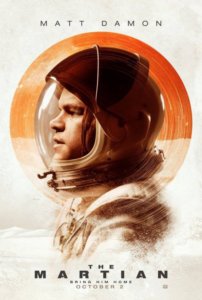
THE MARTIAN became a must-read science fiction novel a few years ago. Not only did the book go mainstream, but the story captured the imagination of Twentieth Century Fox. Under Fox Entertainment, Drew Goddard adapted the book to screen and Ridley Scott was hired to direct. In 2015, THE MARTIAN became Scott’s top grossing film. Mark Watney, the hero of the story, became a household name as did many of his quips, like:
- In the face of overwhelming odds, I’m left with only one option: I’m gonna have to science the shit out of this.
- I don’t want to come off as arrogant here, but I’m the greatest botanist on this planet.
- They say once you grow crops somewhere, you have officially colonized it. So, technically, I colonized Mars. In your face, Neil Armstrong!
THE MARTIAN in novel form
THE MARTIAN tells the story of an astronaut stranded on Mars. He is a member of NASA’s third mission to the red planet, having traveled on Hermes, a one-of-a-kind craft that has the capability to reach Mars. The story is set in the year 2035. While the crew is on day 5 of their 30-day mission and living in a tent-like research structure, a 175 mph sandstorm erupts on Mars. This leads them to abort the mission, but while Watney and the rest of the crew rush out of the tent and are on their way to the ship that will take them back to the Hermes, Watney’s suit is penetrated by a blowing antenna. All of his fellow crew members know this to be a death sentence in the harsh Martian environment and in the confusion of the storm, they lose contact with him and make the tough decision to leave his body behind, assuming he is dead. But, Watney survives.
The rest of the story unfolds as part survivor tale, part rescue mission. The tension is palpable throughout. Watney is the main narrator, making journal entries about every challenge and every Mars-life-hack he performs to survive. He is an engineer and a botanist, so his skill-set comes in handy. He needs to make water, grow food and figure out a way to contact NASA to let them know he is alive. He meticulously details the science in his journal entries and they are funny, while being brilliant. When he does finally reach NASA and his former ship mates, the rescue mission begins, but not without its own challenges/impossibilities.
The narrative broadens in vital ways when NASA is contacted. Now, the reader sees new characters and just in time. It might not have been so compelling a read without the new voices and the new motivations. Watney’s story continues to be mainly told in his journal entries. The NASA folks come into the story via omniscient narrator. Very quickly, NASA tells Watney’s crew (still en route back to Earth) that Watney is alive. Now they become a part of the story, trying to figure out a way (if there is one) to rescue their fellow crewman…These characters are all interesting and are making decisions that ramp up the tension. Saving Watney is going to be extremely costly and potentially fatal for the Hermes and its crew. There are a million reasons to let Mark Watney die.
This story succeeds in capturing the unique voice of a space hero. Mark Watney cannot fly around like Ironman (a reality he bemoans at one point in the story), but his superpower is his ingenuity, his intelligence and his sense of humor in the face of the slimmest of odds. He is matched by NASA’s creative problem solving and his crew mates, who show themselves to be people of courage and sacrifice.
I laughed aloud reading this book (actually consumed it via audio book with my family while on a road trip…all four of us love a good scifi story and Weir’s first person narration does make for a great audio experience). Watney’s voice rings in one’s brain following a good listen.
I highly recommend this novel and will write another post for educators, as the science-inspired story potentially gets kids revved up about their studies.
To buy the Martian, click here.