Media
An Excess Male, The Educator’s Guide
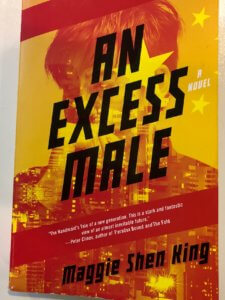
Maggie Shen King
The Perfect Discussion Starter for Public Policy 101
AN EXCESS MALE showcases governmental abuse of big data, but also, the one child policy…perhaps the most disastrous public policy of the modern era.
Warning: this book contains sexual content. I do not recommend it for the Middle Grade Reader<
Do your students know the term public policy?
A societal problem presents itself and a governmental entity decides on laws, regulations or funding priorities to solve the problem…you know, make a policy, for the public. You can find a number of sites that attempt to give a definition of public policy. I appreciated this Audiopedia presentation:
A basic introduction to public policy
Even with the above intro, public policy is still a complicated concept for the average youth who has not paid great attention to politics.
Shen King’s, AN EXCESS MALE tells the story that will enable a reader to study public policy through a microscope, by getting to know a fictional family and the impact a few particular policies have had and will have on them.
For background and history, have your student read one or two articles on China’s One Child Policy. This piece from National Geographic is a good one.
The summary: China feared overpopulation. China had historically been unable to grow enough food to feed their entire population. Their solution to this immediate societal problem was to institute a public policy (a law that went into effect in 1979) that rewarded those who limited their families to one child. Public pressure kept some couples from giving birth more than once, but there were also incentives given, like tax breaks for those who chose to abide by the law. Unfortunately, those who did not conform were sometimes forced to have abortions or to hide their second or third child. Some women were forcibly sterilized. Families, when forced to choose between a girl or a boy child, wanted boys. Boys were prized more highly for their earning potential and for other cultural reasons. Girl babies were given up for adoption, abandoned or hidden away. Unborn girls were also aborted at a higher rate…all because of a public policy. The current problem facing China now (as written about in the article above) is that by 2030, more than 25 percent of men in their late thirties will not have a family of their own. There are not enough brides in China to match up with these excess males.
Starting points for discussion around the novel…
Read chapter 1 most carefully, then continue through the book to the end. The public policy instigated by the Chinese government to solve the problem resulting from the One Child Policy (too many men, not enough women) is presented most concisely in the early scenes of the novel.
- How are the various characters related to Wei-guo? Go down the list and describe the relationships in short sentences or if you prefer draw a family/relationship diagram using Wei-guo as the center. In your diagram and/or description include Big Dad, Dad, May-Ling, Hero, Husband One, Husband Two, MaMa.
- Based on your diagram, what constitutes a family?
- If you were to summarize this first scene, how would you describe what is taking place?
- There is a point of discussion early on around Advanced Families and China First along with a reference to patriotism. How would you summarize what it means to be patriotic in the eyes of Wei-guo’s dads?
- “Every man is allowed one child…” Why do you think that is?
- There are rules and expectations that order these unusual families that are forming as a result of public policy, some rules are dictated by the government, others emerge out of necessity. Begin a list of these rules as you read through the book. Some rules are subtle, not easy to pick up on. Others are more obvious, like “Every man is allowed one child…”
- In chapter one, the term Willfully Sterile is used to describe Hero. What do you think this means?
- Big Dad calls Husband Two a Lost Boy? What do you think that means? How does Hero, the matchmaker defend Husband Two?
- What are the Strategic Games?
- Why might they exist?
- What does Major Jung want from Wei-guo and his band of Strategic Games men?
- He states a statistic. What is the statistic? Doc tries to protest…but clearly, the government official is giving the orders and not allowing for any discussion. Why do you think that is?
- There is a reference in the book periodically to going the max. The meaning is not precisely spelled out. What do you think it means?
- What do you think the government would do to May-ling, Hann and XX if they declared in all honesty who they are and what they want?
- How do you think a government gets this kind of power over individuals…the power to determine what it means to be a man, a woman, a family, a patriot and control those definitions for an entire society?
- The idea of government power through censorship and spying on (keeping track of) their own citizens emerges as a theme and becomes prominent by the final chapters of the book. Do you believe that the government should be able to track you, trace you, know your habits, what you buy and eat and drink? In the name of keeping society safe, is their intrusion into your privacy something you would be okay with?
This is such an important discussion and not just for those living in places like China (where citizens have little say in what their government does)…but in the US and Western Europe and among other “free people”…how much power in the form of data do you want your government to have?
Wired has a great article on the intersection between Big Brother and Big Data This reality is nothing new for the scifi world…but in the past it’s all been make believe. Now science fiction is becoming reality…our reality. What kind of checks on Big Data in the hands of government ought to be put into place now, to avert the kind of situation the reader sees in AN EXCESS MALE?
This ought to be a large public policy debate and a topic discussed by citizens everywhere. How much privacy will we give up for safety and what if our governments turn on us and decide that watching us is a part of creating a better society, more order?
There is much to read and discuss on this topic.
This article from business insider gives another angle and more will be written in the coming years as the technology outruns our ability to debate every new policy.
Enjoy Maggie Shen King’s book. Read it for the love story and the thrilling climax, but pay attention to the under-carriage of this story. A sinister government maintains tremendous power over how society defines everything from sexuality, family and mental illness to patriotism…now that is a scary story…something dreamed up by writer…or something at our doorstep.
To buy AN EXCESS MALE, click here.
An Excess Male, A Book Review Without Spoilers
Author, Maggie Shen King
“Science fiction is any idea that occurs in the head, but doesn’t exist yet, but soon will, and will change everything for everybody, and nothing will ever be the same again.”
Ray Bradbury
The Short Review
Three Reasons I Recommend you read AN EXCESS MALE…
- Learn about China, a rising power with imperial roots and aspirations. Let this novel wake us up to the reality of Big Data meeting Big Brother
- Fall in love with the characters put forward by Maggie Shen King
- Enjoy a good old fashioned love story/thriller. Actually….NO…the love story is unlike anything you have probably read, but the tale will thrill. Love, loyalty, duty are on display, nearly every page.
To buy AN EXCESS MALE, click here.
The Long Review, Also Without Spoilers
I recommend this novel with a few reservations. AN EXCESS MALE falls into the category of speculative fiction, though it bleeds into the scifi genre and would likely be enjoyed by anyone who loves “surveillance stories”, like Minority Report and The Net. This novel has a few PG-13 scenes, and some adult themes that might bore a young adult reader, but many young adults and those older who read speculative fiction will love the book. I would not recommend it for Middle Grade or younger.
Shen King’s story belongs in the future, and yet the reality she portrays is around the bend…How many years away? Maybe ten.
The premise of the novel addresses the terrible truth China is now grappling with…that their one-child policy has resulted in 40 million unmarriageable men. By the year 2030, more than 25% of men in their late thirties will have no family of their own. What are the options for Chinese society? Here are three possibilities…
- Import wives from neighboring Asian nations or elsewhere. The problem…the Chinese, especially the government values a pure and loyal race. They elevate the Han Chinese culture and importing wives will dilute Han Chinese blood.
- Send those extra men to battle. Society does not need them for child-bearing, so let them win honor in fighting to extend China’s influence around Asia and the globe. The problem…many of these men are the only children, the beloved one child of their parents. Who will take care of the parents, those elderly loyal citizens of China who have lived and suffered under this oppressive law to bear only one child? What does it mean if the government plucks away and sacrifices their one and only on the battle field?
- Require that women in China take more than one husband. Most will take two…some will even take three husbands. A new family system will evolve around this patriotic duty. The problems that may result…READ THE NOVEL TO FIND OUT.
Maggie Shen King writes a story that assumes the third possibility. Women marry more than one spouse, all for the good of China. In a spirit and tone that celebrates her Taiwanese/Chinese heritage, Shen King imagines a world where men pay dowries, women of child-bearing age are precious and coveted, and single men bear a painful stigma. Shen King tells the story in the third person, changing the close narrator’s viewpoint chapter by chapter. She signals the shift by titling her chapters with the character’s first name. Two husbands, one wife and one potential husband…these are the characters the reader follows into a labyrinth of love, politics, corruption and societal rules that do not bend for individual freedoms.
I have only one complaint about the novel, that the ending felt rushed and a bit predictable, somewhat contrived. Pacing did not match the earlier portion of the story. It’s an issue that can happen when writing from multiple characters’ perspectives. In this case, the main character and to some extent the heart of the story got somewhat lost in the milieu. However, even with a few flaws, I found the book fascinating and worthwhile. It’s a fun quick read and will immediately get you thinking and feeling.
The House of the Scorpion, Contemplating Human Cloning, For Educators
 Educators, THE HOUSE OF THE SCORPION provides a valuable and sensitive context for a discussion on genetics and cloning. To begin the journey, read the novel alongside your student(s). Next, discuss the science. There are a number of kid-friendly articles on cloning, I liked this one from Science News For Students
Finally, with an understanding of what cloning is, dig deep into the human story presented by Nancy Farmer in her deftly written account of a boy clone, Matt Alacrán.
I reviewed THE HOUSE OF THE SCORPION on another post on this website. If you continue reading this post, you’ll encounter more than a few spoilers, so beware, click here if you’re interested in reading the novel review before continuing.
To order HOUSE OF THE SCORPION, click here.
Here are a few questions to get the discussion flowing.
- Who is Matt? How would you describe him?
- Why do you think others often treat him cruelly?
- How would you describe Celia?
- What does Celia feel about Matt?
- What does El Patrón feel about Matt? Why do you think he calls Matt “mi vida”?
- What does it mean to be owned by a person? (Tam Lin, Matt, Celia, and even Felicia…all of them tell stories that indicate they are owned and not free…owned by El Patrón.) How is it that El Patrón owns them?
- What is an eejit?
- How is an eejit similar or different than Matt?
- How would you describe Matt’s struggle with being a clone? Does it make sense to you? Why or Why not?
- Matt’s life makes a positive difference in the lives of many others in the novel. Make a list of those people.
- Do you believe the cloning of people will take place in our future? In no, why?
- If yes, How should clones be viewed by the society that creates them?
- Can you imagine a situation where you would choose to have a clone of yourself created or that of a loved one?
Synopsis of the Cloning Story:
THE HOUSE OF THE SCORPION is a Middle Grade/YA novel that follows the story of Matt Alacrán, one soul and his battle to find meaning and love in the midst of his genetic reality. El Patrón, a powerful drug lord who has an appetite for eternal life, has allowed Matt to be created as his clone, but the assumption is that Matt will not to live much past his adolescence. El Patrón’s long-term plans are to harvest the boy’s organs for himself. Neither the reader nor Matt know all of this initially. The reveal happens little by little. This is not a horror story in essence, though there are horrific issues to grapple with…Primarily, this story is about a young person figuring out who he is, learning day by day what it means to be human.
The Many Colored Land, Book Review
 Short Book Review with No Spoilers…
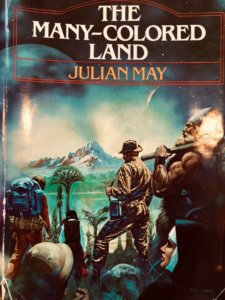
Julian May’s THE MANY COLORED LAND is an exceptional adventure that takes place in Pliocene Europe, think Tolkien meets Jules Verne. This is the first story in a trilogy, involving time travel and aliens. The world created by May is so imaginative, while being true to fossil record and prehistoric science. It’s like taking a course in geology, mammalian evolution and ancient flora all in one.
Three Reasons to Read this Great Book
- Superior world building and vibrant descriptive passages that will delight most scifi lovers.
- A humanoid alien race with a distinctive culture, a compelling ally or enemy?
- A complicated conflict between humans and aliens that drives the narrative
- A female author with mad writing skills. Julian May was unknown to many of my scifi-reading friends until a woman in my scifi book group introduced us to THE MANY COLORED LAND.
To buy this book, click here.
The Longer Review…With a Few Spoilers
The novel opens with a prologue, three essential scenes that set the adventure in motion. I needed to go back and re-read the first two to realize their relevance because there’s no context at that point for the reader to get them. Therefore, I promptly forget them. (Maybe in my younger years I would have recalled them at the right moment, much later in the story…or maybe not!)
The third scene remains memorable. It introduces the reader to a time travel machine and the human scientist who created it. A broader picture of current human existence becomes evident in this scene as scientists from many planets and many species gather to see the machine in operation. Earth’s children have become a part of a larger galactic cooperative, called the Galactic Milieu. The time machine is tested and its limitations are explained. The machine can only send beings back in history, only into Pliocene Europe. No messages can be sent back the other way, none of the beings who travel back in time will be able to return.
The scientist dies, his wife, Madame Guderian, contemplates what to do with the time machine. She begins to hear from various members of her species. Many feel a desire to leave their current situations. They want adventure or purity, something other than what they are experiencing. Many are lost souls, but others desire a simpler existence. She begins sending groups of people back to the Pliocene as a money-making scheme. There are rules, of course, to avoid messing up human evolution, so all females are sterilized before departing. The assumption is that the great ice age and the inability to procreate will bring an ultimate end to whatever societies form in this prehistoric exile. There are also limits to the kind of technology they bring.
The story proceeds to describe a number of human individuals currently living in the Galactic Milieu, all of whom find themselves dissatisfied with their lives in various ways and make the decision to go back in time. Each person has about a chapter of backstory before they come together. They are the characters the reader follows into the Pliocene, landing in the past about 1/4 of the way into the novel.
What follows is an experience in pre-history Europa, with a few good twists. This is scifi, yet fantasy-like, in that the world of the past is a place not unlike medieval Europe, given the absence of technology and another twist…aliens…who have crash-landed on Pliocene Earth. I really cannot say more without giving too much away.
However, here is a taste of May’s lovely writing, a descriptive passage of the Pliocene Black Forest
“The understorey of this evergreen expanse received very little sun. Its plants–only saprophytes nourished by the detritus of the great trees. Some of the things that battened on decomposition were degenerate flowering plants, pale stalks with nodding ghostly blooms of livid white, maroon, or speckled yellow; but paramount among the eaters of the dead were the myxomycetes and the fungi. To the five humans traveling through the Pliocene Black Forest it seemed that these, and not the towering conifers, were the dominant form of life.
They were quivering sheets of orange or white or dusty translucent jelly that crept slowly over the duff of needles and decaying wood like giant amebae. There were bracket fungi–from delicate pink ones resembling baby ears to stiff jumbos that jutted from the trunks like stair treads and were capable of bearing a man’s weight. There were spongy masses of mottled black and white that enveloped several square meters of forest floor as though veiling some unspeakable atrocity. There were airy filaments, pale blue and ivory and scarlet, that hung from rotting limbs like tattered lacework. The forest harbored puffball globes two and a half meters in diameter, and others as small as pearls from a broken string. One variety of fungus cloaked decaying shapes in brittle husks resembling colored popcorn. There were obscene things resembling cancerous organs; graceful ranks of upright fans; counterfeit slabs of raw meat; handsome polished shapes like ebony stars; oozing diseased purple phalluses; faerie parasols blown inside out; furry sausages; and mushrooms and toadstools in varieties the seemed to be without number. At night, they were phosphorescent.”
Another aspect of this novel that I want to write about another time (because this post is getting exceedingly long!) is the way May turns Tolkien ideals on their head. Elves, Humans, Goblins and Orcs? Who are the good guys and who are the bad guys? May’s novel upends the notions set forth in the Tolkien universe and I appreciate how she does it. Julian May died about one year ago, October 17, 2017. I think it’s time to bring this book back into the scifi mainstream and celebrate her for being an imaginative storyteller.
The House of the Scorpion, An Audiobook Review
Roadtrip Listen
Audiobook Rating
THE HOUSE OF THE SCORPION
by Nancy Farmer
read by Raúl Esparza
8 out of 10
Highly Recommend! This listen is perfect for a family road trip because the novel is well written and engaging enough to capture the interest of a variety of story-lovers, young and old. The audio voices are well-performed by actor, Raúl Esparza (Ferdinand, Law & Order: Special Victim’s unit) and the story lends itself easily to the listening ear.
5 Reasons for such a strong review:
1. Initially, there are few characters to follow and as new ones are introduced, the listener can maintain a grip on who everyone is…including, there are a number of characters with accents and very distinct voices (performed well by Esparza).
2. The point of view is third person, it stays close to Matt. It does not jump around from character to character.
3. The repetition of little stories told mostly by El Patrón, work like anchors for the listening brain. I write about this in my review of the novel, THE HOUSE OF THE SCORPION Repetition is a common story-telling technique, much like songwriters or poets will use a chorus or a repeated stanza to drive a point home.
4. The writing is top notch, which means, the dialogue is well written. The dialogue feels authentic, like real people talking.
5. Description of Opium takes place slowly and organically. The listener doesn’t have to absorb a huge amount of exposition, the describing of places, houses, rooms, plants, animals, people etc..takes place incrementally. Matt’s life starts out small and his view of Opium is narrow, but little by little, as he learns, the listener learns. Details are added that are important, but not all at once. It makes the audio format easy to follow.
For more on how to choose a good audiobook, see Part II The Rise of the Audio Book
The House of the Scorpion, A Novel Review With a Few Spoilers

THE HOUSE OF THE SCORPION by Nancy Farmer
Nancy Farmer’s first of of three novels, following the life of Matteo (Matt) Alacrán, is a story worth reading to or with your kids. The primary moral challenge centers around cloning, but there are many other ethical questions that will arise in the reading. Farmer’s writing creates real characters, despite the fantastical nature of the world. She takes on complicated relationships. power dynamics, and even religion as she draws the readers toward an inevitable reckoning. She stays close to the child, Matt, who grows up in the oddly luxurious world that is Opium. Matt is a young child at the start of the narrative, a teenager by the end. The story is told in close third person.
Matt is a clone of the wealthiest drug Lord in the world, an elderly Mexican man who dragged himself out of poverty to become one of the wealthiest men in the world. He is known as El Patrón. El Patrón is well over 100 years old. He rules his nation through fear and raw power and on its land he produces enough Opium, legal and illegal, for those who need the product. The land of Opium is both a place of horrors and an ecological oasis. Nothing is simple in Opium, as the reader will slowly discover.
THE HOUSE OF THE SCORPION deals with extreme wealth versus extreme poverty as well as power, ecological degradation, leadership, friendship, loyalty, religion and meaning. All of this subject matter is delivered in an impactful way to the young reader through relatable characters.
Farmer uses a style of writing that does not explain too much too early, but for those details that are difficult to fathom, they get repeated many times throughout the book, almost like a chorus. For example, the story of how El Patrón’s siblings perished, is told and retold. The story reveals the condition of poverty endured by his family, his town, his people and how desperately powerless he had been at one time. El Patrón is an old man…of course he would repeat himself again and again, but there is more to that story. The tale is part of the legend and a defining trauma in the life of the old man. The story also reminds the reader that Matt, though he is an exact replica of El Patrón on a cellular level, his life experiences will have been completely different. That memory of losing his family is El Patrón’s, but not Matt’s. The nature versus nurture debate looms in the background of this narrative and is worthy of a hearty discussion with your child.
Many other issues are introduced in THE HOUSE OF THE SCORPION There is more great storytelling and ethics to unearth as the narrative progresses. Nothing is black and white in Matt’s world, but this is why I would recommend the book. Farmer has put forward a character and a world with the kind of complexity that leads to memorable discussions. My next post will cover a short audiobook review of THE HOUSE OF THE SCORPION.
To buy THE HOUSE OF THE SCORPION, click here.
THE RAIN, A No-Spoiler Review of Season 1

A Danish star is born. Alba August as lead character, Simone
I recently binge-watched the final 5 episodes of the NETFLIX series THE RAIN…finishing the first season. Here is my take on the potent Danish production, dubbed for English-speaking viewers. By the way, I wasn’t annoyed by dubbing. I thought it was done well.
This series might earn an R rating if released on the big screen, so beware parents. This story contains some great characters and interesting ideas for discussion, but there are a few non-explicit sex scenes, some nudity and a lot of f-bombs…it is the end of the world, after all.
THE RAIN’s genre designation is probably more speculative fiction than science fiction. The story is driven by new science, so this is where the overlap lies…no aliens or spaceships (at least none so far), but there is a biological discovery that rests in the hands of a few and this technology is about to transform the world. The future tech is an element that would appeal to many science fiction fans…(Think TERMINATOR). And now for my review.
First, a short review without spoilers…
Season 1’s narrative follows a sister and brother pair, Simone and Rasmus Anderssen. They survive a deadly virus that infects the population through the rain. Their physician father is somehow in the know and connected to a biotech company called Apollon. They understand little about what is taking place, but they slowly discover the truth, as does the audience with them. Here are three reasons to consider watching THE RAIN.
- See the world’s end through the eyes of the Danes. Sure, THE RAIN follows a well-worn storyline, but rather than the typical American/Canadian or British view on the apocalypse, but this time, we see survival through the eyes of Danish youth. I appreciated viewing their wanderings through cities, towns and topography I don’t typically see on the screen. Moreover, the survivors’ attitudes about who they will be in this new, empty world are also markedly more Scandinavian than American.
- The main players in the drama are well written and interesting. Similar to a few other speculative dramas, like The 100, the youth are smart, naive at times, attractive and slowly becoming a family.
- The overall plot makes sense, yet some mysteries are withheld in a good way. The narrative shows potential for a longer, more complicated drama, including the introduction of a sinister villain by the final episode.
And now for the longer review, with a few spoilers…
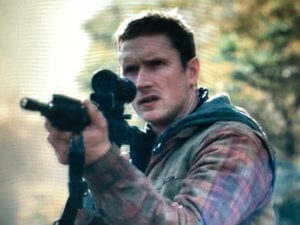
Martin, played by Mikkel Boe Følsgaard,
Simone (about 16 yrs) and Rasmus (about 10 yrs) enter the bunker having never seen its like before. Their father brings them on the first day of the rain, but then leaves, saying he can help with finding a cure. He promises to return to them, but never does. Their mother dies early as the rain touches her skin. This is the most dramatic reveal to Simone and the audience. The rain is absolutely toxic. Simone watches as droplets fall from the sky, strike her mother’s skin and within moments, she convulses and dies.
For a short time, Simone is able to connect with a few individuals outside the bunker via the internet, but that contact comes to an end within hours as civilization breaks down. Simone and Rasmus are alone and know nothing of what is happening outside the bunker.
Simone raises her brother, holding onto the belief that her father will return for them at some point, but six years pass. When food begins to grow scarce and Rasmus shows signs of going berserk from being cooped up underground, Simone sneaks out of the bunker one night to explore a local town and figure out if there is safety outside. She finds decayed corpses and an abandoned town.
Without knowing someone has been watching her, she returns to the bunker. Three young men and two women follow her back. They sabotage the ventilation system forcing Simone and Rasmus to emerge. The sister brother pair face a group of strangers, all of whom are desperate for food.
The strangers seem bent on killing Simone and Rasmus, but a quick witted Simone convinces them that she knows where there are other bunkers and where there are bunkers…there is food.
The unlikely group sets out. Discovery takes place with each new bunker they find. In addition, episode by episode the audience becomes acquainted with the backstory of the various characters and so doing, the viewer learns some of what has transpired outside the bunker following the apocalyptic rains.
The backstories all come via flashbacks. This particular story-telling method has been utilized by many tv and film types, including the creators of LOST. However, I thought the short snippets of flashbacks in THE RAIN felt less heavy-handed than those in LOST and contributed to multiple layers of the plot, besides revealing character. So, if you’re not a fan of flashbacks…never fear, I don’t think they were overused.
Martin’s story (see photo) is presented in episode 2. Martin is the gruff leader of the survivors, former military and not afraid to kill anyone who endangers his group. He, along with Jean, Patrick, Lea and Beatrice and finally, the father to Simone and Rasmus, receive screen time that explains some of their history.
Specific spoilers included in paragraph below, but pay attention if you are a writer of speculative fiction
Regarding the writing of this series and typical tropes that populate end-of-the-world narratives, one can find many in THE RAIN. For most of us, we like them and don’t find them annoying. I also appreciated the little deviances around the various tropes. For example: 1. the chosen child who will save humanity and must be protected at all costs, he’s actually the one who can also kill everyone 2. the evil corporation that sees its technology as a way to control humanity is seeding storm clouds with a virus…such a sophisticated weapon of mass destruction. 3. having sex just might just lead to your death…especially, if you’re even remotely slutty, but THE RAIN’s slut is a really sweet character and finds her way into our hearts before she is killed off 4. those seemingly happy survivors who are really a cult that practices cannibalism, they allow our young survivors to choose in or to leave freely…So humane! So Scandinavian!
Overall, I recommend THE RAIN. Add it to your Netflix queue and enjoy a wet winter!
The Rise of the Audio Book. Part II
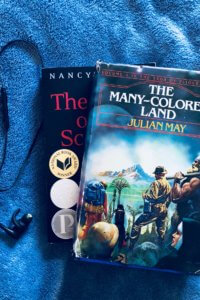
A Tale Worthy of a Listen
What to look for when choosing a book, especially if you’re a novice audiobook consumer…
Today, as I was having my teeth cleaned, my dental hygienist told me she is NOT a reader these days because of having two little girls to whom she reads all the time (a 4-year-old and a 2-year-old), but has found herself addicted to Audible when she drives, cooks and does other chores. She tells me while I am flat on my back, my mouth opened as wide as it will go,
“I fall asleep when I pick up a book to read right before bed, but during the day, I’m finding it so much fun to listen to a romance novel. I’m a sucker for a good love story.”
Audiobook listeners are coming out of the woodwork to talk to me when I indicate that I am writing this post. I don’t have enough data to know if this is a true cultural phenomena, but something is definitely percolating among us.
Like our ancestors of old, we still LOVE listening to stories. If you’re not an audio book-o-phile, consider this…
- More and more, writers and publishers are thinking about the audio platform and their customers who like to hear a story. They are organizing books to cater to our ear, for example, making chapter titles to anchor the listening ear and investing in professional actors as readers.
- You can download many audiobooks from your library for free…right at your fingertips, no subscription necessary…just a library card.
- If you need more choice, try Scribd’s free 30-day trial.
- You can do the same with Audible.
But, how will you know what will be a satisfying listening experience? Here are a few tips, my opinions on the best audio books and the ones to be wary of…
Say YES to these audiobooks…
- Theatrical Productions. Great if you’re listening to a play and can be fun for multi-character stories. Back in the cassette tape era, our family listened to a version of THE HOBBIT, produced by a company of actors under the label Mindspring. The production was originally done for radio and I say version of THE HOBBIT because I believe they edited out/streamlined some of the longer descriptive portions of the novel. My children often listened while they took baths (sometimes for an hour or more…getting extra clean). They begged to hear and re-hear the Bilbo/Gollum dialogue and the Smaug/Bilbo interactions. The varied voices captivated their imaginations.
- Well-reviewed Professional Actors Reading Fiction…Those able to perform the various voices are sought after. The best are employed to read best sellers…like…Harry Potter. There exists (believe me…I found out as I wrote this post…the debate is rabid) an epic debate about who voiced the characters better between two readers, Stephen Fry or Jim Vale…both brilliant in their own right, Fry reads the British version of HP and Dale reads the American version. I am not picky! I recommend both versions! This link to the very real debate reveals how nerdy the listening audience can be…and how nerdy Harry Potter fans often are:
- Any Compelling Story told in First Person. This means, as a listener, you get to stick with one point of view for all of the tale (or, at least most of the tale). HUCKLEBERRY FINN is a good example, so is HUNGER GAMES and one of my recent favs, ANNIHILATION. The first person narration puts the listener in the head of one person, usually the main character, and the main character only. Many find it easier to follow one voice as a listener because you become acquainted with that narrator, the sound, mood and tone of the voice, the opinions held by him/her. You don’t always have to trust the narrator’s opinions, but at least you know him/her and maintain that point of view as an anchor when navigating the story universe in your imagination. At the end of this article I will post a few more science fiction first person narrations I recommend.
- Tried and Tested Non Fiction Authors. Writers like Malcolm Gladwell and Michael Lewis are a great fit for the beginner audio consumer simply because they are such great communicators in writing and in speaking (they read their own audio versions). And, as always, you can also read reviews at Audible or ScribD’s online stores or google the information like the bestselling non-fiction audio books A list like this will point you in the right direction.
What to avoid if you’re unused to listening to stories…
- A Novel with Many Characters and Storylines. I enjoyed the novel, THE THREE BODY PROBLEM, but there were two things made that book a challenging listen…one was the vast number of character, some with semi-similar names. Since the book was originally written in Mandarin Chinese and my ear is not used to listening to the sounds and hearing the distinction regarding names, I was mixing up characters for a while before I got them straight. If I had had the physical book in front of me, I could have used the handy character list at the beginning of the book to keep myself straight. This story also jumps point of view, so anchoring in one mind and one voice were not an option.
- A Novel with Long Descriptive Passages. Tolkien fits into this mold. It’s not that you can’t listen to his books, but they might be challenging for beginners. I’m an audio learner and even my mind wanders when listening to Tolkien, especially portions of THE TWO TOWERS, as the vast landscape around Rohan is described for page after page.
- Poorly Written Anything with Poorly Constructed Characters. I might be a snob here, but certain novels that are written by men in particular who write “their fantasy” of a man (a super brilliant spy or detective, for example) and stereotype women as needy or pseudo-independent, but are really dependent on the super spy dude and the writer denigrates all the main character’s rivals and writes dialogue that is cliché or just terrible to listen to…um…I don’t like those books in any form, not in audio, not in print, not on the screen. My husband and I listened to a book like this for a few hours until I could stomach it no further. We never finished it.
- Beware of the Textbook. Unless that textbook writer is a master storyteller, don’t start with this genre. Not that you can’t work your way up to it, but the kind of info that is dumped onto the page of a textbook is often so dense, it’s better to read with highlighter in hand and in shorter spurts.
And now for THE LIST
Recent audiobooks I loved:
ANNIHILATION by Jeff Vandermeer (scifi), first person narration
EMBASSY TOWN by China Miéville (scifi), first person narration
THE MARTIAN by Andy Weir (scifi), mostly first person narration
The first ¾ of THE POWER OF HABIT by Charles Duhigg (non fiction) compelling subject matter for anyone
THE HOUSE OF THE SCORPION by Nancy Farmer (YA speculative fiction), great story, few characters
Audiobooks that were a challenge to listen to:
THE THREE BODY PROBLEM, by Liu Cixin (scifi) for me, too many storylines and characters
the last ¼ of THE POWER OF HABIT by Charles Duhigg (non fiction)…it felt redundant and repetitive by the end. I quit before finishing, but I’m glad I listened to the first ¾.
THE GANGSTER by Clive Cussler, Okay…he’s a NYTimes bestseller, but I found it difficult to stomach the characters and dialogue, dominated by cliché speeches and stereotypical males/females…maybe his other writing is better?
The Rise of the Audio Book, Part I

Do you listen to audio books? I do (and my family does) and word on the street is, there are a lot of book-listeners out there.
Here’s what Forbes’ Media and Entertainment writer, Adam Rowe reported last year:
“In 2017, digital content subscription service Scribd’s fastest-growing segment was audiobooks. Primary audiobook subscriber numbers for Scribd grew by more than 20% in 2016. The rise isn’t unique to Scribd: Audiobooks are also up about 20% year over year across the publishing industry for the first eight months of 2017, according to the Association of American Publishers’ data reports from 1,200 publishers. In the same time period, print books rose just 1.5%, and e-books dropped by 5.4 %.”
Who is listening to audio books?
Commuters, the home parent who is cooking a meal each night, families on a road trip, dog walkers, endurance athletes who have to train for hours at a time, the gym rat with a literary bent…many are listening. There is evidence to suggest that those who listen to audio books are also avid readers and audio books simply allow these readers to consume more books than their average number, but I suspect, some folks who don’t like to sit still in order to read are consuming books anew, like they haven’t since college or high school.
Where do you fall on the spectrum?
I confess, I don’t often listen to audio books while walking my dog, but use it as a time to be quiet and enjoy nature, but on a long road trip, whether alone or with family, I’m huge fan of audio entertainment, books and podcasts. I live in the Western US, where getting places often requires a long car voyage. A visit to my parents and brother, 12 hours. A visit to my son at the university he attends, 8 to 10 hours depending on traffic. If my daughter decides to go to grad school, we will drive 15 hours to help her move. These are all one-way trips I’ve delineated, so double the car time and I end up with a whopping number of hours spent in a car.
That’s a lot of productive time…or entertainment time…or time to check one or two books off your to read list. You will find that the hours it takes to get through a book vary, but on average, 12 hours will get you to the final chapter. The roundtrip to my daughter and back, for example, is at least 30 hours of drive time, that is about a 2-novel voyage…or we could take on something very long, like Herbert’s DUNE.
That’s the math for the road tripper, but what about the gym rat?
For the gym rat: 5 hours per week, for 4 weeks…that is about one extra book per month.
For the commuter in urban America, the average car time or train time to work is 30 minutes. That is 1 hour per day, 20 hours per month, about 1 to 2 extra books consumed per month.
If you are a business person, imagine reading one dynamic leadership book per month for a year and how that might impact your career. This becomes a fairly compelling model when one thinks about taking in new information that could improve your life coupled with entertainment.
I’m usually buying a science fiction audio book when I listen, but every now and then, a great non fiction book like THE POWER OF HABIT, gets onto the listening list. It turns out, habits do impact a writer like me, sort of a no-brainer, but the book lays out what happens in the body and brain when we establish positive (or negative) habits of life and work. I’m glad I listened to that book. I listened with a group that was on a road trip. My husband, a couple of college-aged kids and I were driving down to pick up my son from college. We ended up engaging in great discussions around the topic of habit that lasted the entire weekend…all while picking up a kid from college and helping him move back home for the summer…a time when college kids can fall into habits, good or bad. Am I a scheming parent to have thought of this? No…We really just stumbled upon the book.
So…it’s important, if you are choosing a book for the driving/riding community, to think about the character of the group that will be listening. Do aim for a book pleasing to all, but also, provocative. Spur those discussions that will happen at In n Out Burger or Grandzella’s or wherever you end up pausing for a meal.
This is part I of a two-part post.
See my post, The Rise of the Audio Book. Part II where I explain the appeal of audiobooks and perhaps entice the skeptic to try them out.
THE LEFT HAND OF DARKNESS, A Book Review

THE LEFT HAND OF DARKNESS is one of the greatest scifi stories of all time and it’s not a difficult read. There is a simplicity to the prose as the main character narrates in the first person, yet profound ideas flow out of this tome like rivers from a mountain spring. I highly recommend this book to any interested in science fiction, but also to the average reader who enjoys smart characters and deft storytelling.
The GREAT Ursula K. Le Guin wrote this novel in 1969. Many feel this novel to be her magnum opus. I have read the novel twice in the last couple of years, once because my child (who also graduated from Berkeley High as did the author) told me I had to read it, but also because my science fiction book group decided to read and discuss it at one of our monthly meetings. To understand the development of science fiction as a genre and its stream of ideas, Le Guin must be read and if you have to pull one book off her author shelf, I recommend THE LEFT HAND OF DARKNESS.
For more biographical info on Le Guin, there are a number of beautiful tributes to her that emerged after her passing this past January. This tribute from the New York Times is lovely, but there are many others. A google search will do the trick.
First, the short review…
Three reasons why I recommend this novel:
- THE LEFT HAND OF DARKNESS was written by a female author writing at a time when men dominated the genre. Ursula K. Le Guin was never really in “the club” with Asimov, Heinlein, Bradbury or Philip K. Dick. She was an outsider, as much as Margaret Atwood and yet she won the Hugo and Nebula Awards for this novel.
- This book is pleasure to read. The writing is tight and beautiful. The characters are other-worldly in a way that stretches the reader, yet both main characters, (including the alien character) are relatable.
- The ideas about politics and sexuality echo beyond the story. They provoke thought about our own culture’s morphing views on both topics and more.
Now for the longer review…
THE LEFT HAND OF DARKNESS tells the story of a man called Mr. Ai, who has traveled to a planet called Winter (or Gethen by its inhabitants). His aim is to woo the planet to join an intergalactic civilization of which he is an emissary and of which Earth is a part. The average temperature of Gethen is cold, which is why the visiting emissaries call it Winter.
The problem Mr. Ai encounters are many, but include the fact that the inhabitants of Gethen are not only suspicious of one another (rooted in tribal affiliations), they are suspicious of Mr. Ai, in part because of his sexual perversion…that Mr. Ai, as a human man, will be a male and remain a sexually-presenting male at all times and not just during courting or mating. On Gethen, inhabitants choose and change their gender. Their reproductive organs and energies are limited to those times when they morph. Their spouse/partner will be a sexual partner for a time or for a few seasons, maybe even for life, but the partnership is rooted in friendship and the male/female roles don’t exist in the same way they do on Earth.
This is a fascinating idea and in a way, it makes sense that Le Guin would think up Gethenian sexuality during the Modern/Western sexual revolution, when the society around her was contemplating gender roles. And still, Le Guin was more prophetic than she might have realized to delve into cultural assumptions around sexual identity. It is possible that this is one of the reasons there has been a resurgence of interest in this story as our society grapples with ever-changing, ever-new gender ideals and ideas. I find THE LEFT HAND OF DARKNESS to be an important touchstone in the public discourse that is taking place today.
An excerpt from the novel: My Landlady, a voluble man, arranged my journey into the East…He was so feminine in looks and manner that I once asked him how many children he had. He looked glum. He had never borne any. He had, however, sired four. It was one of the little jolts I was always getting. Cultural shock was nothing much compared to the biological shock I suffered as a human male among human beings who were, five-sixths of the time, hermaphroditic neuters.
Le Guin did not always want the moniker of science fiction or fantasy writer. She knew she was more than that. She wanted to provoke her reader into new thought. Observe how she deftly weaves politics into this early exchange between the two primary characters about patriotism.
Mr. Ai says: “If by patriotism you don’t mean the love of one’s homeland, for that I do know.”
The Gethen called Estraven replies: “No, I don’t mean love, when I say patriotism. I mean fear. The fear of the other. And its expressions are political, not poetical: hate, rivalry, aggression. It grows in us, that fear. It grows in us year by year. We’ve followed our road too far. And you, who come from a world that outgrew nations centuries ago, who hardly know what I’m talking about, who show us the new road…it is because of fear that I refuse to urge your cause with the king now…”
Estraven emerges as a forward-imagining Gethen and a friend to Mr. Ai. Their friendship and the adventure they undertake together make up the meat of the story.
To order the THE LEFT HAND of DARKNESS, click here.