Media
DESCENDER by Jeff Lemire and Dustin Nguyen, A Review of Volume 4, ORBITAL MECHANICS
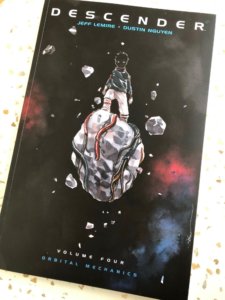
Vol. 4 DESCENDER
Day 4 and the 4th review. I’m tired as I write this because I had a full day and hosted 10 people at my house for a dinner party. They’re all gone now and the dishes are washed or are in the robot machine that cleans them (thank you, Kitchen Aid!)
So, here it goes…The DESCENDER saga continues, a ramping up of tensions across the Megacosm.
Slight spoilers if you haven’t read 1-3 yet. This volume confirms the PG-13 rating. There is a sexual encounter, not explicit, but emotionally portrayed/drawn by the artist. It’s not graphic in that there are no x-rated body parts on display, but still…it’s a sex scene. Some parents will want to view this before passing it onto their kids.
With that said, this sexual and emotional relationship doesn’t seem to be the main thing and doesn’t dominate the storyline from every angle, but it is one angle. The couple that gives into sexual desire has its relevance to the overall plot. I can’t say more without spoiling the story.
What continues in ORBITAL MECHANICS is character revelation while the battle lines become drawn.
Since I’ve written a couple of novels, I will say that the messy middle is the most difficult part of writing something of epic proportions. DESCENDER has the potential to be epic, so this volume works, yes, to pull us in and draw us deeper into caring about the characters and the outcome of the world in which they live.
Highlights for me emerged as curious plot turns took place. Not every turn surprised me, but many did. The story telling and the art are still fantastic. I know I will read to the end.
To purchase, click Volume 4 of DESCENDER
DESCENDER by Jeff Lemire and Dustin Nguyen, A Review of Volume 3, SINGULARITIES
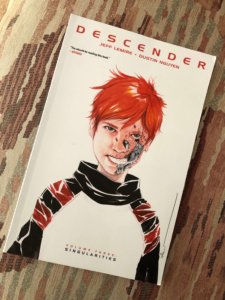
Tim-22, used, abused and almost scrapped
YES. Read on, you won’t be disappointed!
I continue this mad and highly pleasurable dash of reviewing 6 volumes in 6 days. Today is day 3, so I’m reviewing volume 3 of the DESCENDER series. No spoilers (unless you haven’t yet read volumes 1 and 2 yet…in which case there are tiny spoilers).
I’m going to have to call SINGULARITIES my favorite volume, so far. It’s filled almost completely with the backstories of all the important characters. If you’re like me, now that you’re hooked on these characters, you have the patience to read back into their histories and you’re going to love it! I also picked up volume 1 again to re-read the first few chapters.
Don’t you admire an author can draw you in with action and plot-driven narrative, when all the while, his/her real aim is to make you fall in love. I do. Kudos to Jeff Lemire for this original and expansive story world inhabited by not just humans, but aliens and robots as well, many of whom we are coming to love.
You will not be disappointed regarding the various bot characters. The backstory of Driller the Killer is included in this volume, as well as that of Tim-22, the sinister and perhaps, alter-ego of Tim-21. In the 19th century novel, Dr. Jekyll, Mr. Hyde, evil and gentleness exist in one human, split personalities. In DESCENDER, the two Tim A.I. characters take on the representations. This is a captivating and common archetype in countless narratives we love…think, Darth Vader/Luke, Voldemort/Harry Potter, Edmund/Lucy. Opposite and rival archetypes reflect human experience. We all know we are not pure good or pure evil, we’re somewhere in between, but understanding the extremes must help us in some way, otherwise, why do we crave these stories? Does it help us live a more balanced life and make choices for “good” or not?
I will draw a conclusion by the end of DESCENDER in regard to its moral relevance for the average scifi reader, but for now, I’m enjoying the ride. I hope you are too. Follow the links below to purchase.
DESCENDER, Volume 3 Singularities
DESCENDER, Volume 4 Orbital Mechanics
DESCENDER, Volume 5 Rise of the Robots
DESCENDER, Volume 6 The Machine War
DESCENDER by Jeff Lemire and Dustin Nguyen, A Review of Volume 2, MACHINE MOON

Cover Art DESCENDER, Volume 2, MACHINE MOON
Yes! Read this second volume and you might want to order the rest of the series now because if you’re like me, you’re pretty much hooked. This review of volume 2 will have a few spoilers if you haven’t already read volume 1.
MACHINE MOON did not disappoint. The stage is set, the key characters are on that stage (although I’m sure there will be a few new faces in coming volumes) and the heat is cranking up for an epic conflict. In volume 1, the reader is introduced to Tim-21, an A.I. of extraordinary talent, intelligence and empathy. Tim-21 was created by scientist, Dr. Jin Quon, as a companion for humans. The hero, depicted as a gentle-spirited little boy, wakes after 10 years of sleep. He had been companion to a human child and living with him as a brother on a remote mining colony. He wakes to find hundreds of corpses of human miners, dead now for 10 years, and two other robots, lesser A.I. models still active. Following Tim-21’s awakening, the Megacosm made up of nine planets, becomes aware of his presence. His particular intelligence chip is perceived as having brought about a disaster which has wiped out much of civilization. As a result, Tim-21 is targeted by a number of powerful factions who want to destroy him or use him to gain power. He has few human allies, though a couple seem to be emerging. Moreover, his relationship with robotkind turns complicated in this second volume. The reader roots for Tim-21 knowing he is a pawn for nearly every other character, which adds to the tension and the page-turning nature of the story.
I need to take this opportunity to comment further on the gorgeous art of Dustin Nguyen in this series. You too can actually hold this artwork in your hands and it is amazing, worthy of your hard-earned cash.


On Voyage
The colors are intense when the story requires it and muted at other times. For example, backstory and memory are mostly color-less. There are precise pen drawing-style features of characters, with water-color wash to add to the texture and the dreamy quality of the world.
To purchase this comic, click DESCENDER, Volume 2, you won’t regret it. The rest of the series is below.
DESCENDER, vol. 3 Singularities
DESCENDER, vol. 4 Orbital Mechanics
DESCENDER by Jeff Lemire and Dustin Nguyen, A Review of Volume 1, TIN STARS
 If you’re looking for an epic science fiction graphic novel and vibrant reading experience overall, the DESCENDER series is for you. I will be reviewing each volume, 6 in 6 days, without spoilers.
Here’s the review of VOLUME 1: TIN STARS
First, my pure recommendation…YES! You ought to read TIN STARS. Here’s why:
- The Story is Fantastic (and volume 1 is a great set up for more drama)
- The Art is to Die For
- The Characters Feel True and Interesting
- The World is Fantastically Drawn (in the art and in the narrative)
Jeff Lemire and Dustin Nguyen team up to create a beautiful and gripping story. Due to language and some graphic violence, I rate the novel overall PG-13.
If you hunger for A.I. and space and aliens of various types, shapes and forms, they all inhabit this place. Also, the graphic novel format feels like a window into the future. What the author does not describe in words, we see on the page, beautifully drawn and colored by Nguyen (what a talent!). The graphic novel genre lends itself well to the world of a future civilization, something beyond our imagination and fantastical. The author, Lemire, also knows how to build tension and keep his audience gripped and turning pages.
Speaking of turning pages, I found (after I had read the first volume) this handy reference page, called: Atlas of the Core Planets of the the United Galactic Council. The world imagined by Lemire is complex physically and politically. Each planet has a unique character, so I can see why the author saw the value in adding it.
This page was not present in volume 5, perhaps Lemire assumes we know the world by then, but it is at the end of 1-4. It’s helpful, especially if you’re the type who likes to know the world well before you read the story, flip to the back right away to orient yourself.
Don’t be surprised to see this series come to the screen sometime in the near future. When that happens, you can breathe on your fingertips, wipe them on your cuff and brag…Oh yes, I read the graphic novels, back in 2019.
To order your copy, click here: DESCENDER, Volume 1, Tin Stars
To order your copy of
BIRD BOX: A Review with a Couple of Spoilers
Watch and Enjoy. BIRD BOX is an Entertaining Film as Long as you Know that These Images and Themes Have Been Seen Before

BIRD BOX was produced by Netflix and released for public consumption on December, 21, 2018. According to Netflix data, 45 million people watched BIRD BOX in the week before Christmas.
For those who didn’t watch it over Christmas, like me, here’s the review…
This story is a Quiet Place, but without the husband (there is a stand-out dude…Tom, played by Trevante Rhodes…who becomes a stand-in husband and Father, but for a short portion of the film). The story portrays a mother, Sandra Bullock, as Malorie, who gives birth shortly after a catastrophic alien invasion? The film does not make this clear…Is it really aliens? At one point, there is a reference to North Korea and bio warfare…but one can be pretty sure it’s more along the alien invasion spectrum. Creatures are mentioned in one of the early scenes. Most eager scifi fans will swallow yet another apocalyptic scenario and accept the tragedy as instigated by something otherworldly that impacts every person, mostly in a negative way. (99% of the human race does not thrive under its influence…yes, that’s a spoiler of sorts, but then you probably knew this).
There is some challenge in writing a review of this film with zero spoilers, because the narrative is so familiar to so many of us, but I’ll try. 
Here’s the premise…After an alien invasion (I think) every person becomes infected with a psychosis. This is spread from person to person through what they see. What do they see? That remains a mystery, but the results can be seen and they are catastrophic. Those infected figure out ways to kill themselves. Society drifts into destruction. Those who survive either do so by covering their eyes or a few see and don’t kill themselves right away. However, they become crazy people who attempt to get everyone else infected. The aliens are never seen by the audience, though they are heard and they are drawn in charcoal on paper by one survivor (one of the crazies). The aliens appear (in his drawings) as demons or devils. It’s possible this is some kind of bio-tech warfare and the creatures/aliens are all imagined, part of the psychosis. The audience isn’t in the know on that one.
Sandra Bullock finds herself responsible for two children and needs to figure out a way to get them to safety and a place where they can thrive. For that to happen, she needs to float them down a river, blindfolded. The story opens with her getting on the boat after lecturing the two little ones on the dangers of the trip and the importance of never taking off the blindfold, but the real body of the film takes place in backstory.
BIRD BOX portrays what A Quiet Place never did…the immediate aftermath of a catastrophic alien invasion that jacks up humanity. In BIRD BOX, the audience sees the unraveling. In A Quiet Place the viewer needs to imagine that unraveling. However, in BIRD BOX, the audience needs to imagine the villain. In A Quiet Place, the audience gets a clear view, eventually, of the alien that is bent on destroying humanity and by the end, a possible way to defeat it. That “ending” note is missing from BIRD BOX. It does not deliver enough answers about the mystery. Does an unseen villain ruin this film? Not exactly, but if a sequel is ever made, I will expect answers.
Regarding the similarities between the two films…It did strike me right away that in BIRD BOX, covering eyes is important, while in A Quiet Place not speaking is essential…which begs the questions…is this a theme that our current audiences want to explore? What if we had to survive in a post apocalyptic world without our sight or without speaking? Maybe the post apocalyptic universe is too easy…or maybe too familiar? I suppose, the next film of this ilk will explore surviving without hearing, or how about without tasting. Apparently, the public hungers for the answers to these question. I suspect, the quandary has to do with our over-teched and over-connected reality, but maybe there is another yearning I don’t yet comprehend. Another similarity between the films is the prominence of a pregnant mom as a survivor during a horrid moment of human existence.
I will say, the film (free for Netflix users) BIRD BOX is an entertaining jaunt. If you can get past the unknowns that are never explained…watch it and enjoy the drama that can only unfold at the end of the world.
Spider-Man Into the Spider-Verse, A Guest Review

Hello audience of All Sci Fi! Welcome to the second guest post. My name is Abby Jensen and I am Susi Pritchett Jensen’s daughter. She raised me with a strong love of good stories and science fiction. I also am lucky enough to be one of the first test readers for many of her stories and her novel. I have been helping my mom set up this site for the past year and am very excited to write my first content for it!
No Spoilers Review:
 We have a longstanding tradition in our family of seeing a movie on my mom’s birthday because it’s so close to Christmas. This year she chose SPIDER-MAN: INTO THE SPIDER-VERSE. My brother and I had already seen it once, but it is definitely the kind of film you can go back to and enjoy more every time.
SPIDER-MAN: INTO THE SPIDER-VERSE is an action-packed, hilarious, and heartwarming story of family told from the perspective of Miles Morales, a Black/Latino middle school boy. Miles faces the standard coming-of-age problems of a mixed-race kid from gentrifying Brooklyn, along with a plethora of classic Spider-Man villains to save not just his universe, but the entire multiverse from collapse. It’s also rated PG and is accessible to kids as young as 7 or 8 (younger if they’re precocious.)
The writers deftly deal with multiple Spiderman comic universes, keeping them accurate, in-character, and interesting for both kids and adults. If you are a nerdy parent looking to introduce your kids to comic books, this film could be an excellent inroad. And even if you aren’t familiar with Marvel Comics, Spiderman, and especially Miles Morales as Spiderman, is incredibly relatable for people of all ages. After all, anyone can wear the mask, which Miles and the Spider gang (from the other universes) discover together. All they need is a persistent willingness to get back up after every hit.
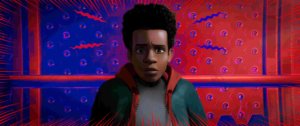 What impressed me more than the well-handled story, was the unique animation style. As a designer, I was dazzled by the ways the visuals connected to narrative elements in the film. High quality 3D computer animation has been around for long enough that it finally seems like studios are willing to experiment with the medium. For SPIDER-MAN: INTO THE SPIDER-VERSE, Sony uses animation to its full potential, creating a colorful comic-like universe for Miles. The textures and chaotic 3D effects connected with the disruptions of the multiverse evoke the unknowns of multiple dimensions in a way that is familiar enough that even kids will appreciate it.
3 Reasons You and Your Kids Should See SPIDER-MAN: INTO THE SPIDER-VERSE
- The message is inclusive and accessible to kids as young as 7 and as old as me (a 23-year-old kid.)
- The animation is beautiful and artistically adventurous, both of which add to the story.
- Miles Morales, a black/latino middle-school kid, brings one of the most relatable superheroes ever created to 21st century gen-z relevance.
COLONY for Educators: A Discussion of the Holocaust and Other Atrocities

showers as gas chambers
Rating: PG-13 or thereabouts. This series was made for television by USA Network. There are a couple of steamy sex scenes in season 1, but no explicit nudity. In the photo you see here, the nudity is not explicit and is also relevant to the story.
COLONY, particularly the first season, is a methodical and painful study of society fracturing under the strain of a foreign occupation. The occupiers happen to be a technologically advanced alien invasion force, but for whatever reason (this is not fully explained in the first season of COLONY), those aliens have decided to rule through human governors.
The first season of this series portrays how human survivors figure out ways to continue life following a traumatic takeover of the globe. Writers, Carlton Cuse and Ryan J. Condal, draw in the audience and give their viewers a window into the psychology of the various groups of people as they cope. (Note: regarding the writers, I have tried to give credit to writers who are on the team. It’s important for students, in particular, to know that television often utilizes teams of writers to keep the story going and flowing. Those writers will get credit for their episodes. They are named below, episode by episode.)
For youths studying the Holocaust and other historic occupations, like the Belgians in The Congo, The USSR across Russia and Eastern Europe and the Roman Empire across much of the ancient world, just to name a few, the opportunities for discussion come with each episode.
To order the first season dvds, click here.
Cuse, Condal and the rest of their writing team don’t shy away from giving a few more obvious discussion starters, like the gas chamber scene in episode 2. It’s horrific and frightening as it should be, but what should be just as frightening is seeing weak and fearful human beings turn so quickly against one another. Watching COLONY has the potential to draw out more reflection in those who might be bored by a history they think they understand in full. Most youth (and to be fair, most adults) do not comprehend what it was really like to live in Nazi occupied Holland for example, where some courageous citizens hid Jews and/or helped them escape. Everyday people performed heroically even though their actions endangered their lives. Their families also assumed huge costs. I know of one family that sent their youngest children away, out of the city, to protect them from any retribution that might come if they were discovered. Those children were raised by relatives, their family life shattered not just by the occupiers, but because of the choices their parents had made to do what they understood as right and just. This family also had to kill a neighbor who was about to turn them into the authorities.
We all like to think we would be heroes, but what would it really feel like to pay the costs and resist an occupying power? COLONY gets under the skin and forces the viewer to think about these questions.
Here are a few potent questions that emerge out of COLONY…episode by episode…to get the discussion juices flowing. (Warning: spoilers written in this next section)
Episode 1…Pilot written by Carlton Cuse and Ryan J. Condal. This episode juxtaposes Katie with Will. Will Bowman, after a failed attempt to find his son, decides to collaborate with The Transitional Authority. What convinces Will to work alongside the collaborators? What lengths would you go to in terms of collaborating with the occupiers, if you or your family were directly threatened? Katie decides to go a different route, which will involve her spying on her husband. What do you think of her choice?
Episode 2…Written by Wes Tooke. Being sent to The Factory has been mentioned a few times. This episode culminates with the gas chamber scene. How do the occupiers use fear to ensure order? How does fear impact normal citizens in the LA bloc? Do you fear people in power in our society? Who? How does that impact you?
Episode 3…Written by Daniel C. Connolly. In this episode, Katie takes part in the hijacking of a supply truck, in which civilian and Resistance lives are sacrificed to determine drone response times. Do you think the Resistance has a right to sacrifice these lives for the greater good? Why or why not?
Episode 4…Written by Anna Fishko & Dre Alvarez. In this episode Broussard, a key friend to Katie and Resistance member, executes Phyllis (one of the heads of Homeland Security) and her bedridden husband. They do this to send a message to Homeland Security and to the Transitional Authority. Strange sacrifices are made by those living under occupation. Why do you think Phyllis pleads for Broussard to shoot her husband when she knows she is about to die? What does that say about the living standards under the occupation, even for those who are most elite?
Episode 5…Written by Carlton Cuse. Watch the interrogation scene that starts around minute 15. Does the Transitional Authority understand who is on its team and who is rebelling? If you were living in this world, would you resist and if so, how?
Episode 6…Written by Ryan J. Condal. More and more, Will is disillusioned with the Transitional Authority as Katie is with the Resistance. In COLONY, what is portrayed is a broken system on either end of the spectrum. There are good people trying to make sense of the world who are collaborators. There are bad people, trying to overturn the system within the Resistance. The world is complex and it forces choices on human actors at every turn. What do you think would be the most difficult choice for you if an occupier took over your city/state/country and why would that be the most difficult choice?
Episode 7…Written by Sal Calleros. An insidious character, introduced a few episodes before, is the Bowman’s personal tutor, Lindsey. Lindsey is a true believer in the occupation. She understands the coming of the aliens as an answer to a prophesy, associated with a religion promulgated by the alien invaders and the collaborators. Why do you think Lindsey believes and why does she try to convert the Bowman’s daughter, Gracie, into this belief system?
Episode 8…Written by Wes Tooke. Betrayal at the top of the Resistance. The episode drives home the truth that in an occupation, even the rebels have a messy house. Those who collaborate with the occupiers and those who resist must watch their backs. Information becomes a commodity for both sides. How do you respond to the betrayal of trust by Quayle? If you were to have a conversation with him before his betrayal, how would you try to convince him to remain true to the Resistance?
Episode 9…Written by Ryan J. Condal. Loyalty is a confusing maze in the case of the occupation What do you value? Who is most important to you and what would it take for you to betray that person? At the first anniversary of the alien invasion, those who remember it are persecuted, those who rebel are at risk by one of their own and those who collaborate understand that their positions of power are always in question. In a situation such as this, who does one trust? Who would you trust?
Episode 10…Written by Carlton Cuse & Ryan J. Condal & Wes Tooke. One might get lucky…friendship and loyalty might make a difference…In the case of Will Bowman and his relationship with the collaborator, Snyder, this might be the case. In the case of Will and his relationship with Jennifer (the Homeland head) will friendship make a difference? In the case of Katie and Broussard, how will it all shake out? There are many questions emerging in this season finale. Katie and Will epitomize the conflict regarding loyalty. Both want the same thing…the recovery of their son, Charlie, but they take different tacts. Does their loyalty hold when everything is on the line? What does loyalty mean to you? Is there someone in your life you would be loyal to even if it meant you might die for that loyalty?
A QUIET PLACE, Film Review with a Slight Spoiler
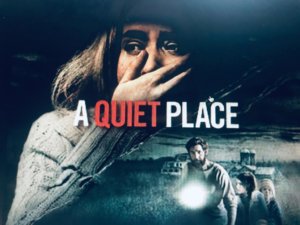 Science fiction pops up in the darndest places, some of those places are quiet places. Okay, okay…so that’s a bit of a spoiler, but why the heck did it take me so long to hear from someone/anyone that this film was about people surviving an alien invasion. I think some of why is because of the code of mystery that surrounded this film when it came out. Everyone seemed reluctant to tell…
I assumed A QUIET PLACE was horror/suspense. Most of the trailers indicated that this was so. I did not get the chance to see this film in the theater, but I might have tried a lot harder had I known about the scifi underpinnings. At some point, both my kids saw the film and told me with a wink and a nod that I should definitely view it. “It’s really good,” they said, “and not gory like a horror flick.”
That comment from them made me think it was for sure a horror flick, a well done horror flick, but still, horror all the way.
So…I didn’t get it. In fact, I might have missed the film altogether had it not been for a friend spilling the beans recently.
“You’ve seen A QUIET PLACE, haven’t you? There are aliens in this film.”
Okay, so now I know and now you know and it’s not a huge spoiler. The first view of the alien comes by the end of the beginning sequence, about 7 minutes into the film.
However, this story is not alien-centric. It’s family-centric in a really great way. The premise of an alien who hears its prey and only then comes to destroy, but leaves survivors alone if they are silent, now that is a fun and new angle on the alien invasion story.
Five reasons I recommend A QUIET PLACE, directed by the lead actor, John Krasinski
- Superior storytelling, lots of tension and heart. The idea of watching a silent film has been lost to the modern audience. In this creepy portrayal, there are powerful swaths of storytelling in which the visual completely dominates the viewing experience. That feels new and vibrant, in part because the visual story telling in A QUIET PLACE is well done.
- The family unit (not one individual) is the protagonist and each of the members are smartly drawn. A deaf character adds depth to the unfolding drama. We root for all of them. (Dad played by John Krasinski. Mom played by Emily Blunt. Daughter played by Millicent Simmonds, a deaf actress.)
- Powerful and brutal villain(s). Ugly too.
- Inspiring examples of the will to survive and the costs we incur, AKA the suffering we endure, to love one another.
- Juxtaposition of idyllic scenery/cinematography and the unknown, the mystery of that which is not seen, the horror that is waiting to besiege.
The story unfolds in a post-alien invasion rural US (the locale is possibly somewhere East of the Mississippi, maybe Vermont). The aliens, rarely present, including their spaceships are not seen in the film, have come to Earth and have destroyed all living creatures who make noise (even animals that sniff about and snarl). It seems the aliens have no visual acuity, but can hear from very very far away and once they hear, they come to kill almost immediately. Those who survive the invasion are attempting a life in silence, including the protagonist family. The audience meets them initially as they tiptoe through a drug store (they are all barefoot) and scavenge for medicine and goods. The audience deduces, this is one town of millions of towns and this is one family among thousands of surviving groups? One other survivor is seen in the film…Let’s just say, he doesn’t last long.

Imagine your family trying not to make any noise. Imagine trying to communicate, trying to thrive without vocalizing. Imagine feeling pain without crying and playing monopoly without table chatter. Imagine that your life depended on staying silent. Herein lies the tension of the film. Also, there are discoveries to be made about the villain and how to defeat it/them. Might something be unearthed by our protagonists? Perhaps, but at what cost? You’ll have to watch the film to find out. $5.99 to rent on iTunes.
THE EXPANSE, No Spoiler Guest Review

John Mayberry
I am excited about this post, a first guest post for allscifiallthetime.com, written by a PhD and a math nerd at that…
It is my pleasure to introduce fellow SciFi fan, Dr. John Mayberry, an Associate Professor of Mathematics at the University of the Pacific in Stockton, CA. Dr. Mayberry teaches a wide range of courses in applied math and statistics. He first became interested in science fiction and fantasy after reading Susan Cooper’s the Dark is Rising in fifth grade and found it such a welcome and imaginative escape from the real world that he has been hooked on the genre ever since. He is married with three kids and has enjoyed sharing this love with them through bedtime stories and weekend movie nights.
Here is Dr. Mayberry’s review of THE EXPANSE:
The Expanse made the news last year after its cancellation on the SyFy channel led to massive protests and rallies from fans who wanted more. Their pleas were so convincing that Amazon picked up the show, released it on Prime, and started work on Season 4. Comparisons between the Expanse and Firefly, one of my personal all-time favorite space operas, coupled with its newfound accessibility to us non-cable folks encouraged me to give it a shot. I was not disappointed. In fact, after watching all three currently available seasons in just a few weeks (no small feat for a parent of three little ones), I believe that The Expanse has surpassed Firefly and even (dare I say it?) Battlestar Galactica in the pantheon of epic SyFy channel originals.
The Expanse takes place three hundred years from now in a future where humankind has populated the far reaches of our solar system, thanks to a series of technological breakthroughs in “high-g” space travel. The United Nations controls Earth and “Luna” while Mars is under the governance of an independent military coalition. The outer reaches of the system (referred to as “the Belt”) consists of a series of asteroids and space stations operating on artificial spin gravity. The Earth and Mars depend on the Belt for resources while “Belters” are treated as second-class citizens by the “inners”. Season 1 centers around three distinct storylines that respectively follow a cop in one of the largest belt stations, the crew of a deep space ice freighter, and a high-ranking Earth diplomat as they independently discover evidence of an unfathomable plot to destroy the solar system’s fragile peace. It turns out to run so much deeper than any of them could have possibly imagined.
The show accelerates you into a “high-g burn” from the start of episode one and never really lays off the juice thereafter. BSG, for all its glorious moments, suffered from some pretty lame episodes and character inconsistencies (like Lee’s sudden “you never let me fulfill my dream of being a lawyer, dad” moment), but no episode of The Expanse is wasted on such side plots and trivialities. Everything builds towards major epiphanies that aren’t dragged out indefinitely (like in Lost), but instead brought to fruition within the scope of seasons or even half seasons and then turn into bigger questions and realizations which keep you coming back for more. In fact, at the end of Season 3, my wife and I felt like the whole first three seasons, for all they accomplished, played like a prologue leading up to an even greater space adventure in the seasons to follow.

Underlying the compelling storyline is a charismatic and well-cast group of actors whose chemistry on screen is reminiscent of the Firefly cast at times. The Tarantino-esque convergent storylines woven throughout the show merge in extremely satisfying fashion throughout the series. New characters are introduced with purpose and have important roles to play in driving the overarching plot towards its objectives. Even for sci-fi skeptics (like my wife), the characters and political backdrop of the Earth-Mars-Belter coalition will draw you in and force you to imagine what the future could be like…and whether it is the future we want to build towards or not.
ARRIVAL, Film Review Without Spoilers
 I recently watched ARRIVAL for a second time through Amazon Prime. In my first viewing, I was in a theater and I loved it. This second go-around, I was not disappointed. I watched with a group of my cousins who are all film/scifi nuts. The viewing was free for Prime members.
ARRIVAL is rated PG 13…it’s somewhat creepy and suspenseful, but a middle school child or a sensitive viewer could probably handle the production. I’m not sure why it did not receive the PG rating. It unfolds without graphic violence and there is no explicit sexual content. One might call ARRIVAL a quiet film, but the subject matter takes it from the quiet realm into the epic and deeply thoughtful.
ARRIVAL was released in theaters to much acclaim in 2016. The film is based on a short story by Ted Chiang. Eric Heisserer wrote the screenplay. I hope to read and review Chiang’s short story in a future post.
The film unfolds with slow intensity primarily around one character, Louise Banks, played wonderfully by Amy Adams. Banks is a linguist recruited by the US government to learn the language spoken by aliens who have alighted in giant oblong space ships in twelve locations around the globe.
The story is a linguist’s dream and as a science fiction fan, I recall a number of novels that view first contact in light of language and communication. China Miéville’s Embassy Town is a good example. In a story such as this, violence is often threatened, but not center stage. Mysteries and the push to understand the other dominate the narrative.
Five quotes from the screenplay to pique your interest:
- “If this is some sort of peaceful first contact, why send twelve? Why not just send one?”
- “Language is the first weapon drawn in a conflict…”
- “Are they scientists or tourists? If they’re scientist, they don’t seem to ask a lot of questions…”
- “If you could see your life from start to finish, would you change things?”
- “Meeting you…was more important that seeing the stars…”
Five reasons to watch this film.

- It’s free if you’re an Amazon Prime member.
- If your family is into science fiction, ARRIVAL is a crowd pleaser which you can show to your kids with a clear conscience.
- Lots to ponder about language and linguistics, language and meaning, the puzzle and the importance of communication.
- Female hero with lots of brains and only a few characters to keep track of.
- Potentially leads to fruitful discussion about love, suffering, beauty, grace, even religion.
To buy this DVD, click here.