Posts Tagged ‘sci fi’
DESCENDER by Jeff Lemire and Dustin Nguyen, A Review of Volume 3, SINGULARITIES
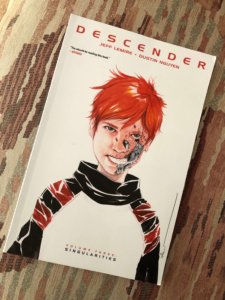
Tim-22, used, abused and almost scrapped
YES. Read on, you won’t be disappointed!
I continue this mad and highly pleasurable dash of reviewing 6 volumes in 6 days. Today is day 3, so I’m reviewing volume 3 of the DESCENDER series. No spoilers (unless you haven’t yet read volumes 1 and 2 yet…in which case there are tiny spoilers).
I’m going to have to call SINGULARITIES my favorite volume, so far. It’s filled almost completely with the backstories of all the important characters. If you’re like me, now that you’re hooked on these characters, you have the patience to read back into their histories and you’re going to love it! I also picked up volume 1 again to re-read the first few chapters.
Don’t you admire an author can draw you in with action and plot-driven narrative, when all the while, his/her real aim is to make you fall in love. I do. Kudos to Jeff Lemire for this original and expansive story world inhabited by not just humans, but aliens and robots as well, many of whom we are coming to love.
You will not be disappointed regarding the various bot characters. The backstory of Driller the Killer is included in this volume, as well as that of Tim-22, the sinister and perhaps, alter-ego of Tim-21. In the 19th century novel, Dr. Jekyll, Mr. Hyde, evil and gentleness exist in one human, split personalities. In DESCENDER, the two Tim A.I. characters take on the representations. This is a captivating and common archetype in countless narratives we love…think, Darth Vader/Luke, Voldemort/Harry Potter, Edmund/Lucy. Opposite and rival archetypes reflect human experience. We all know we are not pure good or pure evil, we’re somewhere in between, but understanding the extremes must help us in some way, otherwise, why do we crave these stories? Does it help us live a more balanced life and make choices for “good” or not?
I will draw a conclusion by the end of DESCENDER in regard to its moral relevance for the average scifi reader, but for now, I’m enjoying the ride. I hope you are too. Follow the links below to purchase.
DESCENDER, Volume 3 Singularities
DESCENDER, Volume 4 Orbital Mechanics
DESCENDER, Volume 5 Rise of the Robots
DESCENDER, Volume 6 The Machine War
DESCENDER by Jeff Lemire and Dustin Nguyen, A Review of Volume 2, MACHINE MOON

Cover Art DESCENDER, Volume 2, MACHINE MOON
Yes! Read this second volume and you might want to order the rest of the series now because if you’re like me, you’re pretty much hooked. This review of volume 2 will have a few spoilers if you haven’t already read volume 1.
MACHINE MOON did not disappoint. The stage is set, the key characters are on that stage (although I’m sure there will be a few new faces in coming volumes) and the heat is cranking up for an epic conflict. In volume 1, the reader is introduced to Tim-21, an A.I. of extraordinary talent, intelligence and empathy. Tim-21 was created by scientist, Dr. Jin Quon, as a companion for humans. The hero, depicted as a gentle-spirited little boy, wakes after 10 years of sleep. He had been companion to a human child and living with him as a brother on a remote mining colony. He wakes to find hundreds of corpses of human miners, dead now for 10 years, and two other robots, lesser A.I. models still active. Following Tim-21’s awakening, the Megacosm made up of nine planets, becomes aware of his presence. His particular intelligence chip is perceived as having brought about a disaster which has wiped out much of civilization. As a result, Tim-21 is targeted by a number of powerful factions who want to destroy him or use him to gain power. He has few human allies, though a couple seem to be emerging. Moreover, his relationship with robotkind turns complicated in this second volume. The reader roots for Tim-21 knowing he is a pawn for nearly every other character, which adds to the tension and the page-turning nature of the story.
I need to take this opportunity to comment further on the gorgeous art of Dustin Nguyen in this series. You too can actually hold this artwork in your hands and it is amazing, worthy of your hard-earned cash.


On Voyage
The colors are intense when the story requires it and muted at other times. For example, backstory and memory are mostly color-less. There are precise pen drawing-style features of characters, with water-color wash to add to the texture and the dreamy quality of the world.
To purchase this comic, click DESCENDER, Volume 2, you won’t regret it. The rest of the series is below.
DESCENDER, vol. 3 Singularities
DESCENDER, vol. 4 Orbital Mechanics
DESCENDER by Jeff Lemire and Dustin Nguyen, A Review of Volume 1, TIN STARS
 If you’re looking for an epic science fiction graphic novel and vibrant reading experience overall, the DESCENDER series is for you. I will be reviewing each volume, 6 in 6 days, without spoilers.
Here’s the review of VOLUME 1: TIN STARS
First, my pure recommendation…YES! You ought to read TIN STARS. Here’s why:
- The Story is Fantastic (and volume 1 is a great set up for more drama)
- The Art is to Die For
- The Characters Feel True and Interesting
- The World is Fantastically Drawn (in the art and in the narrative)
Jeff Lemire and Dustin Nguyen team up to create a beautiful and gripping story. Due to language and some graphic violence, I rate the novel overall PG-13.
If you hunger for A.I. and space and aliens of various types, shapes and forms, they all inhabit this place. Also, the graphic novel format feels like a window into the future. What the author does not describe in words, we see on the page, beautifully drawn and colored by Nguyen (what a talent!). The graphic novel genre lends itself well to the world of a future civilization, something beyond our imagination and fantastical. The author, Lemire, also knows how to build tension and keep his audience gripped and turning pages.
Speaking of turning pages, I found (after I had read the first volume) this handy reference page, called: Atlas of the Core Planets of the the United Galactic Council. The world imagined by Lemire is complex physically and politically. Each planet has a unique character, so I can see why the author saw the value in adding it.
This page was not present in volume 5, perhaps Lemire assumes we know the world by then, but it is at the end of 1-4. It’s helpful, especially if you’re the type who likes to know the world well before you read the story, flip to the back right away to orient yourself.
Don’t be surprised to see this series come to the screen sometime in the near future. When that happens, you can breathe on your fingertips, wipe them on your cuff and brag…Oh yes, I read the graphic novels, back in 2019.
To order your copy, click here: DESCENDER, Volume 1, Tin Stars
To order your copy of
KNOW THY ROBOT, Original Fiction
Leti unlatched the feeder from its holder and squeezed a few drops of tea between her lips. Coffee was not going to help, not when her stomach was churning like Jupiter’s poles.
Christian hovered at the viz, monitoring the debris field from which they had just emerged. “I believe we’re through the worst of it, Leti.” He settled into his seat and strapped in.
“You think?” she said.
“Yes, Leti.” He answered confidently, a confidence she did not trust.
For eleven hours, she had steered the Artemis through a shitload of space junk, losing a portion of the landing gear, an escape pod and one and a half blasters. Essentially, she and her two crew members were limping through space, totally defenseless. It brought Leti no comfort that the Sino-Nihon, her main competition, would likely beat her to the drill site.
“God, I miss my porcelain mug.” She squeezed up another mouthful of tea, moving the lukewarm liquid along the seam of the pouch, pushing the dab between her lips. “Fucking space. I’m so pissed off right now.”
“You are sleep deprived,” Christian said.
“My brain’s not firing on all cylinders, that’s for sure.”
“That’s a funny saying,” Christian said.
The expression was her grandfather’s, who in his youth had worked on all things automobile. He was a mechanic, one of the last of a breed of humans on Earth put out of business by robots. He switched to fixing bots by the end of his life. He was lucky to have been clever enough to understand the complex machinery operating in the earliest AI.
“We could not have anticipated this anomaly.” Christian had read something into her silence. Now he was trying to reassure her, yet not invalidate her feelings. He was programmed to be an encourager and a diffuser of tension, which on occasion, left Leti feeling massively grumpy.
She punched the empty feeder pouch into the trash chute and slammed on the blue button, the one that sent all of her waste and hers alone, since Christian didn’t create any waste, into the compression tank. She snarled at her co-pilot. “We mastered this scenario in our training. What happened to us is inexcusable.”
“That’s not true, Leti. Unknowns can be found in all corners of the cosmos. We may have mastered the training scenario, but we are not masters of the universe.”
She let out a coarse laugh. “You made a joke, Christian. Do you know who the Masters of the Universe are?”
“No, Leti. I do not.”
“Search the net. I think you’ll be pleased,” she said.
“Fair enough, but I won’t embark on such a search until you deem us safe,” he said.
Leti glanced over the readouts. “I deem us safe for now, as safe as we can be under the circumstances.”
Christian waved her over. “There’s one more thing. Can you come here?” He pointed at the viz, tapping the screen lightly. “You can see it for yourself, Leti. Come here, Leti. Leti, come here.”
And now she wanted to smack him. Who was the corporate numbskull who had programmed in such redundancies? Come here, Leti. Leti, come here. What the hell? Recognizing she was in a horrid mood, she closed her eyes for a moment, unbuckled herself and moved in behind him.
He was still tapping the screen. “The debris. I think it is all rock, probably a small body.”
Leti squinted at the tiny blobs on the screen. “By small body, you mean small bodies.”
“I mean it started out as one small body. I am working out a theory on why it became a debris field. This debris field was not on any of our maps.”
“Well…I sure can’t tell if it’s all rock…How the hell can you?”
Christian gave a slight lift and tilt to his head to look back at her. He blinked once. A deliberate and programmed blink. “It’s a guess, but as we were passing through, I took the opportunity to scoop up a few fragments with our research net. I will analyze what we collected, after which we might be able to determine their origin. In the meantime, you should get some sleep, boss. You know what they say, early to bed, early to rise, makes a woman healthy, wealthy…”
“…and wise, I know,” she said. Christian was a collector of old timey sayings. “Is the Sino-Nihon still on the radar?”
He flicked across the screen to the radar readout. “It appears as though they’re descending.”
“So they’re gonna beat us. If that’s the case, I might as well rest before we go any further.”
She pulled off her magnetized boots and strapped herself into her bunk.
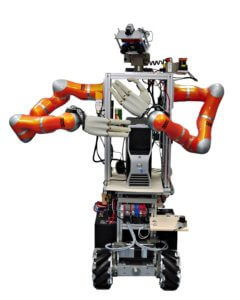
Four hours later, Ty woke her. Ty, Artemis’ third crew member, was her personal assistant and a different breed of AI than Christian. He existed in an aluminum cylinder and rode around on four magnetized wheels. Ty performed most of his duties with mechanical arms and though his body was the carapace of a bot from an earlier era, his intelligence chip had been upgraded for the trip to Titan.
“You are due at the bridge in approximately five minutes,” he said. Ty’s programmer had given him a low male voice, weirdly sexy.
As Ty readied her boots, she pushed off the bunk and glided to the sink, knuckling her eye sockets as she drifted. Eye irritation was the rule in space, mostly due to the lack of moisture. Sleep deprivation always made it worse.
She squirted a bubble of recycled water into her wash cloth and rubbed it over her face. Glazed anew by micro gravity water, she reached under the sink. She knew where her pouch of Scotch was by feel. She squeezed out a shot and swallowed it down. The throat burn jolted her awake.
“Did Christian find anything interesting?” she asked Ty as he helped her dress.
“There was metal wreckage in the debris he collected, along with rock.”
“Weird.” she said.
“Indeed, Ty said.
“What was the name of the unmanned ship that crashed on Titan last year?”
“Two years ago, Santa Maria, the Vatican’s unmanned space vessel disappeared into Titan’s atmosphere. We don’t know if it truly crashed. Six months ago, Freya, the Nordic research vessel exploded somewhere above Titan. Two humans and one AI were lost.”
“The metal could be pieces of the Freya. Has Christian done a full analysis yet?”
“Christian maintains a working theory on the metal in the debris field,” Ty said.
“Give me the synopsis.”
“Based on the velocity of the debris as it hit us, Christian suspects the Sino-Nihon might have intentionally blasted apart a small body of some sort.”
“And not warned us?”
“That is correct,” Ty said.
“Then rock would have made up the debris. What about the metal?”
“Perhaps, the Sino-Nihon was damaged in the process.”
Leti whistled through her still-wet lips. “Crazy theory…Strike it from the log until we verify.”
“I will strike it from the log,” Ty said.
Leti pulled her Snow Mantra parka out of the hatch. She had lowered the internal temps to save fuel.
“Call coming in,” Christian said as she entered the bridge.
“From where? The mining company?” She trudged toward her seat.
“From Earth, your hometown. It’s your ex-husband.”
“Great,” she said, adding a little moan to her complaint. Strapping herself into her pilot’s chair, she zipped up her parka until the metal pull was floating under her chin.
“I’m about to connect. You want visual?” Christian said.
“Not really.” Leti ran her fingers through her greasy hair and used her sleeve to scrape some of the water off her cheeks. She waited for Blake’s face to appear and lifted her hand in greeting as he came into focus.
“Can you hear me?” she asked. “Can you see me?”
“Yeah,” he said.
Blake’s new wife was toiling in the background, cooking something over the stove. She wore a pink robe. So domestic, Leti could almost smell the coffee.
“How’s Tommy?” she asked, then remembered her manners. “How are you and Bing?”
“We’re fine. He’s fine. Trying to figure out a few things for the summer. Tommy wants to go to that soccer camp I told you about, so we need an extra six thousand.” He wasn’t really looking into the camera. In fact, it appeared as though he was reading something on the table.
Asking for money, hurried communication and lack of eye contact. What an asshole.
“What are you reading or watching?” she asked.
“What?” he said.
“You’re not looking at me. You’re multitasking. Am I right?”
He scratched above his left ear and forced his eyes on her. “It’s business, Leti…the business of parenting our child. I didn’t call to be social.”
“I’m going to differ with your opinion here. Even though I’m a billion kilometers from Earth, I still have feelings…not to mention, I’m sacrificing for the Americas.”
Blake laughed. He had a beautiful, sonorous laugh. Bing approached the computer behind him and flicked him on the cheek playfully, after which her youthful face took over the screen. “She’s right, Blake. Hi, Leticia,” she said, “How is it going up there?”
“Hi, Bing.” Leti allowed herself a smirk. “You hear that? Even your wife is nice to me.”
Bing exited the frame, waving as she went.
“Okay, okay…So HOW ARE YOU?” Blake said, and though his heart clearly wasn’t in it, she decided to unload on him anyway.
“I’m a mess. This mission sucks. Christian and I almost wrecked the ship a few hours ago and the mining contract has just been forfeited.”
“Wow. I’m sorry. How is Christian doing? It sounds like you’re not happy.”
“Christian…he’s fine. Always upbeat, perfect in every way, an ideal partner.”
“Okay…Well…Will you think about the soccer camp because I have to get to work soon.”
“Yeah, yeah…I’ll transfer the money. Is Tommy there? Can he talk?”
“In the shower,” Blake said.
“Avoiding me?”
“What do you think?”
Leti said nothing, so Blake filled in the silence. “It’s a bummer about your issues up there. It’s dangerous, I know, but you’re a great pilot. I’m sure you’ll figure things out.”
“I don’t know shit out here. I make it up as I go.” She threw up her hands. “We almost died.”
Blake glanced left. He was disinterested or protecting himself from making an emotional connection. “I don’t know what to say, Leti. You love space. You chose this career.”
She snorted. “Well, one of us needed to make money for things like expensive soccer camps.”
And oh, Blake was focused on her now, glaring and hating on every inch of her semi-gloss face. “So. That’s great, yeah…awesome. I’ll monitor whether your money comes through. God bless the Americas, the corporation and all that shit.” He did not log out, but his face disappeared from the screen.
Leti planted her cheeks into her palms. So who’s the real asshole?
She heard Bing’s voice. “Leticia. Are you still there? Tommy’s out of the shower. I think he wants to talk to you.”
Leti lifted her face as she heard her son’s greeting.
“Hey, Mom.” He was wiping his spiky hair with a towel, seeming way too mature for fourteen.
Leti sprang into cheerful mode. “Hi-ya, Tom Tom. Is that you?”
“Um…yeah…”
“You’re not looking like that freshman I left behind. You sure you’re the same person?”
Tommy chuckled, pleased with her observation. “So, how’s it going out there?” he asked.
“Not like I planned, but I think the job will get done, one way or the other. On the up side, if I complete this contract, I’ll be set. No more long trips away.” She blinked a few times, trying to conjure some moisture. “Anything you want to tell me?” she said. “I’ll probably need to get going soon.”
“Dad told you about the soccer camp? The Canadian one?”
“Canadian,” she said. “Okay. That’s why it’s expensive. Anyway, yeah, he told me. It sounds good to me. You have some friends going with?”
“Jordan and maybe Edgar.”
“How’s Español?” she asked. She had seen his mid-year report card earlier in the week.
“Not like I planned, but I think the job will get done, one way or the other.”
She laughed and shook a parental finger at the screen. “That’s an A+ for snarky humor, but don’t fail that class. Save yourself the agony of repeating.”
“I know,” he said. “Hey, you’re sort of breaking up.”
“Ok. We’ll talk soon. Only 9 months and 26 days, and when I come back, no more trips, I promise! Can’t wait. Love you.”
“Okay. Bye. Love you too.”
The screen went dark. She was shivering.
“Christian. Can we bump up the temps? One degree.”
“No problem, Leti,” Christian said.
“Ty,” she said. “I think I need some of those eye drops?”
The robot motored to the first aid kit and pulled out a tubular bottle. She tipped her head back and prepared for the application.
He placed a suction cup attached to the bottle over her socket. She opened her eyes wide.
“Ty…Am I a bad person?” she asked. There was no way to read Ty. His camera lens, its black glass-like bulb, revealed nada.
“You do your duty,” he said.
He shot three or four drops into her right eye and waited to make sure the liquid had entered.
As he removed the suction cup, Leti pressed against her eyelid. “So I am dutiful, but does that make me a good person?” She rubbed the lid.
“You would do well to avoid rubbing like that,” Ty said.
“I know.” She opened her eyes for the second application.
“It makes you good by machine standards.” Ty shot the drops into her left eye.
She blinked repeatedly to incorporate her eye juices with the medicine. The coolness was soothing. She did not rub her lid this time.
“Thank you,” she said.
“Doing my duty is a great pleasure.”
Ty was the perfect slave.
Christian’s report, that some of the metal fragments were in fact off of the Sino-Nihon, were next on the agenda.
“I find it difficult to imagine the crew of the Sino-Nihon blasting away at a piece of rock to slow us down. They would not do something so dangerous and unethical. You’re talking about attempted murder.”
The group for which her competitors worked maintained a stellar reputation in the solar system. They were known to be aggressive in business, but not reckless. Not destructive. Five years before, Leti had considered accepting a job to fly for the Asian Space Cooperative, but South American Mining had wanted her badly enough to double their offer. Her choice to pilot for SAM was all about money. She did not consider the Sino-Nihon her enemy.
“So you are ruling out sabotage?” Christian said.
“I HAVE ruled out sabotage,” she answered. “Put it in the log.”
Leti and Christian flew their semi-disabled ship around Titan, as far away from Saturn as possible. Leti used the moon’s gravitational pull to draw lower toward the massive ice-rock, thus saving fuel. After a few hours, she needed to unbuckle and relieve herself. Ty assisted her, but even with his help, the process always took a while. Christian stayed at the viz and monitored their trajectory.
Before Leti had a chance to resettle, Christian reported, “We lost radar contact with the Sino-Nihon about seven minutes ago.”
“They’re probably way under the haze or on the other side of the moon,” she said.
“Should we look for them?” With a tilt to his head and lifting of the eyebrows, Christian wore his best question mark face and blinked twice. Another adaptation? Christian never blinked twice like that. Maybe he was taking cues from her.
Regardless, the question was genuine and she needed to take it seriously. To spend energy and time looking for the Sino-Nihon would be off-script and frowned upon by her superiors, but space law demanded it. Any space vessel had to be ready to abort mission if it meant saving lives. Few pilots had to be convinced of this international norm.
“We don’t know where they are, but we can scan for them as we approach the drill site,” she said.
Titan’s faint gravitational pull anchored them poetically in a yellow-orange methane haze. The colors here were view-worthy, absolutely, but Leti was focused on Titan. Titan, the moon of promise, that which was about to become the prize of Earth’s corporate giants. Rare minerals and methane, and other necessary elements for robot technology were assumed to be hiding under its frozen shell. She brought the ship through the haze and into a closer orbit. Christian had been working for 20 hours straight, so Leti sent him to recharge.
She tugged the hood of her parka forward, still shivering. She turned up the heat another degree.
Ty commented. “Was it your wish to turn up the heat, Leti?”
“Yes, Ty. I turned up the heat,” she said.
“I will recalibrate our fuel needs,” he said.
Leti brought the Artemis around, circling the area where the Sino-Nihon had gone off grid. Visibility was next to impossible, but on her third pass, she spotted the vessel, buried nose first at the edge of the Kraken Mare. The wreckage was difficult to see because of the low lighting of the crashed ship. Low lighting meant there would be very little power for life support. It was a bad sign. Not that a crashed ship in deep space could ever be interpreted as anything but catastrophic. There were always challenges and unknowns associated with space travel, but one could usually count on precision engineering to figure a way through a disaster. The wreckage of the Sino-Nihon indicated that something both very bad and unexpected had taken place.
Leti contemplated her next moves. For her to fly in closer, she needed Christian’s help. Reviving him would be no easy task given that he had not recharged to full power, but moving quickly was crucial in case any of the crew had managed to survive.
She marched across to Christian and unplugged him from the recharge dock. She returned, carrying him to his seat. She buckled him in then gently tapped his cheeks with the pads of her fingers. The scenario reminded her of pulling her adolescent son out of bed. Christian, like Tommy, woke up slowly, reluctantly.
Christian’s software eventually buzzed to life and began pairing with the ship, alignment taking place within his spinal tube, from tailbone up. He moaned and nodded, in and out of consciousness though that comparison was not quite accurate. After about five minutes, he emerged from the fog as his cheerful self.
With Christian assisting her, they flew toward the Sino-Nihon, observing the wreckage from 1000 meters above. She hailed the crew multiple times and waited after each hail.
“Sino-Nihon. This is Artemis. Do you read? Are you in distress?”
Silence. Not even the buzz of an open radio channel.
The Sino-Nihon was home to six humans and one AI. Two pilots, two engineers, one physicist and one corporate executive. The crew had voyaged to stake a claim on behalf of the Asian Space Cooperative. The Sino-Nihon was poorly equipped for anything other than that.
“I think they’re all dead,” she said finally.
“All the humans are most likely dead and frozen,” Christian said. “Are there any AI on board?”
Had Christian not seen the crew manifest? “I think there is one.”
“If we were in trouble, we would hope the Sino-Nihon would come to our aid,” he said.
“Yes, but we know…”
“The AI might have survived.”
Christian never interrupted her. Another adaptation, perhaps? Not one she wanted to encourage.
“Maybe,” she said.
International rescue law included most AIs.
She let out a long breath. “With our current deficiencies, we would probably have to give up the mining site to rescue any AI. No mining on Titan. Do you know what that means for me?”
“No bonus?” said Christian.
“No bonus. No retirement,” she said.
Some bullshit feels were building in Leti’s chest and she hella did not want that creature to emerge. Take. Back. Control.
She had developed a technique for compartmentalizing emotions during her first year of pilot’s training and one particular visualization had gotten her through more shit-hole situations than she cared to count. It was always a feline she imagined, half-asleep in her lap as she stroked its silky back. If she sat there long enough, depending on the level of emotions, the vibration and the sound of its animal purring and the warmth of its body, it calmed her…
When she felt herself right again, she made her proposal.
“Let’s scan one more time,” she said. “If we see or hear any sign of life, we attempt a rescue. Is that valid?” Leti actually turned her torso to her First Officer, peering directly into his green-pixel eyes. There was no blinking this time.
“Yes, Leti. I think so,” he said finally. “Your proposal is valid. Though a rescue will risk the profitability of our mission, if we can save a life, we must act. It is the moral thing to do.”
Nodding, Leti turned back to controls. She hated that Christian had brought up the money or had she brought it up?
They flew in closer. Leti hailed them. “Sino-Nihon. Do you read?” She repeated the message at least ten times, pausing between each hail.
The silence yawned, howled and screamed. Leti watched the viz for any signs of life, then telescoped the viewer to see more details. The hull of the ship appeared to have buckled, likely due to its crash landing.
Christian shifted nervously in his seat. “Our proximity is unwise,” he reported.
She ignored him. “Have our ship record everything.”
“Yes, Leti.”
She studied the wreckage, noticing a rip in their hull and smaller dents across its body. It looked almost…pockmarked.
“They probably encountered the same debris field we did,” Christian said.
“You still believe in the sabotage theory?” she asked him.
“It explains what we see before us. The Sino-Nihon was hit by the debris that they created and crashed as a result,” he said.
“To even mention this in the log will taint the memory of the dead,” she said.
“Then what shall we do?” asked Christian.
“About your theory? We forget you ever mentioned it.”
“No. About the bodies?” he said.
“We leave them. We change course and fly to the mining site.”
“What about the AI?” he said.
“It did not respond to our hails.” She glanced his way again.
“Though the body of the AI might be frozen, it could still be revived.” His fingers hovered over the controls. Was his hand shaking?
Leti paused, making the calculations in her head. “You’re right. It would also give us an answer about what happened to the Sino-Nihon. Of course, the AI will not be damaged if we leave it for a while longer. We will come back for its body, but first, we set up the mining infrastructure.”
Christian nodded, perhaps appreciating her decisiveness. Although he was programmed to counter her assumptions, he was also programmed to obey her orders. Deep down, he was just a robot.
For the next 15 hours, Christian and Leti maneuvered into Titan’s swirling atmosphere. They set anchors on two sides of the mining site, holding them in place above target. They deployed the drill bot and watched it sink into the surface according to specs, after which, they set loose the hive bots. From the hive’s brain, data streamed into their ship’s computer. Based on the early readings, Titan’s wealth was going to exceed the company’s expectations. Leti sent the initial information onto headquarters along with a copy to her accountant. She was sure that after viewing the numbers, her bosses at SAM would set in motion the launching of at least two harvest vessels.
She could count on a huge bonus. Half of it would go into her account when the data was officially analyzed. The other half would be delivered when she returned on time with the Artemis and her crew. With any luck, she would make it home without any more drama.
She raised her arms overhead and whooped. “We did it, Christian. We just made bank, and we’re famous. You and I and even our buddy, Ty.” She patted the robot across his top. “We will be celebrated as the first. I can’t believe we did it.”
“Leti, you have ensured a valuable contribution to South American Mining and to the Americas. Congratulations, Leti.” He bowed from his seat.
“I couldn’t have done it without you, Christian.” Her screen was still filling with amazing numbers and as much as she wanted to celebrate with a squirt of Scotch, she needed to plan for the next phase. “We have a few hours for you to recharge before data collection is complete, and then, we head home.”
“Except we’re going back to the Sino-Nihon wreckage, to collect the AI, right?”
“Yes…” she said, “…we are going back to check for the machine.” She avoided looking at Christian while attempting to modulate her heart rate, knowing he monitored her vitals at all times. “That’s what I meant. In the meantime, you should plug in. We’ll need you in top form, so we can manage the rescue.”
Once again, Christian plugged into his recharge dock. After a few minutes of quiet, she unbuckled and walked over to where he sat, stiff as a corpse, his head bent and resting on his chest.
His skin was a glittering tan. He had been designed to look like a Latin pop star, one of any number that had populated Earth in the past 50 years. There was no denying what a work of art he was. She touched the back of his neck, as cold as the temps in her ship. She moved her fingers, feeling around his hairline above his left ear. She found the tiny latch and opened his main brain. She pulled out his red memory square and sat beside him at the computer. She inserted the square into the viewing port and re-watched their search for the Sino-Nihon. She highlighted the portions of their conversation that included the AI, being careful to make her edits artful. A sloppy job here might alert him to her meddling. After a few goes, she was satisfied with the result. As she was ejecting the square from the computer, she heard the buzzing of Ty’s camera eye. She glanced back. She had forgotten about him.
“I see you, Ty,” she said. There was a slight tremor in her voice. “You probably don’t understand what I’m doing right now.”
She was hoping to draw him out, to understand his programming, what he might relay to the bosses, or more importantly, what he might relay to Christian.
“I aim to please, Leti,” Ty said. “I know full well that mistakes are a part of being human.”
“You feel I am making a mistake?”
Ty did not answer.
“I mean…you THINK this is a mistake?” said Leti.
“In this case,” said Ty. “I do not think. I only report.”
“But YOU used the word mistake,” she said. “I did not present that idea. Therefore, you do have a thought about what I am doing.”
Leti was nearly certain that if her actions were reviewed by the mining company, her decision would be praised as practical and perfectly legal. With her ship compromised and the mission complete, there was no way Leti was going to take risks to recover a frozen robot. All would be swept under the rug once she was back with the Artemis.
Ty spoke again. “Remember that you asked Christian to record everything with our ship’s cameras. The ship’s memory will not line up with Christian’s, nor will Christian’s line up with mine. What you have done will not remain a secret. Do you wish your decision, to leave the AI body behind, to be a secret?”
She gazed into Ty’s convex lens, her own bloodshot eyes reflected in the dark glass. “Why are you telling me this?”
“I have been programmed to help you succeed,” he said.
“So what should I do?” she asked.
“That is for you to decide,” Ty said, as calmly as a priest might say to his parishioner.
Spider-Man Into the Spider-Verse, A Guest Review

Hello audience of All Sci Fi! Welcome to the second guest post. My name is Abby Jensen and I am Susi Pritchett Jensen’s daughter. She raised me with a strong love of good stories and science fiction. I also am lucky enough to be one of the first test readers for many of her stories and her novel. I have been helping my mom set up this site for the past year and am very excited to write my first content for it!
No Spoilers Review:
 We have a longstanding tradition in our family of seeing a movie on my mom’s birthday because it’s so close to Christmas. This year she chose SPIDER-MAN: INTO THE SPIDER-VERSE. My brother and I had already seen it once, but it is definitely the kind of film you can go back to and enjoy more every time.
SPIDER-MAN: INTO THE SPIDER-VERSE is an action-packed, hilarious, and heartwarming story of family told from the perspective of Miles Morales, a Black/Latino middle school boy. Miles faces the standard coming-of-age problems of a mixed-race kid from gentrifying Brooklyn, along with a plethora of classic Spider-Man villains to save not just his universe, but the entire multiverse from collapse. It’s also rated PG and is accessible to kids as young as 7 or 8 (younger if they’re precocious.)
The writers deftly deal with multiple Spiderman comic universes, keeping them accurate, in-character, and interesting for both kids and adults. If you are a nerdy parent looking to introduce your kids to comic books, this film could be an excellent inroad. And even if you aren’t familiar with Marvel Comics, Spiderman, and especially Miles Morales as Spiderman, is incredibly relatable for people of all ages. After all, anyone can wear the mask, which Miles and the Spider gang (from the other universes) discover together. All they need is a persistent willingness to get back up after every hit.
 What impressed me more than the well-handled story, was the unique animation style. As a designer, I was dazzled by the ways the visuals connected to narrative elements in the film. High quality 3D computer animation has been around for long enough that it finally seems like studios are willing to experiment with the medium. For SPIDER-MAN: INTO THE SPIDER-VERSE, Sony uses animation to its full potential, creating a colorful comic-like universe for Miles. The textures and chaotic 3D effects connected with the disruptions of the multiverse evoke the unknowns of multiple dimensions in a way that is familiar enough that even kids will appreciate it.
3 Reasons You and Your Kids Should See SPIDER-MAN: INTO THE SPIDER-VERSE
- The message is inclusive and accessible to kids as young as 7 and as old as me (a 23-year-old kid.)
- The animation is beautiful and artistically adventurous, both of which add to the story.
- Miles Morales, a black/latino middle-school kid, brings one of the most relatable superheroes ever created to 21st century gen-z relevance.
COLONY for Educators: A Discussion of the Holocaust and Other Atrocities

showers as gas chambers
Rating: PG-13 or thereabouts. This series was made for television by USA Network. There are a couple of steamy sex scenes in season 1, but no explicit nudity. In the photo you see here, the nudity is not explicit and is also relevant to the story.
COLONY, particularly the first season, is a methodical and painful study of society fracturing under the strain of a foreign occupation. The occupiers happen to be a technologically advanced alien invasion force, but for whatever reason (this is not fully explained in the first season of COLONY), those aliens have decided to rule through human governors.
The first season of this series portrays how human survivors figure out ways to continue life following a traumatic takeover of the globe. Writers, Carlton Cuse and Ryan J. Condal, draw in the audience and give their viewers a window into the psychology of the various groups of people as they cope. (Note: regarding the writers, I have tried to give credit to writers who are on the team. It’s important for students, in particular, to know that television often utilizes teams of writers to keep the story going and flowing. Those writers will get credit for their episodes. They are named below, episode by episode.)
For youths studying the Holocaust and other historic occupations, like the Belgians in The Congo, The USSR across Russia and Eastern Europe and the Roman Empire across much of the ancient world, just to name a few, the opportunities for discussion come with each episode.
To order the first season dvds, click here.
Cuse, Condal and the rest of their writing team don’t shy away from giving a few more obvious discussion starters, like the gas chamber scene in episode 2. It’s horrific and frightening as it should be, but what should be just as frightening is seeing weak and fearful human beings turn so quickly against one another. Watching COLONY has the potential to draw out more reflection in those who might be bored by a history they think they understand in full. Most youth (and to be fair, most adults) do not comprehend what it was really like to live in Nazi occupied Holland for example, where some courageous citizens hid Jews and/or helped them escape. Everyday people performed heroically even though their actions endangered their lives. Their families also assumed huge costs. I know of one family that sent their youngest children away, out of the city, to protect them from any retribution that might come if they were discovered. Those children were raised by relatives, their family life shattered not just by the occupiers, but because of the choices their parents had made to do what they understood as right and just. This family also had to kill a neighbor who was about to turn them into the authorities.
We all like to think we would be heroes, but what would it really feel like to pay the costs and resist an occupying power? COLONY gets under the skin and forces the viewer to think about these questions.
Here are a few potent questions that emerge out of COLONY…episode by episode…to get the discussion juices flowing. (Warning: spoilers written in this next section)
Episode 1…Pilot written by Carlton Cuse and Ryan J. Condal. This episode juxtaposes Katie with Will. Will Bowman, after a failed attempt to find his son, decides to collaborate with The Transitional Authority. What convinces Will to work alongside the collaborators? What lengths would you go to in terms of collaborating with the occupiers, if you or your family were directly threatened? Katie decides to go a different route, which will involve her spying on her husband. What do you think of her choice?
Episode 2…Written by Wes Tooke. Being sent to The Factory has been mentioned a few times. This episode culminates with the gas chamber scene. How do the occupiers use fear to ensure order? How does fear impact normal citizens in the LA bloc? Do you fear people in power in our society? Who? How does that impact you?
Episode 3…Written by Daniel C. Connolly. In this episode, Katie takes part in the hijacking of a supply truck, in which civilian and Resistance lives are sacrificed to determine drone response times. Do you think the Resistance has a right to sacrifice these lives for the greater good? Why or why not?
Episode 4…Written by Anna Fishko & Dre Alvarez. In this episode Broussard, a key friend to Katie and Resistance member, executes Phyllis (one of the heads of Homeland Security) and her bedridden husband. They do this to send a message to Homeland Security and to the Transitional Authority. Strange sacrifices are made by those living under occupation. Why do you think Phyllis pleads for Broussard to shoot her husband when she knows she is about to die? What does that say about the living standards under the occupation, even for those who are most elite?
Episode 5…Written by Carlton Cuse. Watch the interrogation scene that starts around minute 15. Does the Transitional Authority understand who is on its team and who is rebelling? If you were living in this world, would you resist and if so, how?
Episode 6…Written by Ryan J. Condal. More and more, Will is disillusioned with the Transitional Authority as Katie is with the Resistance. In COLONY, what is portrayed is a broken system on either end of the spectrum. There are good people trying to make sense of the world who are collaborators. There are bad people, trying to overturn the system within the Resistance. The world is complex and it forces choices on human actors at every turn. What do you think would be the most difficult choice for you if an occupier took over your city/state/country and why would that be the most difficult choice?
Episode 7…Written by Sal Calleros. An insidious character, introduced a few episodes before, is the Bowman’s personal tutor, Lindsey. Lindsey is a true believer in the occupation. She understands the coming of the aliens as an answer to a prophesy, associated with a religion promulgated by the alien invaders and the collaborators. Why do you think Lindsey believes and why does she try to convert the Bowman’s daughter, Gracie, into this belief system?
Episode 8…Written by Wes Tooke. Betrayal at the top of the Resistance. The episode drives home the truth that in an occupation, even the rebels have a messy house. Those who collaborate with the occupiers and those who resist must watch their backs. Information becomes a commodity for both sides. How do you respond to the betrayal of trust by Quayle? If you were to have a conversation with him before his betrayal, how would you try to convince him to remain true to the Resistance?
Episode 9…Written by Ryan J. Condal. Loyalty is a confusing maze in the case of the occupation What do you value? Who is most important to you and what would it take for you to betray that person? At the first anniversary of the alien invasion, those who remember it are persecuted, those who rebel are at risk by one of their own and those who collaborate understand that their positions of power are always in question. In a situation such as this, who does one trust? Who would you trust?
Episode 10…Written by Carlton Cuse & Ryan J. Condal & Wes Tooke. One might get lucky…friendship and loyalty might make a difference…In the case of Will Bowman and his relationship with the collaborator, Snyder, this might be the case. In the case of Will and his relationship with Jennifer (the Homeland head) will friendship make a difference? In the case of Katie and Broussard, how will it all shake out? There are many questions emerging in this season finale. Katie and Will epitomize the conflict regarding loyalty. Both want the same thing…the recovery of their son, Charlie, but they take different tacts. Does their loyalty hold when everything is on the line? What does loyalty mean to you? Is there someone in your life you would be loyal to even if it meant you might die for that loyalty?
COLONY, Season 1, A Review Without Spoilers

Josh Holloway and Sarah Wayne Callies as Will Bowman and Katie Bowman
Short Review: 5 Reasons You Need to Watch COLONY
Watch it for the…
- Superb story-telling
- Compelling characters
- Action-packed scenes
- Subtle historic allusions that drill home how humans fail and struggle during an occupation
- Gripping mystery and tension
To order the first season dvds, click here.
Longer Review
USA Network’s COLONY has been around for a couple of years. The premiere of season 1 aired in January of 2016, the finale of season 3 aired July of 2018. The show first caught my attention as I was viewing CW’s The 100 and Netflix’s algorithm as if sensing my waning interest in the dystopian teen drama, suggested other shows I might be interested in. COLONY was at the top of their list. I decided to watch episode 1 and got hooked. I have watched all of season 1 and part of season 2. Regarding a rating, there are a few steamy sex scenes in the first season, but no HBO-style nudity.
COLONY is an alien invasion story. Aliens, referred to as hosts, occupy some portion of Earth. Writers of the series, Carlton Cuse and Ryan J. Condal, reveal the alien side of the equation incrementally, tauntingly so. Much of why COLONY captivates its audience is because of the tension associated with not knowing.
Not knowing holds true for the Bowmans as well, the family in the center of the story, living in a walled-off part of LA called the Los Angeles bloc. The audience follows them as survivors trying to maintain some semblance of family life post alien invasion. They manage okay, but are tortured by the fact that their middle child, Charlie, was at a baseball game when the aliens invaded. He remains in the Santa Monica bloc, separated from them. Will and Katie Bowman hold no power in the occupation and are struggling to find out how to reach their lost son. Holloway, of Lost and Wayne Callies, of The Walking Dead, give convincing performances as two desperate parents who will do almost anything to get their child back.
Will, former Army Ranger and FBI agent, joins the collaborators. He only does so after a his attempt to illegally enter the Santa Monica bloc goes wrong. Katie, without telling Will, joins the resistance and proceeds to spy on her own husband. The scene is now set for misunderstanding, deception and conflict at every turn. Episode by episode, the audience’s knowledge about the invasion grows.
Regarding the larger themes in COLONY, I am impressed by the way the writers handle the human side of surviving an occupation. A scarcity of resources creates desperate people. Fear and desperation drive the actions that follow. Types of survivors emerge. Collaborators range from being true believers, to pure opportunists. Women will sleep their way to the top of the food chain. In one character’s defense, she does so to obtain insulin for her diabetic son. Back-stabbing at the top of the resistance and at the top of the Authority accelerate. Spying and being spied upon become common place. The enemy invader has set the community against itself…just as Will and Katie have chosen opposite sides. The family embodies the societal breakdown.
Other themes in COLONY hearken back to 20th century history. The wall that divides a city is one, think Berlin, but the allusions to the Soviet State and The Third Reich don’t end there. The occupiers use their human collaborators to confiscate great art and a long scene in episode 2 portrays a group of prisoners forced to enter a shower in which they are all gassed.
I plan to go the distance watching the remainder of COLONY. Two seasons can be seen on Netflix as the writing of this post. It’s unclear whether or not Netflix with buy the final season, but it’s available to rent or buy on Amazon.
showers as gas chambers
A QUIET PLACE, Film Review with a Slight Spoiler
 Science fiction pops up in the darndest places, some of those places are quiet places. Okay, okay…so that’s a bit of a spoiler, but why the heck did it take me so long to hear from someone/anyone that this film was about people surviving an alien invasion. I think some of why is because of the code of mystery that surrounded this film when it came out. Everyone seemed reluctant to tell…
I assumed A QUIET PLACE was horror/suspense. Most of the trailers indicated that this was so. I did not get the chance to see this film in the theater, but I might have tried a lot harder had I known about the scifi underpinnings. At some point, both my kids saw the film and told me with a wink and a nod that I should definitely view it. “It’s really good,” they said, “and not gory like a horror flick.”
That comment from them made me think it was for sure a horror flick, a well done horror flick, but still, horror all the way.
So…I didn’t get it. In fact, I might have missed the film altogether had it not been for a friend spilling the beans recently.
“You’ve seen A QUIET PLACE, haven’t you? There are aliens in this film.”
Okay, so now I know and now you know and it’s not a huge spoiler. The first view of the alien comes by the end of the beginning sequence, about 7 minutes into the film.
However, this story is not alien-centric. It’s family-centric in a really great way. The premise of an alien who hears its prey and only then comes to destroy, but leaves survivors alone if they are silent, now that is a fun and new angle on the alien invasion story.
Five reasons I recommend A QUIET PLACE, directed by the lead actor, John Krasinski
- Superior storytelling, lots of tension and heart. The idea of watching a silent film has been lost to the modern audience. In this creepy portrayal, there are powerful swaths of storytelling in which the visual completely dominates the viewing experience. That feels new and vibrant, in part because the visual story telling in A QUIET PLACE is well done.
- The family unit (not one individual) is the protagonist and each of the members are smartly drawn. A deaf character adds depth to the unfolding drama. We root for all of them. (Dad played by John Krasinski. Mom played by Emily Blunt. Daughter played by Millicent Simmonds, a deaf actress.)
- Powerful and brutal villain(s). Ugly too.
- Inspiring examples of the will to survive and the costs we incur, AKA the suffering we endure, to love one another.
- Juxtaposition of idyllic scenery/cinematography and the unknown, the mystery of that which is not seen, the horror that is waiting to besiege.
The story unfolds in a post-alien invasion rural US (the locale is possibly somewhere East of the Mississippi, maybe Vermont). The aliens, rarely present, including their spaceships are not seen in the film, have come to Earth and have destroyed all living creatures who make noise (even animals that sniff about and snarl). It seems the aliens have no visual acuity, but can hear from very very far away and once they hear, they come to kill almost immediately. Those who survive the invasion are attempting a life in silence, including the protagonist family. The audience meets them initially as they tiptoe through a drug store (they are all barefoot) and scavenge for medicine and goods. The audience deduces, this is one town of millions of towns and this is one family among thousands of surviving groups? One other survivor is seen in the film…Let’s just say, he doesn’t last long.

Imagine your family trying not to make any noise. Imagine trying to communicate, trying to thrive without vocalizing. Imagine feeling pain without crying and playing monopoly without table chatter. Imagine that your life depended on staying silent. Herein lies the tension of the film. Also, there are discoveries to be made about the villain and how to defeat it/them. Might something be unearthed by our protagonists? Perhaps, but at what cost? You’ll have to watch the film to find out. $5.99 to rent on iTunes.
ARRIVAL, Film Review Without Spoilers
 I recently watched ARRIVAL for a second time through Amazon Prime. In my first viewing, I was in a theater and I loved it. This second go-around, I was not disappointed. I watched with a group of my cousins who are all film/scifi nuts. The viewing was free for Prime members.
ARRIVAL is rated PG 13…it’s somewhat creepy and suspenseful, but a middle school child or a sensitive viewer could probably handle the production. I’m not sure why it did not receive the PG rating. It unfolds without graphic violence and there is no explicit sexual content. One might call ARRIVAL a quiet film, but the subject matter takes it from the quiet realm into the epic and deeply thoughtful.
ARRIVAL was released in theaters to much acclaim in 2016. The film is based on a short story by Ted Chiang. Eric Heisserer wrote the screenplay. I hope to read and review Chiang’s short story in a future post.
The film unfolds with slow intensity primarily around one character, Louise Banks, played wonderfully by Amy Adams. Banks is a linguist recruited by the US government to learn the language spoken by aliens who have alighted in giant oblong space ships in twelve locations around the globe.
The story is a linguist’s dream and as a science fiction fan, I recall a number of novels that view first contact in light of language and communication. China Miéville’s Embassy Town is a good example. In a story such as this, violence is often threatened, but not center stage. Mysteries and the push to understand the other dominate the narrative.
Five quotes from the screenplay to pique your interest:
- “If this is some sort of peaceful first contact, why send twelve? Why not just send one?”
- “Language is the first weapon drawn in a conflict…”
- “Are they scientists or tourists? If they’re scientist, they don’t seem to ask a lot of questions…”
- “If you could see your life from start to finish, would you change things?”
- “Meeting you…was more important that seeing the stars…”
Five reasons to watch this film.

- It’s free if you’re an Amazon Prime member.
- If your family is into science fiction, ARRIVAL is a crowd pleaser which you can show to your kids with a clear conscience.
- Lots to ponder about language and linguistics, language and meaning, the puzzle and the importance of communication.
- Female hero with lots of brains and only a few characters to keep track of.
- Potentially leads to fruitful discussion about love, suffering, beauty, grace, even religion.
To buy this DVD, click here.
An Excess Male, The Educator’s Guide

Maggie Shen King
The Perfect Discussion Starter for Public Policy 101
AN EXCESS MALE showcases governmental abuse of big data, but also, the one child policy…perhaps the most disastrous public policy of the modern era.
Warning: this book contains sexual content. I do not recommend it for the Middle Grade Reader<
Do your students know the term public policy?
A societal problem presents itself and a governmental entity decides on laws, regulations or funding priorities to solve the problem…you know, make a policy, for the public. You can find a number of sites that attempt to give a definition of public policy. I appreciated this Audiopedia presentation:
A basic introduction to public policy
Even with the above intro, public policy is still a complicated concept for the average youth who has not paid great attention to politics.
Shen King’s, AN EXCESS MALE tells the story that will enable a reader to study public policy through a microscope, by getting to know a fictional family and the impact a few particular policies have had and will have on them.
For background and history, have your student read one or two articles on China’s One Child Policy. This piece from National Geographic is a good one.
The summary: China feared overpopulation. China had historically been unable to grow enough food to feed their entire population. Their solution to this immediate societal problem was to institute a public policy (a law that went into effect in 1979) that rewarded those who limited their families to one child. Public pressure kept some couples from giving birth more than once, but there were also incentives given, like tax breaks for those who chose to abide by the law. Unfortunately, those who did not conform were sometimes forced to have abortions or to hide their second or third child. Some women were forcibly sterilized. Families, when forced to choose between a girl or a boy child, wanted boys. Boys were prized more highly for their earning potential and for other cultural reasons. Girl babies were given up for adoption, abandoned or hidden away. Unborn girls were also aborted at a higher rate…all because of a public policy. The current problem facing China now (as written about in the article above) is that by 2030, more than 25 percent of men in their late thirties will not have a family of their own. There are not enough brides in China to match up with these excess males.
Starting points for discussion around the novel…
Read chapter 1 most carefully, then continue through the book to the end. The public policy instigated by the Chinese government to solve the problem resulting from the One Child Policy (too many men, not enough women) is presented most concisely in the early scenes of the novel.
- How are the various characters related to Wei-guo? Go down the list and describe the relationships in short sentences or if you prefer draw a family/relationship diagram using Wei-guo as the center. In your diagram and/or description include Big Dad, Dad, May-Ling, Hero, Husband One, Husband Two, MaMa.
- Based on your diagram, what constitutes a family?
- If you were to summarize this first scene, how would you describe what is taking place?
- There is a point of discussion early on around Advanced Families and China First along with a reference to patriotism. How would you summarize what it means to be patriotic in the eyes of Wei-guo’s dads?
- “Every man is allowed one child…” Why do you think that is?
- There are rules and expectations that order these unusual families that are forming as a result of public policy, some rules are dictated by the government, others emerge out of necessity. Begin a list of these rules as you read through the book. Some rules are subtle, not easy to pick up on. Others are more obvious, like “Every man is allowed one child…”
- In chapter one, the term Willfully Sterile is used to describe Hero. What do you think this means?
- Big Dad calls Husband Two a Lost Boy? What do you think that means? How does Hero, the matchmaker defend Husband Two?
- What are the Strategic Games?
- Why might they exist?
- What does Major Jung want from Wei-guo and his band of Strategic Games men?
- He states a statistic. What is the statistic? Doc tries to protest…but clearly, the government official is giving the orders and not allowing for any discussion. Why do you think that is?
- There is a reference in the book periodically to going the max. The meaning is not precisely spelled out. What do you think it means?
- What do you think the government would do to May-ling, Hann and XX if they declared in all honesty who they are and what they want?
- How do you think a government gets this kind of power over individuals…the power to determine what it means to be a man, a woman, a family, a patriot and control those definitions for an entire society?
- The idea of government power through censorship and spying on (keeping track of) their own citizens emerges as a theme and becomes prominent by the final chapters of the book. Do you believe that the government should be able to track you, trace you, know your habits, what you buy and eat and drink? In the name of keeping society safe, is their intrusion into your privacy something you would be okay with?
This is such an important discussion and not just for those living in places like China (where citizens have little say in what their government does)…but in the US and Western Europe and among other “free people”…how much power in the form of data do you want your government to have?
Wired has a great article on the intersection between Big Brother and Big Data This reality is nothing new for the scifi world…but in the past it’s all been make believe. Now science fiction is becoming reality…our reality. What kind of checks on Big Data in the hands of government ought to be put into place now, to avert the kind of situation the reader sees in AN EXCESS MALE?
This ought to be a large public policy debate and a topic discussed by citizens everywhere. How much privacy will we give up for safety and what if our governments turn on us and decide that watching us is a part of creating a better society, more order?
There is much to read and discuss on this topic.
This article from business insider gives another angle and more will be written in the coming years as the technology outruns our ability to debate every new policy.
Enjoy Maggie Shen King’s book. Read it for the love story and the thrilling climax, but pay attention to the under-carriage of this story. A sinister government maintains tremendous power over how society defines everything from sexuality, family and mental illness to patriotism…now that is a scary story…something dreamed up by writer…or something at our doorstep.
To buy AN EXCESS MALE, click here.