Posts Tagged ‘space’
BINTI, A Review Without Spoilers
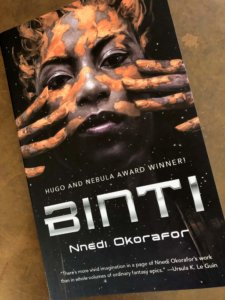
BY NNEDI OKORAFOR
BINTI, by Nnedi Okorafor, is a novella about a young woman from a desert tribe on Earth. Her people are called the Himba people and they make a vital piece of technology on Earth called an astrolabe. Binti is the name of the main character. The story, told in first person, begins with Binti climbing aboard a transporter that is taking her to a launch port, then onward to Oomza Uni. Oomza Uni is a university on a distant planet where Binti will have the opportunity to study mathematics with the best and brightest from all over the universe. She is the first of her people to be admitted, so there is the sense of her achieving a great honor. However, she and we (the reader) clearly understand how high the cost is as she leaves her tribe and family behind, potentially forever.
Binti is a 16-year-old, but this book is not a YA book according to the author. However, the back cover of the paperback calls it a “coming of age story”, which might put it in that genre for some. I believe it will appeal most to the middle grade and YA audience, with some degree of PG-13 gore (one incident).
The Novella, BINTI, won the Hugo award in 2016 and the Nebula in 2015 for best novella.
To order BINTI, click here.
What I enjoyed about BINTI.
- Sometimes, a novella is just right. There aren’t many around, but novellas can be a satisfying reading experience. To get through a story in one long sitting or two or three short sittings is a lovely thing. Also…light-weight, perfect for a 2-hour plane ride.
- The main character is unique and different than a typical caucasian protagonist. Her culture will feel different to many readers. Okorafor has ties to Nigeria and I am guessing that her place of origin impacts the writing of this world. That world is powerful in many respects in how it anchors the character’s identity. For the sci-fi reader who loves to enter into new cultures and worlds, this story will scratch an itch.
- Decent tension to keep the reader going.
- A satisfying introduction to an author’s burgeoning world. (two novellas follow this one)
It’s a bargain to order the complete trilogy. To do so, click here.
What annoyed me about BINTI and makes me hesitant to give it the highest review…
- Somewhat shallow character development. This is the negative of the novella format…it’s a challenge to develop the characters deeply.
- The conflict is resolved too easily.
- There are wonderful characters here, but I found the writing a bit underwhelming. My exposure to literary fiction makes me a snob sometimes…the writing won’t be a problem for most readers.
- The tech is more like magic in this story than science…or might as well be. I’m wondering if it will be explained in the next novella in a sciency way or not?
Writing Dynamic Non-Humanoid Aliens, Part 4 of 4
The Hive Brain Alien (Spoilers Galore)
Writing non-humanoid aliens who don’t speak a human language is no easy task. This post is preceded by three others. If you want the earlier insights, link to to Part 1, Part 2, and Part 3. It occurs to me that I ought to define dynamic. That word is in all four titles.
In terms of a dynamic literary character, I mean a character who is neither pure good, nor pure evil…a character that can change its/his/her mind, can act morally or immorally.

Alien, of Ridley Scott fame
This post will be a study of ALIEN, BATTLE STAR GALACTICA, ANNIHILATION and ENDER’S GAME.
Hive brain aliens (or A.I. in the case of Battle Star Galactica) differ so much from human beings, in part because their societies resemble what would be perceived by humans, as dictatorships or slave states. Hive communities, though a perfectly reasonable way of life for many of Earth’s tiny creatures, when translated into human terms, feel unpalatable. All hive individuals think alike. All live for the queen. All work for her good and the good of the community, often at the expense of the individual. So, how does an author drum up empathy for these characters? In the case of Ridley Scott with his Alien creature…almost none. The exception would be in Alien Resurrection, the third film in the franchise, when the newborn hybrid alien is killed by its own mother, Ripley. The audience knows this is necessary, but still…it hurts to see that cute (not cute) little spawn (not little) sucked out of the spaceship.

Mommy?
So, these aliens in the Alien franchise are not interested in good of any other species aside from their own (seemingly). They do not make tools and have no technological civilization.
They are predators, with one goal…survival. Not only will they eliminate other lifeforms that may pose a threat to them, they will impregnate those who remain and use them to feed their young. Yeah…not a pretty picture, but still, that moment when Ripley turns her back on her offspring…it tugs our heart for a brief moment.
My husband and I have been re-watching Battle Star Galactica (which, by the way is fantastic; the writing, the acting and the overall production hold up to any tv series ever produced). In BSG, the Cylons are the worker bees of a hive mind (an A.I. computer searching for meaning). The Cylons have destroyed human civilization and are chasing down the remnant who are fleeing in space vessels across galaxies to find a place where they will be able to survive/start over. The Cylons are called “toasters” by the humans who shoot them dead (otherwise, they will likely die by the hands/guns of those Cylons). The Cylons are non-human with little or no individuality…until, the computer brain figures out how to create machines that are VERY human-like. Those Cylons infiltrate the human remnant and take on unique personalities. One even falls in love and is impregnated by a human. So…it all becomes complicated. Including, the episode we just watched which chronicles a Cylon called Scar. The episode is the 15th of the second season and is titled, Scar. It is free for for Amazon Prime members as is the entire series. (Update, as of January 2021, this is not true…hoping it will come back to screens for free again, sometime in the future).
This particular Cylon is not only named by the human fleet (naming a hive member changes the way the audience sees this character), it is feared by them. The fleet’s fear of Scar also puts it in a unique category. No longer is Scar a worker bee.
Scar has been able to kill more human viper pilots by learning. The implication put forward by one of the human-like Cylons (the pregnant one) is that each time Scar has been destroyed, its failure in battle remains in its brain. As that brain is downloaded into the new Cylon body, a new pilot is born, only it does not forget. Scar is able to access the lessons of its battle failures and grow more adept at fighting human pilots. In a previous episode of BSG, the human fleet has destroyed the Cylon “resurrection ship”. Therefore, this battle with Scar is to the death. Scar will not be coming back in a new body if it is destroyed this time.

Cylon. Battle Star Galactica
In BSG, the writers want the audience to grapple with a morphing understanding of the Cylons. Cylons start out all evil, but don’t stay that way. Various human-like Cylons enter into human community and help it, many step in with critiques of human society, acting almost like prophets. The Cylons are monotheists, who believe there is a purpose to their existence. The human remnant is polytheistic, worshipping the gods of the Greek Pantheon. Wonderful fodder for philosophical ponderings within BSG.. Through the many episodes, the audience begins to feel more compassion for the Cylons. The entire series is worth watching if you are a writer who cares about humanizing characters that fall into the category of enemy or other.
 In ANNIHILATION, the enemy is mysterious, hive-like in that it reacts en masse and not as individuals…In fact, it can’t be categorized as a hive-brain alien exactly. There is little clarity that the anomaly in Area X is actually an alien takeover. What emerges is the notion (at least in the novel) that the changes taking place in Area X are inevitable and may be good for Earth. The anomaly, however, is impersonal. The alien impact, or whatever it is, is spreading and seems to have no consciousness in the way we think of consciousness, but is more like a fungus or a virus. It has power to change its environment, but any actual “brain” that would become a military target, allowing our government to remove the anomaly is unclear. Lots of mystery, but the writer, Vandermeer, makes it work, especially in ANNIHILATION, the first novel of the Southern Reach Trilogy.
Area X is frightening because it consumes and/or changes all who encounter it. As a writer, ANNIHILATION is worth studying for the utter strangeness of the alien anomaly. There is no verbal communication with it, only physical and psychological encounter. The biologist character in the novel (Lina, in the film) helps the audience see the mystery as beauty. However, the ambiguity remains and is never truly resolved. It’s good to see an alien like this. The presence of it pushes the human characters to their limits and reveals aspects of our humanity that are important to recognize. Really great sci-fi ought to do this.
If you want to purchase ANNIHILATION, click here.
 Lastly, ENDER’S GAME. The Formics are the enemies, (the Buggers) that Ender eventually destroys. The novel is about how he is trained to perform this act. Ender commits xenocide without knowing it. It’s worth reading or re-reading ENDER’S GAME to watch how Orson Scott Card pulls this off. The Formics are all evil until very close to the end of the novel. The turn takes place when the innocent, but talented Ender, realizes how he has been manipulated and how his power has been used to “save Earth”, but while doing so, he has destroyed another species. His grief is immense. Ender will bear this guilt into subsequent novels. The audience, once it realizes that the Formics have been destroyed, enters into Ender’s regret. A young boy’s conscience has been scarred. The novel then portrays the Bugger queen communicating with Ender, giving hope to him that there might be a path to redemption. The audience wants this for Ender. The queen reveals that the Formics had initially assumed humans were a non-sentient race because they lacked a hive mind. She/they realized their mistake too late. In other words, the war was a BIG misunderstanding. The queen requests that Ender take a dormant egg that has not been destroyed to a new planet where this species can thrive anew and Ender agrees. Suddenly, the audience is rooting for the Formics.
That is a turnaround worthy of study! The audience moves from hating Formics and seeing them as a monolith, to empathizing with them and hoping for their rebirth.
Make sure you pick this novel up next time you’re at the bookstore or you can order it here.
Writing Dynamic Non-Humanoid Aliens, Part 3 of 4
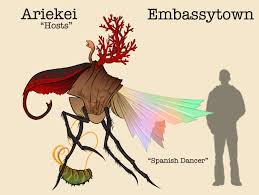
SPANISH DANCER, EMBASSYTOWN
Today, I look at China Miéville’s, EMBASSYTOWN. Beware of spoilers. This won’t be a review of the novel, but a study of the Ariekei, the aliens indigenous to the planet Arieka.
First, a little advice…If you have the opportunity, consume EMBASSYTOWN via audiobook. To buy EMBASSYTOWN via Audible, click here. To buy the physical novel, EMBASSYTOWN click here. Language is central to the story, but the Ariekei language is best experienced when heard rather than read, therefore my encouragement to read via Audible. The Ariekei (also known as the hosts) speak from two mouths at once. One mind, but two words emerge from the creature when it vocalizes. In the audio reading, the sound producers overlay two words spoken at once, like hearing two notes played at the same time. The effect is marvelous and strange.
For a synopsis: One human culture, the Bremen, has adapted and figured out a method of speaking with and listening to the indigenous population of Arieka, a planet on the edge of the known universe. Their motivation for doing so is to maintain a colony on Arieka. Like a typical colonial power, the Bremen dig for metals and also trade with the Ariekei, whose biotech is advanced and valuable across the known universe. The Ariekei are advanced in many respects, but their language does not allow them to lie or even speculate.
Conflict arises in EMBASSYTOWN when one Bremen ambassador introduces lying into the Ariekei language. He does this in the hopes of taking control of the host population, but chaos ensues. The main character, a woman named Avice Benner Cho, steps in to save those living on the planet, both human and Ariekei.
How does Miéville give the aliens, the Areikei, personality and tap into audience empathy?
- Similar to the film Arrival (see post 2 of 3), point of view is key. POV rests in one human character who is relatable. Avice narrates this tale in the first person. Not only is she human, she was raised on Arieka and is known by the indigenous population. She is returning to her home after many years of traveling through space. Avice is the “in between” character. She describes, interprets and translates for the audience.

The sea creature also known as the Spanish Dancer
- Miéville finds colorful shorthand ways of describing the physical and personality attributes of particular Ariekei. Miéville, through his narrator, Avice gives the aliens nicknames, like Spanish Dancer. It’s genius because this shorthand gives the audience color, shape and depth to individual Ariekei and is so much better than than referring to all of them as “insect-horse-coral-fan things” another set of descriptors Avice muses on in the novel. An artist’s rendering in the top image is not necessarily what I had imagined when I pictured the Spanish Dancer, but Miéville doesn’t need me to have that specific picture in my mind. The broad brush strokes are there in the nickname and not just any nickname…calling the creature a dancer implies grace and dignity. The name takes an alien that might be perceived as monstrous and draws our attention to its beauty and gentleness. Maybe this is why ocean scientists call the sea creature (pictured above) a Spanish Dancer. The moniker is descriptive and if I’m visiting an aquarium staring at this thing through glass, if I am thinking of dancers instead of monsters, my eyes are drawn to its beauty. Miéville is doing the same thing when he has Avice call one particular Ariekei, The Spanish Dancer.
- The Ariekei have known Avice since she was a child. Avice has a positive association with the Ariekei. She was raised on their planet and thrived. Humans and Ariekei have lived together for many years in peace. This underlying truth makes a difference in how the audience feels about the Ariekei.
- The Ariekei are vulnerable to human abuse. The narrative of indigenous people groups used and abused by empires and greedy civilizations is not an uncommon story for the current sci-fi reading audience. Miéville dips into that narrative in this novel, portraying the aliens as complex, but also also as innocent, in large part because their language makes it impossible for them to lie. The audience empathizes with the vulnerable indigenous population. The narrative of “empire” taking over the “innocents” and using them for its own gain is familiar. That story taps into the audience’s empathy and our empathy lies with the Ariekei in this case.
- Avice relates to individual Ariekei, Miéville’s way of showing the audience that the Ariekei are not a monolith. Spanish Dancer is the most important Ariekei to the story, but there are others. As Avice relates to her and describes her and other Ariekei, the audience recognizes that though they are different from humans, the Ariekei are not all the same as one another. They are distinct in appearance and personality just as human beings are distinct from one another. (contrast this reality with the hive mind aliens, like the Formics in the Ender’s Game series, or the big computer brain of the Cylons “toasters” in Battle Star Galactica television series. I will tackle hive mind aliens in my final post on this topic.


In the next part, ALIEN, BATTLESTAR GALACTICA, ANNHILIATION, ENDER’S GAME
Writing Dynamic Non-Humanoid Aliens, Part 2 of 4
Caution: A few spoilers in this post…
Complex portrayals of the non-humanoid alien are a writing challenge for many sci-fi writers…this I tried to establish in my previous post on writing dynamic non-humanoid aliens
- If the alien doesn’t look or act like a human, it will be difficult for the audience to comprehend its character and motivation
- If it doesn’t speak in plain human lingo, along with not looking like a human being…it will be nearly impossible to draw in the typical audience. The alien will remain “the other” and may never transcend its designation of foreigner/alien.
The honest sci-fi writer knows that if a first contact event were ever to take place in the real world, the likelihood of an alien looking like a human being and/or speaking or thinking like a human being is slim to none.
 Therefore, the imagination must soar and novels like Embassytown (China Miéville) and short stories like Arrival (Ted Chiang) come into the canon. These are stories that give the audience an alien we might never have imagined. It’s worth looking at both examples. In this post, I will focus on ARRIVAL, the short story and the film. Both were excellent and if you haven’t already consumed these stories, do so and do so before you read on. Here is my non-spoiler review of the film, ARRIVAL Otherwise, I forge ahead with analysis and spoilers. You’ve been warned.
How did Ted Chiang and Eric Heisserer (screenplay writer) pull off portraying an alien that was both non-humanoid, with no human language and still give it/them so much character that went beyond “the monster” designation?
- They reveal the alien through the eyes of Louise Banks, the main character and the linguist who is trying to communicate with the creatures/entities. The story is told from Louise’s point of view. That makes a big difference in how the audience sees all that transpires in the narrative because Louise comes to the aliens as a learner, as curious and though the creatures are powerful and instill fear in most of the humans who encounter them, Louise is not overcome by fear. (Note: Louise is a fantastic hero, but she is no Ripley, of the Alien franchise. It’s likely she would have been an early snack for the buggers on that vessel. Louise is fierce in her dedication to her academic discipline, but unlike Ripley, my guess is she would not be as ready to use a gun to blow their brains out if they had revealed themselves to be monsters).
- The writers give the aliens agency, first by showing their power. These entities that have arrived on Earth are powerful, there’s no doubt about that and showing their power is not a difficult writing task. It is accomplished in a variety of well thought-out details. For starters, the vessels they have traveled in are massive. Also, these entities have traveled through space to find another sentient species, which reveals how their technology is superior to human tech. In addition, the mystery of where they have come from, their beautiful language, their form…all create an aura of their power, and I would add, their dignity. The fact that humanity is freaking out (especially the military) is another clue about these aliens and their power. We learn about them by watching how others react to them. This is a classic writing tool, especially when a mysterious character presents itself. The audience takes its cues from the group surrounding the mystery.
- The writers reveal alien character by showing us how those aliens use their power. They show us by showing us the alien actions As ARRIVAL progresses, the audience begins to form an opinion about the motives of these characters. They are characters with personality. First, the audience recognizes what the aliens have not done. They have not blasted the planet to shreds, started a war or abducted any humans. In terms of what they have done, the aliens are trying (trying hard) to communicate. They readily engage when Louise begins to learn their language. The most important scene in the narrative that reveals their goodness is the moment the entities warn Louise about danger, then save the lives of Louise and her counterpart when a bomb, planted by one of the freaked-out military men, explodes in the cave-like room where they have been making slow progress on communicating. The contrast becomes clear. We see humans who are fearful and violent. We see aliens who are steadily revealing themselves and using their power to save lives.
To close this second of four posts, I’ll nerd out a little on words.
The Etymology of Our Other-Worldly Friends/Enemies
The ALIEN

Spielberg’s E.T.
In English, the word alien is derived from the Latin, alius, meaning other, and alienus, meaning belonging to another. The al in these words comes from the Proto-European root (it precedes Sanskrit), meaning beyond. Its root is different from the English word, foreigner, whose Proto-European root is the word dhwer, meaning door. The senses of the two words are different based on the roots. The foreigner lives outside one’s door, the alien is from somewhere beyond. I key into the fact that the word precedes Sanskrit. The labeling of the other is incredibly old. Human psychology is fundamentally tribal. Those outside our door or from beyond are automatically suspect. The film ARRIVAL is about this tribal fear and our inability…not just to communicate with strangers/aliens, but to communicate with one another. In the film, this becomes a large issue and almost leads to disaster.
One other term for the sci-fi consumer…E.T.
The term extra-terrestrial was coined in the modern era. It was first documented in 1953 or 1956 depending on who you believe. The initials, E.T., was made famous by Spielberg’s 1982 film.
In the next part, I look at China Miéville’s EMBASSYTOWN.
Writing Dynamic Non-Humanoid Aliens, Part 3 of 4
CAPTAIN MARVEL: Female Empowerment and the Superhero
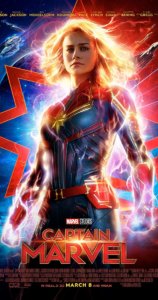
A REVIEW OF THE 2019 FILM AND A FEW OTHER OBSERVATIONS
In the last ten years, the urging of audiences around the globe have pushed the film industry to re-think the way it portrays people of color and women, folks who might not have been featured in stories (especially superhero stories) as headliners.
A number of different types of heroes have emerged victorious: Wonder Woman hit the scene big in 2017, the Black Widow in the Marvel universe has taken an elevated seat (will not spoil, but she plays an essential roll in Avengers: End Game, released this past month), and Black Panther, another Marvel character and storyline that incorporates not only one African character, but an entire culture.
All those films/characters broke open that hunger into full fledged box office $ and now, CAPTAIN MARVEL enters the scene.
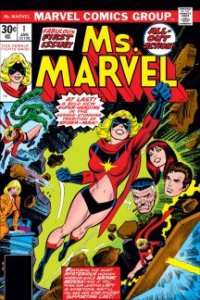
Captain Marvel. First of all…I have to say. What fun! I loved this film and I noticed after emerging from the fog of the fictional dream what the credits indicated. I noticed how many women worked on the writing. The WRITING. I cannot emphasize this enough. Women were put into positions of power, able to make decisions about the story.
- Directed by Anna Boden
- Screenplay written by Anna Boden and a dude named Ryan
- Story credits going to Anna Boden, Nicole Perlman, Geneva Roberson-Dworet, Meg Le Fauve, and yes…a dude named Ryan
Ms. Marvel
So…when there was a shouting match in the writer’s room about what the character is thinking and feeling and the actions she is about to take…Ryan might have been “out-shouted” by the women. That was a good thing for audiences everywhere.
Wonder Woman was an amazing film, but women were not in the writing credits. A woman was instrumental in the direction of the film, which is awesome, but women did not “create the character”. Here are the names of the writers:
- Zach Snyder
- Alan Heinberg
- Jason Fuchs
I’m not saying these dudes were bad people, insensitive to female motivation and feminine issues of power and agency, but…they are three dudes and there are zero women in terms of the story creation.
What was it like to be in the writer’s room of CAPTAIN MARVEL versus Wonder Woman. I imagine there was a difference.
And for me, even before I saw the credits, CAPTAIN MARVEL struck a note about women differently than Wonder Woman did. I noticed how the character’s strengths and flaws made sense to me as a woman.
CAPTAIN MARVEL was not a perfect film and there are problems (as an author I foresee them) with how incredibly powerful the creators have made Carol “Captain Marvel”. What is to keep her from showing up every other day and solving the world’s issues? The implication from Avengers: End Game is that she is super dang busy with solving the universe’s problems, so she can’t bail us out every time Earth has an issue.
A problem a lot of great woman face, I suppose. They want to help people, but have too much to do and not enough time on their hands…CAPTAIN MARVEL sounds like any number of Saints in the Catholic Canon. “If there were just more of us…” said one lady saint to another…
Indeed…I hope there will be more female heroes portrayed in the superhero universe in the coming years.
By the way…for those interested…there is a weird subtext to the Wonder Woman mythology. Click here to read an article about the man who conceived of the character: The Creepy Creator of Wonder Woman
But don’t discount this creator/writer too quickly. He is said to have written this in a letter to the publishers of DC Comics:
“Look, if you had a female superhero, her powers could all be about love and truth and beauty, and you could also sell your comic books better to girls,” he said. “And that would be really important and great because she could show girls that they (girls) could do anything.”
ANNIHILATION, Echoes of Ripley and the Alien Franchise…A No-Spoiler Review of the Film

ANNIHILATION is free for Amazon Prime members, or at least it was at the writing of this post. This film is Rated R, some sex and violence, therefore might not be appropriate for teens.
For Educators: An AP Biology “fun watch” with a discussion to follow about the ideas put forward by the author. Do preview to make sure it’s not too sexy or violent for your students.
Five Reasons to Watch ANNIHILATION
- The film puts forward a non-humanoid portrayal of an alien species invading our planet–always a welcome change in sci-fi land.
- Watch it for the tension, mystery and suspense (on par with films like Alien and The Thing).
- Watch it for the dynamic, mostly female cast. Realistic and flawed characters with agency and intelligence.
- Watch it for the beautifully imagined world. The CGI and other effects are a visual feast.
- I also enjoyed the creepy music. I expect it will make your skin crawl as it did mine.

Lena
ANNIHILATION is based on The Southern Reach Trilogy novels by Jeff VanderMeer. Watch the film and read the first book (in particular), also called Annihilation. To read my review of the first novel, click here. The film diverges enough from the novel, spoilers aren’t an issue. Both stand alone and give the consumer something different. The most important commonality in both is the main character: Lena, as named in the film. She is not named in the book, but is only known as the biologist.
Alex Garland wrote the screenplay based on the trilogy, but focused on the first book. He takes that novel told in the first person, a story relayed by the journal entries of the biologist, and creates something that makes sense for the screen.
In one of the film’s earliest scenes, a comet or asteroid hits Earth, near a lighthouse on the North-Eastern coast of the US. Within a few years (we learn later), an anomaly develops in and around the area where the asteroid hit. It becomes circumscribed by what the government people call, the shimmer.
The story of Lena opens with her sitting in a chair in a mostly empty hospital-type viewing room. She is dressed in scrubs, surrounded by men and women in hazmat suits, many of whom watch her through windows. One man is interviewing her about her journey into the shimmer. She is the only survivor who has returned from inside the shimmer out of a 5-person team. As he questions her, the story unfolds.
The casting of ANNIHILATION is strong, with nuanced performances by Natalie Portman and Jennifer Jason Leigh (as the psychologist and expedition leader).
This film was released on a February weekend in 2018, the weekend following the release of Black Panther. While the Marvel masterpiece sucked nearly all of the movie-going public into the theaters to ooh and aah over that story as well as the graphics and the unfolding of a Wakanda power struggle, ANNIHILATION quietly drew its small and eclectic audience. It left the theaters before the Hollywood press had a chance to say much about it. In truth, even without Black Panther as competition for eyeballs, the film was rated “R”, and therefore would not have attracted the masses.
However, similar to a film like Under the Skin, this story is so creepy and alien, it pushes the imagination. The sci-fi fanatic will adore it…as should biologists, who will see their discipline elevated in a way not often witnessed on the big screen without a virus taking over the world.
If you are a DVD watcher, here is a link for purchase.
I end with a favorite quote:
“Was it carbon based? What did it want? It came here for a reason. It came here for a reason. It mutated everything.”
Battle Star Galactica, Check Out This Podcast
 My husband and I are watching Battle Star Galactica (BSG) for the second time in our married lives. The first time we watched, our kids were always in bed. It was just-for-parents entertainment…Our daughter was a middle schooler, our son, a couple of years behind her. They’re both out of college now. So it was a while ago.
BSG was created for the SyFy channel by Glen A. Larson and Ronald D. Moore.
There is much pleasure in the re-watching for me. Last night, we viewed The Hand of God, episode 10, one of many amazing episodes in that first season. Our re-watch has me reflecting on what makes BSG so good?
- The writing is absolutely spot on. No-nonsense story-telling that provides the audience with a solid long-term arc of purpose and meaning: humanity, betrayed by A.I. known as Cylons, must leave their home and find another habitable planet. An epic journey in a space ship. Grafted onto the journey narrative are countless subplots that will draw in scifi and non scifi fans. How do the writers do this? That leads me to my second point…
- This story is inhabited by heroic, but flawed characters most of us can relate to.
- The production value is superb. Even in the 2019s, the set, special effects and costumes create a believable fictional world.
- The actors embody their characters well, extra dramatic heft carried by the Commander of the fleet, William Adama and President of the survivors, Laura Roslin (played by Edward James Olmos and Mary McDonnel respectively).
- The themes around protecting a way of life, more specifically, a democratic society in the midst of battle, are extremely poignant in our current political environment.
- Ethnically diverse cast of characters and women in key leadership roles.
If this will be your first time viewing the series, or if you’re re-watching like me, consider this podcast aptly named Galacticast to augment the full depth of each episode. It’s a fun and easy way to be extra nerdy about BSG. Click below for the link up.
A Podcast Discussing Each and Every Episode
As an aside, I find myself wishing The Expanse would produce an episode by episode podcast…Sometimes, I feel like I’m not quite getting it. Maybe in the re-watch, I will.
To watch the entire series, click here.
THE EXPANSE Fans: Take Notice! You Can Stream (Free) All Three Seasons on Amazon Prime, Starting Friday
Frankie Adams as Marine, Roberta, “Bobbie” Draper
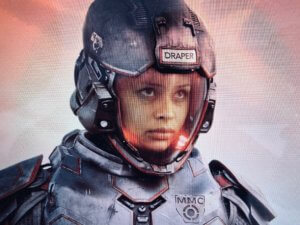
In two days, Amazon Prime makes three seasons of THE EXPANSE available to members. This comes in advance of their release of season 4 and fans of the show, across the globe, are celebrating. This series almost came to a bitter and premature end. Firefly fans know exactly what I’m talking about.
THE EXPANSE (based on books by James S.A. Corey) had been canceled by NBCUniversal’s Syfy channel after season 3. Fans exploded in fury and came out of the woodwork to figure out how they could keep this series going.
The story of how the EXPANSE survived is one worth reading. It includes fans hiring a plane to fly a Save THE EXPANSE banner over the Amazon headquarters as well as George RR Martin and Craig Newmark (founder of Craig’s List), writing emails to Bezos. Bezos and his Amazon studio head, Jennifer Salke, paid attention. Season 4 went into production last year and will be released sometime in 2019. I’ll post the release date when announced.
If you are a scifi nut or you just love great characters, epic story telling and the casting of strong men and women, including a number of kickass women of color and you haven’t already stuck your nose into this series, I highly recommend. For a no spoiler review, see this guest post of THE EXPANSE written earlier this Fall by friend and math professor, John Mayberry.
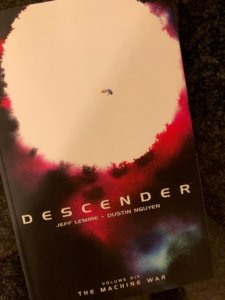
DESCENDER by Jeff Lemire and Dustin Nguyen, A Review of Volume 6, THE MACHINE WAR
THE MACHINE WAR
The 6th and final post of a 6-day reading fest. I’m excited to recommend this series…all 6 volumes. I would rate DESCENDER as PG-13. This comic series is pretty mild compared to some of the stuff your kids are exposed to. Parents might want to view volume 4 to get a sense (regarding the one sex scene). Overall, the language was extremely tame. The violence was not graphic…not as graphic as many other comic series.
Also…FYI…don’t piss off you machines, those very helpful robots that make your life easier.
Today, I want to acknowledge my dishwasher, for all the hard work and quality service it does every other day or so…also, my robot vacuum machine. Also…the electric toothbrush, and much much more. Thanks to you, machines…I have more time to read amazing comics/stories like DESCENDER, THE MACHINE WAR.
Really, though, I have continued praise for the story. You can view my previous reviews on allscifi I’ve written a review for each volume. As a novel-writer, I am intrigued by the strengths and weaknesses of the comics genre. The visuals in this epic are so gorgeous and add so much to the understanding and the feeling the story. However, I did find myself missing lovely passages of linguistic poetry and the interior monologue that takes place in some novels and short stories.
THE MACHINE WAR does close with a longer interior monologue. A character the reader has not yet met, but one who makes sense in the story overall, she begins to narrate the post-story of DESCENDER, the pre-story of the coming series. This is the bridge character who will take center stage in the sequel to DESCENDER. The next series will be called ASCENDER.
Final word on the review. If you love comics…you will absolutely LOVE this series. The art and the writing are top notch. Furthermore, if you’re a scifi fan…you ought to read this tome. The narrative adds so much to our morality around how we understand ourselves, our machines, our planet and those who work in the shadows to make our lives easier. Let us no forget that real work has to be done by someone. More and more of that is done by machines…but much of it is still done by humans, people who we can easily marginalize and treat as less than human. This is important for all of us to remember. The best scifi stories teach us to be better humans. DESCENDER does exactly that.
Click here to buy this final in the series: DESCENDER, Volume 6 The Machine War
Click here to buy the first installment of the sequel to the DESCENCER, series ASCENDER, Vol. 1, The Haunted Galaxy
DESCENDER by Jeff Lemire and Dustin Nguyen, A Review of Volume 5, RISE OF THE ROBOTS
RISE OF THE ROBOTS
Six reviews in 6 days. Today marks the 5th day and review of volume 5 of DESCENDER. No spoilers for this volume, but beware of spoilers if you haven’t already read the first 4 volumes. You can see my first review of volume 1 here in case you stumbled upon this review as a first exposure to my website.
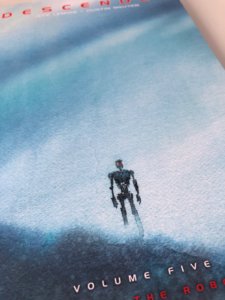
In RISE OF THE ROBOTS, Lemire delivers a number of answers to mysteries within the story world…not all of them, but enough to open up the possibility of some sort of redemptive ending to the saga. By the way, I don’t know the ending, so this is not a spoiler. I’m reading volume 6, the finale of DESCENDER tomorrow. In this volume, the planet Mata, an aquatic world, takes center stage. Mata itself is a mysterious place. It is less known by the UGC and there are early allusions in the first volumes of DESCENDER to the ruins of a great city in the water’s depths. Water is often a symbol in literature, so I look forward to seeing how Lemire works that thematic angle. You’ll also notice that the cover of this volume is a robot in a hazy blue environment…I’m interpreting that blue as an underwater world.
The unique (in the volumes so far) and fun surprise in volume 5 is a double page fold out. Lemire and Nguyen chose to dramatize the culmination of the RISE OF THE ROBOTS as it takes place across the UGC through the art.  You’ll notice as you turn toward the final pages of volume 5 that a couple feel thicker than the rest. Be careful when you fold them out, so they don’t tear. This is the third reading of our copies of DESCENDER and so far, we’ve only had one issue with the binding (loose pages). I want these beauties to last a long time, so I am reading them carefully. I also love loaning out great books and I’m sure I will loan these out in the future, but I’ll ask my reader friends to read them gently.
Tomorrow, the final review of DESCENDER.
Click here to buy your copy of DESCENDER, Volume 5 Rise of the Robots