Posts Tagged ‘book review’
DESCENDER by Jeff Lemire and Dustin Nguyen, A Review of Volume 4, ORBITAL MECHANICS
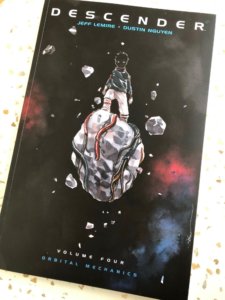
Vol. 4 DESCENDER
Day 4 and the 4th review. I’m tired as I write this because I had a full day and hosted 10 people at my house for a dinner party. They’re all gone now and the dishes are washed or are in the robot machine that cleans them (thank you, Kitchen Aid!)
So, here it goes…The DESCENDER saga continues, a ramping up of tensions across the Megacosm.
Slight spoilers if you haven’t read 1-3 yet. This volume confirms the PG-13 rating. There is a sexual encounter, not explicit, but emotionally portrayed/drawn by the artist. It’s not graphic in that there are no x-rated body parts on display, but still…it’s a sex scene. Some parents will want to view this before passing it onto their kids.
With that said, this sexual and emotional relationship doesn’t seem to be the main thing and doesn’t dominate the storyline from every angle, but it is one angle. The couple that gives into sexual desire has its relevance to the overall plot. I can’t say more without spoiling the story.
What continues in ORBITAL MECHANICS is character revelation while the battle lines become drawn.
Since I’ve written a couple of novels, I will say that the messy middle is the most difficult part of writing something of epic proportions. DESCENDER has the potential to be epic, so this volume works, yes, to pull us in and draw us deeper into caring about the characters and the outcome of the world in which they live.
Highlights for me emerged as curious plot turns took place. Not every turn surprised me, but many did. The story telling and the art are still fantastic. I know I will read to the end.
To purchase, click Volume 4 of DESCENDER
DESCENDER by Jeff Lemire and Dustin Nguyen, A Review of Volume 3, SINGULARITIES
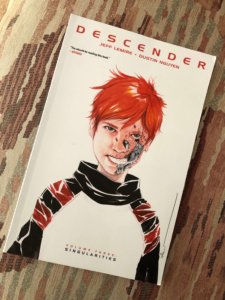
Tim-22, used, abused and almost scrapped
YES. Read on, you won’t be disappointed!
I continue this mad and highly pleasurable dash of reviewing 6 volumes in 6 days. Today is day 3, so I’m reviewing volume 3 of the DESCENDER series. No spoilers (unless you haven’t yet read volumes 1 and 2 yet…in which case there are tiny spoilers).
I’m going to have to call SINGULARITIES my favorite volume, so far. It’s filled almost completely with the backstories of all the important characters. If you’re like me, now that you’re hooked on these characters, you have the patience to read back into their histories and you’re going to love it! I also picked up volume 1 again to re-read the first few chapters.
Don’t you admire an author can draw you in with action and plot-driven narrative, when all the while, his/her real aim is to make you fall in love. I do. Kudos to Jeff Lemire for this original and expansive story world inhabited by not just humans, but aliens and robots as well, many of whom we are coming to love.
You will not be disappointed regarding the various bot characters. The backstory of Driller the Killer is included in this volume, as well as that of Tim-22, the sinister and perhaps, alter-ego of Tim-21. In the 19th century novel, Dr. Jekyll, Mr. Hyde, evil and gentleness exist in one human, split personalities. In DESCENDER, the two Tim A.I. characters take on the representations. This is a captivating and common archetype in countless narratives we love…think, Darth Vader/Luke, Voldemort/Harry Potter, Edmund/Lucy. Opposite and rival archetypes reflect human experience. We all know we are not pure good or pure evil, we’re somewhere in between, but understanding the extremes must help us in some way, otherwise, why do we crave these stories? Does it help us live a more balanced life and make choices for “good” or not?
I will draw a conclusion by the end of DESCENDER in regard to its moral relevance for the average scifi reader, but for now, I’m enjoying the ride. I hope you are too. Follow the links below to purchase.
DESCENDER, Volume 3 Singularities
DESCENDER, Volume 4 Orbital Mechanics
DESCENDER, Volume 5 Rise of the Robots
DESCENDER, Volume 6 The Machine War
DESCENDER by Jeff Lemire and Dustin Nguyen, A Review of Volume 2, MACHINE MOON

Cover Art DESCENDER, Volume 2, MACHINE MOON
Yes! Read this second volume and you might want to order the rest of the series now because if you’re like me, you’re pretty much hooked. This review of volume 2 will have a few spoilers if you haven’t already read volume 1.
MACHINE MOON did not disappoint. The stage is set, the key characters are on that stage (although I’m sure there will be a few new faces in coming volumes) and the heat is cranking up for an epic conflict. In volume 1, the reader is introduced to Tim-21, an A.I. of extraordinary talent, intelligence and empathy. Tim-21 was created by scientist, Dr. Jin Quon, as a companion for humans. The hero, depicted as a gentle-spirited little boy, wakes after 10 years of sleep. He had been companion to a human child and living with him as a brother on a remote mining colony. He wakes to find hundreds of corpses of human miners, dead now for 10 years, and two other robots, lesser A.I. models still active. Following Tim-21’s awakening, the Megacosm made up of nine planets, becomes aware of his presence. His particular intelligence chip is perceived as having brought about a disaster which has wiped out much of civilization. As a result, Tim-21 is targeted by a number of powerful factions who want to destroy him or use him to gain power. He has few human allies, though a couple seem to be emerging. Moreover, his relationship with robotkind turns complicated in this second volume. The reader roots for Tim-21 knowing he is a pawn for nearly every other character, which adds to the tension and the page-turning nature of the story.
I need to take this opportunity to comment further on the gorgeous art of Dustin Nguyen in this series. You too can actually hold this artwork in your hands and it is amazing, worthy of your hard-earned cash.


On Voyage
The colors are intense when the story requires it and muted at other times. For example, backstory and memory are mostly color-less. There are precise pen drawing-style features of characters, with water-color wash to add to the texture and the dreamy quality of the world.
To purchase this comic, click DESCENDER, Volume 2, you won’t regret it. The rest of the series is below.
DESCENDER, vol. 3 Singularities
DESCENDER, vol. 4 Orbital Mechanics
DESCENDER by Jeff Lemire and Dustin Nguyen, A Review of Volume 1, TIN STARS
 If you’re looking for an epic science fiction graphic novel and vibrant reading experience overall, the DESCENDER series is for you. I will be reviewing each volume, 6 in 6 days, without spoilers.
Here’s the review of VOLUME 1: TIN STARS
First, my pure recommendation…YES! You ought to read TIN STARS. Here’s why:
- The Story is Fantastic (and volume 1 is a great set up for more drama)
- The Art is to Die For
- The Characters Feel True and Interesting
- The World is Fantastically Drawn (in the art and in the narrative)
Jeff Lemire and Dustin Nguyen team up to create a beautiful and gripping story. Due to language and some graphic violence, I rate the novel overall PG-13.
If you hunger for A.I. and space and aliens of various types, shapes and forms, they all inhabit this place. Also, the graphic novel format feels like a window into the future. What the author does not describe in words, we see on the page, beautifully drawn and colored by Nguyen (what a talent!). The graphic novel genre lends itself well to the world of a future civilization, something beyond our imagination and fantastical. The author, Lemire, also knows how to build tension and keep his audience gripped and turning pages.
Speaking of turning pages, I found (after I had read the first volume) this handy reference page, called: Atlas of the Core Planets of the the United Galactic Council. The world imagined by Lemire is complex physically and politically. Each planet has a unique character, so I can see why the author saw the value in adding it.
This page was not present in volume 5, perhaps Lemire assumes we know the world by then, but it is at the end of 1-4. It’s helpful, especially if you’re the type who likes to know the world well before you read the story, flip to the back right away to orient yourself.
Don’t be surprised to see this series come to the screen sometime in the near future. When that happens, you can breathe on your fingertips, wipe them on your cuff and brag…Oh yes, I read the graphic novels, back in 2019.
To order your copy, click here: DESCENDER, Volume 1, Tin Stars
To order your copy of
An Excess Male, A Book Review Without Spoilers
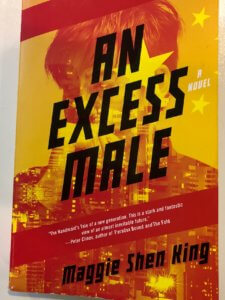
Author, Maggie Shen King
“Science fiction is any idea that occurs in the head, but doesn’t exist yet, but soon will, and will change everything for everybody, and nothing will ever be the same again.”
Ray Bradbury
The Short Review
Three Reasons I Recommend you read AN EXCESS MALE…
- Learn about China, a rising power with imperial roots and aspirations. Let this novel wake us up to the reality of Big Data meeting Big Brother
- Fall in love with the characters put forward by Maggie Shen King
- Enjoy a good old fashioned love story/thriller. Actually….NO…the love story is unlike anything you have probably read, but the tale will thrill. Love, loyalty, duty are on display, nearly every page.
To buy AN EXCESS MALE, click here.
The Long Review, Also Without Spoilers
I recommend this novel with a few reservations. AN EXCESS MALE falls into the category of speculative fiction, though it bleeds into the scifi genre and would likely be enjoyed by anyone who loves “surveillance stories”, like Minority Report and The Net. This novel has a few PG-13 scenes, and some adult themes that might bore a young adult reader, but many young adults and those older who read speculative fiction will love the book. I would not recommend it for Middle Grade or younger.
Shen King’s story belongs in the future, and yet the reality she portrays is around the bend…How many years away? Maybe ten.
The premise of the novel addresses the terrible truth China is now grappling with…that their one-child policy has resulted in 40 million unmarriageable men. By the year 2030, more than 25% of men in their late thirties will have no family of their own. What are the options for Chinese society? Here are three possibilities…
- Import wives from neighboring Asian nations or elsewhere. The problem…the Chinese, especially the government values a pure and loyal race. They elevate the Han Chinese culture and importing wives will dilute Han Chinese blood.
- Send those extra men to battle. Society does not need them for child-bearing, so let them win honor in fighting to extend China’s influence around Asia and the globe. The problem…many of these men are the only children, the beloved one child of their parents. Who will take care of the parents, those elderly loyal citizens of China who have lived and suffered under this oppressive law to bear only one child? What does it mean if the government plucks away and sacrifices their one and only on the battle field?
- Require that women in China take more than one husband. Most will take two…some will even take three husbands. A new family system will evolve around this patriotic duty. The problems that may result…READ THE NOVEL TO FIND OUT.
Maggie Shen King writes a story that assumes the third possibility. Women marry more than one spouse, all for the good of China. In a spirit and tone that celebrates her Taiwanese/Chinese heritage, Shen King imagines a world where men pay dowries, women of child-bearing age are precious and coveted, and single men bear a painful stigma. Shen King tells the story in the third person, changing the close narrator’s viewpoint chapter by chapter. She signals the shift by titling her chapters with the character’s first name. Two husbands, one wife and one potential husband…these are the characters the reader follows into a labyrinth of love, politics, corruption and societal rules that do not bend for individual freedoms.
I have only one complaint about the novel, that the ending felt rushed and a bit predictable, somewhat contrived. Pacing did not match the earlier portion of the story. It’s an issue that can happen when writing from multiple characters’ perspectives. In this case, the main character and to some extent the heart of the story got somewhat lost in the milieu. However, even with a few flaws, I found the book fascinating and worthwhile. It’s a fun quick read and will immediately get you thinking and feeling.
The Many Colored Land, Book Review
 Short Book Review with No Spoilers…
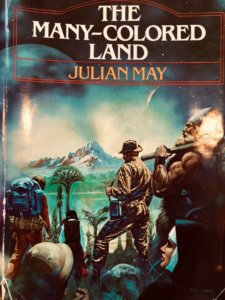
Julian May’s THE MANY COLORED LAND is an exceptional adventure that takes place in Pliocene Europe, think Tolkien meets Jules Verne. This is the first story in a trilogy, involving time travel and aliens. The world created by May is so imaginative, while being true to fossil record and prehistoric science. It’s like taking a course in geology, mammalian evolution and ancient flora all in one.
Three Reasons to Read this Great Book
- Superior world building and vibrant descriptive passages that will delight most scifi lovers.
- A humanoid alien race with a distinctive culture, a compelling ally or enemy?
- A complicated conflict between humans and aliens that drives the narrative
- A female author with mad writing skills. Julian May was unknown to many of my scifi-reading friends until a woman in my scifi book group introduced us to THE MANY COLORED LAND.
To buy this book, click here.
The Longer Review…With a Few Spoilers
The novel opens with a prologue, three essential scenes that set the adventure in motion. I needed to go back and re-read the first two to realize their relevance because there’s no context at that point for the reader to get them. Therefore, I promptly forget them. (Maybe in my younger years I would have recalled them at the right moment, much later in the story…or maybe not!)
The third scene remains memorable. It introduces the reader to a time travel machine and the human scientist who created it. A broader picture of current human existence becomes evident in this scene as scientists from many planets and many species gather to see the machine in operation. Earth’s children have become a part of a larger galactic cooperative, called the Galactic Milieu. The time machine is tested and its limitations are explained. The machine can only send beings back in history, only into Pliocene Europe. No messages can be sent back the other way, none of the beings who travel back in time will be able to return.
The scientist dies, his wife, Madame Guderian, contemplates what to do with the time machine. She begins to hear from various members of her species. Many feel a desire to leave their current situations. They want adventure or purity, something other than what they are experiencing. Many are lost souls, but others desire a simpler existence. She begins sending groups of people back to the Pliocene as a money-making scheme. There are rules, of course, to avoid messing up human evolution, so all females are sterilized before departing. The assumption is that the great ice age and the inability to procreate will bring an ultimate end to whatever societies form in this prehistoric exile. There are also limits to the kind of technology they bring.
The story proceeds to describe a number of human individuals currently living in the Galactic Milieu, all of whom find themselves dissatisfied with their lives in various ways and make the decision to go back in time. Each person has about a chapter of backstory before they come together. They are the characters the reader follows into the Pliocene, landing in the past about 1/4 of the way into the novel.
What follows is an experience in pre-history Europa, with a few good twists. This is scifi, yet fantasy-like, in that the world of the past is a place not unlike medieval Europe, given the absence of technology and another twist…aliens…who have crash-landed on Pliocene Earth. I really cannot say more without giving too much away.
However, here is a taste of May’s lovely writing, a descriptive passage of the Pliocene Black Forest
“The understorey of this evergreen expanse received very little sun. Its plants–only saprophytes nourished by the detritus of the great trees. Some of the things that battened on decomposition were degenerate flowering plants, pale stalks with nodding ghostly blooms of livid white, maroon, or speckled yellow; but paramount among the eaters of the dead were the myxomycetes and the fungi. To the five humans traveling through the Pliocene Black Forest it seemed that these, and not the towering conifers, were the dominant form of life.
They were quivering sheets of orange or white or dusty translucent jelly that crept slowly over the duff of needles and decaying wood like giant amebae. There were bracket fungi–from delicate pink ones resembling baby ears to stiff jumbos that jutted from the trunks like stair treads and were capable of bearing a man’s weight. There were spongy masses of mottled black and white that enveloped several square meters of forest floor as though veiling some unspeakable atrocity. There were airy filaments, pale blue and ivory and scarlet, that hung from rotting limbs like tattered lacework. The forest harbored puffball globes two and a half meters in diameter, and others as small as pearls from a broken string. One variety of fungus cloaked decaying shapes in brittle husks resembling colored popcorn. There were obscene things resembling cancerous organs; graceful ranks of upright fans; counterfeit slabs of raw meat; handsome polished shapes like ebony stars; oozing diseased purple phalluses; faerie parasols blown inside out; furry sausages; and mushrooms and toadstools in varieties the seemed to be without number. At night, they were phosphorescent.”
Another aspect of this novel that I want to write about another time (because this post is getting exceedingly long!) is the way May turns Tolkien ideals on their head. Elves, Humans, Goblins and Orcs? Who are the good guys and who are the bad guys? May’s novel upends the notions set forth in the Tolkien universe and I appreciate how she does it. Julian May died about one year ago, October 17, 2017. I think it’s time to bring this book back into the scifi mainstream and celebrate her for being an imaginative storyteller.
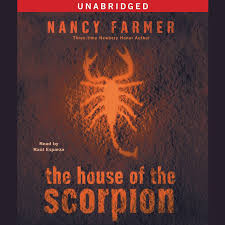
The House of the Scorpion, An Audiobook Review
Roadtrip Listen
Audiobook Rating
THE HOUSE OF THE SCORPION
by Nancy Farmer
read by Raúl Esparza
8 out of 10
Highly Recommend! This listen is perfect for a family road trip because the novel is well written and engaging enough to capture the interest of a variety of story-lovers, young and old. The audio voices are well-performed by actor, Raúl Esparza (Ferdinand, Law & Order: Special Victim’s unit) and the story lends itself easily to the listening ear.
5 Reasons for such a strong review:
1. Initially, there are few characters to follow and as new ones are introduced, the listener can maintain a grip on who everyone is…including, there are a number of characters with accents and very distinct voices (performed well by Esparza).
2. The point of view is third person, it stays close to Matt. It does not jump around from character to character.
3. The repetition of little stories told mostly by El Patrón, work like anchors for the listening brain. I write about this in my review of the novel, THE HOUSE OF THE SCORPION Repetition is a common story-telling technique, much like songwriters or poets will use a chorus or a repeated stanza to drive a point home.
4. The writing is top notch, which means, the dialogue is well written. The dialogue feels authentic, like real people talking.
5. Description of Opium takes place slowly and organically. The listener doesn’t have to absorb a huge amount of exposition, the describing of places, houses, rooms, plants, animals, people etc..takes place incrementally. Matt’s life starts out small and his view of Opium is narrow, but little by little, as he learns, the listener learns. Details are added that are important, but not all at once. It makes the audio format easy to follow.
For more on how to choose a good audiobook, see Part II The Rise of the Audio Book
The House of the Scorpion, A Novel Review With a Few Spoilers

THE HOUSE OF THE SCORPION by Nancy Farmer
Nancy Farmer’s first of of three novels, following the life of Matteo (Matt) Alacrán, is a story worth reading to or with your kids. The primary moral challenge centers around cloning, but there are many other ethical questions that will arise in the reading. Farmer’s writing creates real characters, despite the fantastical nature of the world. She takes on complicated relationships. power dynamics, and even religion as she draws the readers toward an inevitable reckoning. She stays close to the child, Matt, who grows up in the oddly luxurious world that is Opium. Matt is a young child at the start of the narrative, a teenager by the end. The story is told in close third person.
Matt is a clone of the wealthiest drug Lord in the world, an elderly Mexican man who dragged himself out of poverty to become one of the wealthiest men in the world. He is known as El Patrón. El Patrón is well over 100 years old. He rules his nation through fear and raw power and on its land he produces enough Opium, legal and illegal, for those who need the product. The land of Opium is both a place of horrors and an ecological oasis. Nothing is simple in Opium, as the reader will slowly discover.
THE HOUSE OF THE SCORPION deals with extreme wealth versus extreme poverty as well as power, ecological degradation, leadership, friendship, loyalty, religion and meaning. All of this subject matter is delivered in an impactful way to the young reader through relatable characters.
Farmer uses a style of writing that does not explain too much too early, but for those details that are difficult to fathom, they get repeated many times throughout the book, almost like a chorus. For example, the story of how El Patrón’s siblings perished, is told and retold. The story reveals the condition of poverty endured by his family, his town, his people and how desperately powerless he had been at one time. El Patrón is an old man…of course he would repeat himself again and again, but there is more to that story. The tale is part of the legend and a defining trauma in the life of the old man. The story also reminds the reader that Matt, though he is an exact replica of El Patrón on a cellular level, his life experiences will have been completely different. That memory of losing his family is El Patrón’s, but not Matt’s. The nature versus nurture debate looms in the background of this narrative and is worthy of a hearty discussion with your child.
Many other issues are introduced in THE HOUSE OF THE SCORPION There is more great storytelling and ethics to unearth as the narrative progresses. Nothing is black and white in Matt’s world, but this is why I would recommend the book. Farmer has put forward a character and a world with the kind of complexity that leads to memorable discussions. My next post will cover a short audiobook review of THE HOUSE OF THE SCORPION.
To buy THE HOUSE OF THE SCORPION, click here.
The Rise of the Audio Book, Part I

Do you listen to audio books? I do (and my family does) and word on the street is, there are a lot of book-listeners out there.
Here’s what Forbes’ Media and Entertainment writer, Adam Rowe reported last year:
“In 2017, digital content subscription service Scribd’s fastest-growing segment was audiobooks. Primary audiobook subscriber numbers for Scribd grew by more than 20% in 2016. The rise isn’t unique to Scribd: Audiobooks are also up about 20% year over year across the publishing industry for the first eight months of 2017, according to the Association of American Publishers’ data reports from 1,200 publishers. In the same time period, print books rose just 1.5%, and e-books dropped by 5.4 %.”
Who is listening to audio books?
Commuters, the home parent who is cooking a meal each night, families on a road trip, dog walkers, endurance athletes who have to train for hours at a time, the gym rat with a literary bent…many are listening. There is evidence to suggest that those who listen to audio books are also avid readers and audio books simply allow these readers to consume more books than their average number, but I suspect, some folks who don’t like to sit still in order to read are consuming books anew, like they haven’t since college or high school.
Where do you fall on the spectrum?
I confess, I don’t often listen to audio books while walking my dog, but use it as a time to be quiet and enjoy nature, but on a long road trip, whether alone or with family, I’m huge fan of audio entertainment, books and podcasts. I live in the Western US, where getting places often requires a long car voyage. A visit to my parents and brother, 12 hours. A visit to my son at the university he attends, 8 to 10 hours depending on traffic. If my daughter decides to go to grad school, we will drive 15 hours to help her move. These are all one-way trips I’ve delineated, so double the car time and I end up with a whopping number of hours spent in a car.
That’s a lot of productive time…or entertainment time…or time to check one or two books off your to read list. You will find that the hours it takes to get through a book vary, but on average, 12 hours will get you to the final chapter. The roundtrip to my daughter and back, for example, is at least 30 hours of drive time, that is about a 2-novel voyage…or we could take on something very long, like Herbert’s DUNE.
That’s the math for the road tripper, but what about the gym rat?
For the gym rat: 5 hours per week, for 4 weeks…that is about one extra book per month.
For the commuter in urban America, the average car time or train time to work is 30 minutes. That is 1 hour per day, 20 hours per month, about 1 to 2 extra books consumed per month.
If you are a business person, imagine reading one dynamic leadership book per month for a year and how that might impact your career. This becomes a fairly compelling model when one thinks about taking in new information that could improve your life coupled with entertainment.
I’m usually buying a science fiction audio book when I listen, but every now and then, a great non fiction book like THE POWER OF HABIT, gets onto the listening list. It turns out, habits do impact a writer like me, sort of a no-brainer, but the book lays out what happens in the body and brain when we establish positive (or negative) habits of life and work. I’m glad I listened to that book. I listened with a group that was on a road trip. My husband, a couple of college-aged kids and I were driving down to pick up my son from college. We ended up engaging in great discussions around the topic of habit that lasted the entire weekend…all while picking up a kid from college and helping him move back home for the summer…a time when college kids can fall into habits, good or bad. Am I a scheming parent to have thought of this? No…We really just stumbled upon the book.
So…it’s important, if you are choosing a book for the driving/riding community, to think about the character of the group that will be listening. Do aim for a book pleasing to all, but also, provocative. Spur those discussions that will happen at In n Out Burger or Grandzella’s or wherever you end up pausing for a meal.
This is part I of a two-part post.
See my post, The Rise of the Audio Book. Part II where I explain the appeal of audiobooks and perhaps entice the skeptic to try them out.
THE LEFT HAND OF DARKNESS, A Book Review

THE LEFT HAND OF DARKNESS is one of the greatest scifi stories of all time and it’s not a difficult read. There is a simplicity to the prose as the main character narrates in the first person, yet profound ideas flow out of this tome like rivers from a mountain spring. I highly recommend this book to any interested in science fiction, but also to the average reader who enjoys smart characters and deft storytelling.
The GREAT Ursula K. Le Guin wrote this novel in 1969. Many feel this novel to be her magnum opus. I have read the novel twice in the last couple of years, once because my child (who also graduated from Berkeley High as did the author) told me I had to read it, but also because my science fiction book group decided to read and discuss it at one of our monthly meetings. To understand the development of science fiction as a genre and its stream of ideas, Le Guin must be read and if you have to pull one book off her author shelf, I recommend THE LEFT HAND OF DARKNESS.
For more biographical info on Le Guin, there are a number of beautiful tributes to her that emerged after her passing this past January. This tribute from the New York Times is lovely, but there are many others. A google search will do the trick.
First, the short review…
Three reasons why I recommend this novel:
- THE LEFT HAND OF DARKNESS was written by a female author writing at a time when men dominated the genre. Ursula K. Le Guin was never really in “the club” with Asimov, Heinlein, Bradbury or Philip K. Dick. She was an outsider, as much as Margaret Atwood and yet she won the Hugo and Nebula Awards for this novel.
- This book is pleasure to read. The writing is tight and beautiful. The characters are other-worldly in a way that stretches the reader, yet both main characters, (including the alien character) are relatable.
- The ideas about politics and sexuality echo beyond the story. They provoke thought about our own culture’s morphing views on both topics and more.
Now for the longer review…
THE LEFT HAND OF DARKNESS tells the story of a man called Mr. Ai, who has traveled to a planet called Winter (or Gethen by its inhabitants). His aim is to woo the planet to join an intergalactic civilization of which he is an emissary and of which Earth is a part. The average temperature of Gethen is cold, which is why the visiting emissaries call it Winter.
The problem Mr. Ai encounters are many, but include the fact that the inhabitants of Gethen are not only suspicious of one another (rooted in tribal affiliations), they are suspicious of Mr. Ai, in part because of his sexual perversion…that Mr. Ai, as a human man, will be a male and remain a sexually-presenting male at all times and not just during courting or mating. On Gethen, inhabitants choose and change their gender. Their reproductive organs and energies are limited to those times when they morph. Their spouse/partner will be a sexual partner for a time or for a few seasons, maybe even for life, but the partnership is rooted in friendship and the male/female roles don’t exist in the same way they do on Earth.
This is a fascinating idea and in a way, it makes sense that Le Guin would think up Gethenian sexuality during the Modern/Western sexual revolution, when the society around her was contemplating gender roles. And still, Le Guin was more prophetic than she might have realized to delve into cultural assumptions around sexual identity. It is possible that this is one of the reasons there has been a resurgence of interest in this story as our society grapples with ever-changing, ever-new gender ideals and ideas. I find THE LEFT HAND OF DARKNESS to be an important touchstone in the public discourse that is taking place today.
An excerpt from the novel: My Landlady, a voluble man, arranged my journey into the East…He was so feminine in looks and manner that I once asked him how many children he had. He looked glum. He had never borne any. He had, however, sired four. It was one of the little jolts I was always getting. Cultural shock was nothing much compared to the biological shock I suffered as a human male among human beings who were, five-sixths of the time, hermaphroditic neuters.
Le Guin did not always want the moniker of science fiction or fantasy writer. She knew she was more than that. She wanted to provoke her reader into new thought. Observe how she deftly weaves politics into this early exchange between the two primary characters about patriotism.
Mr. Ai says: “If by patriotism you don’t mean the love of one’s homeland, for that I do know.”
The Gethen called Estraven replies: “No, I don’t mean love, when I say patriotism. I mean fear. The fear of the other. And its expressions are political, not poetical: hate, rivalry, aggression. It grows in us, that fear. It grows in us year by year. We’ve followed our road too far. And you, who come from a world that outgrew nations centuries ago, who hardly know what I’m talking about, who show us the new road…it is because of fear that I refuse to urge your cause with the king now…”
Estraven emerges as a forward-imagining Gethen and a friend to Mr. Ai. Their friendship and the adventure they undertake together make up the meat of the story.
To order the THE LEFT HAND of DARKNESS, click here.