Posts Tagged ‘books’
The Many Colored Land, Book Review
 Short Book Review with No Spoilers…
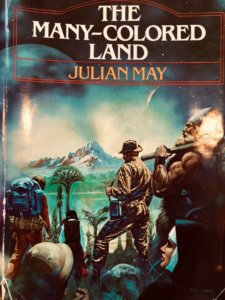
Julian May’s THE MANY COLORED LAND is an exceptional adventure that takes place in Pliocene Europe, think Tolkien meets Jules Verne. This is the first story in a trilogy, involving time travel and aliens. The world created by May is so imaginative, while being true to fossil record and prehistoric science. It’s like taking a course in geology, mammalian evolution and ancient flora all in one.
Three Reasons to Read this Great Book
- Superior world building and vibrant descriptive passages that will delight most scifi lovers.
- A humanoid alien race with a distinctive culture, a compelling ally or enemy?
- A complicated conflict between humans and aliens that drives the narrative
- A female author with mad writing skills. Julian May was unknown to many of my scifi-reading friends until a woman in my scifi book group introduced us to THE MANY COLORED LAND.
To buy this book, click here.
The Longer Review…With a Few Spoilers
The novel opens with a prologue, three essential scenes that set the adventure in motion. I needed to go back and re-read the first two to realize their relevance because there’s no context at that point for the reader to get them. Therefore, I promptly forget them. (Maybe in my younger years I would have recalled them at the right moment, much later in the story…or maybe not!)
The third scene remains memorable. It introduces the reader to a time travel machine and the human scientist who created it. A broader picture of current human existence becomes evident in this scene as scientists from many planets and many species gather to see the machine in operation. Earth’s children have become a part of a larger galactic cooperative, called the Galactic Milieu. The time machine is tested and its limitations are explained. The machine can only send beings back in history, only into Pliocene Europe. No messages can be sent back the other way, none of the beings who travel back in time will be able to return.
The scientist dies, his wife, Madame Guderian, contemplates what to do with the time machine. She begins to hear from various members of her species. Many feel a desire to leave their current situations. They want adventure or purity, something other than what they are experiencing. Many are lost souls, but others desire a simpler existence. She begins sending groups of people back to the Pliocene as a money-making scheme. There are rules, of course, to avoid messing up human evolution, so all females are sterilized before departing. The assumption is that the great ice age and the inability to procreate will bring an ultimate end to whatever societies form in this prehistoric exile. There are also limits to the kind of technology they bring.
The story proceeds to describe a number of human individuals currently living in the Galactic Milieu, all of whom find themselves dissatisfied with their lives in various ways and make the decision to go back in time. Each person has about a chapter of backstory before they come together. They are the characters the reader follows into the Pliocene, landing in the past about 1/4 of the way into the novel.
What follows is an experience in pre-history Europa, with a few good twists. This is scifi, yet fantasy-like, in that the world of the past is a place not unlike medieval Europe, given the absence of technology and another twist…aliens…who have crash-landed on Pliocene Earth. I really cannot say more without giving too much away.
However, here is a taste of May’s lovely writing, a descriptive passage of the Pliocene Black Forest
“The understorey of this evergreen expanse received very little sun. Its plants–only saprophytes nourished by the detritus of the great trees. Some of the things that battened on decomposition were degenerate flowering plants, pale stalks with nodding ghostly blooms of livid white, maroon, or speckled yellow; but paramount among the eaters of the dead were the myxomycetes and the fungi. To the five humans traveling through the Pliocene Black Forest it seemed that these, and not the towering conifers, were the dominant form of life.
They were quivering sheets of orange or white or dusty translucent jelly that crept slowly over the duff of needles and decaying wood like giant amebae. There were bracket fungi–from delicate pink ones resembling baby ears to stiff jumbos that jutted from the trunks like stair treads and were capable of bearing a man’s weight. There were spongy masses of mottled black and white that enveloped several square meters of forest floor as though veiling some unspeakable atrocity. There were airy filaments, pale blue and ivory and scarlet, that hung from rotting limbs like tattered lacework. The forest harbored puffball globes two and a half meters in diameter, and others as small as pearls from a broken string. One variety of fungus cloaked decaying shapes in brittle husks resembling colored popcorn. There were obscene things resembling cancerous organs; graceful ranks of upright fans; counterfeit slabs of raw meat; handsome polished shapes like ebony stars; oozing diseased purple phalluses; faerie parasols blown inside out; furry sausages; and mushrooms and toadstools in varieties the seemed to be without number. At night, they were phosphorescent.”
Another aspect of this novel that I want to write about another time (because this post is getting exceedingly long!) is the way May turns Tolkien ideals on their head. Elves, Humans, Goblins and Orcs? Who are the good guys and who are the bad guys? May’s novel upends the notions set forth in the Tolkien universe and I appreciate how she does it. Julian May died about one year ago, October 17, 2017. I think it’s time to bring this book back into the scifi mainstream and celebrate her for being an imaginative storyteller.
The House of the Scorpion, An Audiobook Review
Roadtrip Listen
Audiobook Rating
THE HOUSE OF THE SCORPION
by Nancy Farmer
read by Raúl Esparza
8 out of 10
Highly Recommend! This listen is perfect for a family road trip because the novel is well written and engaging enough to capture the interest of a variety of story-lovers, young and old. The audio voices are well-performed by actor, Raúl Esparza (Ferdinand, Law & Order: Special Victim’s unit) and the story lends itself easily to the listening ear.
5 Reasons for such a strong review:
1. Initially, there are few characters to follow and as new ones are introduced, the listener can maintain a grip on who everyone is…including, there are a number of characters with accents and very distinct voices (performed well by Esparza).
2. The point of view is third person, it stays close to Matt. It does not jump around from character to character.
3. The repetition of little stories told mostly by El Patrón, work like anchors for the listening brain. I write about this in my review of the novel, THE HOUSE OF THE SCORPION Repetition is a common story-telling technique, much like songwriters or poets will use a chorus or a repeated stanza to drive a point home.
4. The writing is top notch, which means, the dialogue is well written. The dialogue feels authentic, like real people talking.
5. Description of Opium takes place slowly and organically. The listener doesn’t have to absorb a huge amount of exposition, the describing of places, houses, rooms, plants, animals, people etc..takes place incrementally. Matt’s life starts out small and his view of Opium is narrow, but little by little, as he learns, the listener learns. Details are added that are important, but not all at once. It makes the audio format easy to follow.
For more on how to choose a good audiobook, see Part II The Rise of the Audio Book
The House of the Scorpion, A Novel Review With a Few Spoilers

THE HOUSE OF THE SCORPION by Nancy Farmer
Nancy Farmer’s first of of three novels, following the life of Matteo (Matt) Alacrán, is a story worth reading to or with your kids. The primary moral challenge centers around cloning, but there are many other ethical questions that will arise in the reading. Farmer’s writing creates real characters, despite the fantastical nature of the world. She takes on complicated relationships. power dynamics, and even religion as she draws the readers toward an inevitable reckoning. She stays close to the child, Matt, who grows up in the oddly luxurious world that is Opium. Matt is a young child at the start of the narrative, a teenager by the end. The story is told in close third person.
Matt is a clone of the wealthiest drug Lord in the world, an elderly Mexican man who dragged himself out of poverty to become one of the wealthiest men in the world. He is known as El Patrón. El Patrón is well over 100 years old. He rules his nation through fear and raw power and on its land he produces enough Opium, legal and illegal, for those who need the product. The land of Opium is both a place of horrors and an ecological oasis. Nothing is simple in Opium, as the reader will slowly discover.
THE HOUSE OF THE SCORPION deals with extreme wealth versus extreme poverty as well as power, ecological degradation, leadership, friendship, loyalty, religion and meaning. All of this subject matter is delivered in an impactful way to the young reader through relatable characters.
Farmer uses a style of writing that does not explain too much too early, but for those details that are difficult to fathom, they get repeated many times throughout the book, almost like a chorus. For example, the story of how El Patrón’s siblings perished, is told and retold. The story reveals the condition of poverty endured by his family, his town, his people and how desperately powerless he had been at one time. El Patrón is an old man…of course he would repeat himself again and again, but there is more to that story. The tale is part of the legend and a defining trauma in the life of the old man. The story also reminds the reader that Matt, though he is an exact replica of El Patrón on a cellular level, his life experiences will have been completely different. That memory of losing his family is El Patrón’s, but not Matt’s. The nature versus nurture debate looms in the background of this narrative and is worthy of a hearty discussion with your child.
Many other issues are introduced in THE HOUSE OF THE SCORPION There is more great storytelling and ethics to unearth as the narrative progresses. Nothing is black and white in Matt’s world, but this is why I would recommend the book. Farmer has put forward a character and a world with the kind of complexity that leads to memorable discussions. My next post will cover a short audiobook review of THE HOUSE OF THE SCORPION.
To buy THE HOUSE OF THE SCORPION, click here.
The Rise of the Audio Book. Part II
A Tale Worthy of a Listen
What to look for when choosing a book, especially if you’re a novice audiobook consumer…
Today, as I was having my teeth cleaned, my dental hygienist told me she is NOT a reader these days because of having two little girls to whom she reads all the time (a 4-year-old and a 2-year-old), but has found herself addicted to Audible when she drives, cooks and does other chores. She tells me while I am flat on my back, my mouth opened as wide as it will go,
“I fall asleep when I pick up a book to read right before bed, but during the day, I’m finding it so much fun to listen to a romance novel. I’m a sucker for a good love story.”
Audiobook listeners are coming out of the woodwork to talk to me when I indicate that I am writing this post. I don’t have enough data to know if this is a true cultural phenomena, but something is definitely percolating among us.
Like our ancestors of old, we still LOVE listening to stories. If you’re not an audio book-o-phile, consider this…
- More and more, writers and publishers are thinking about the audio platform and their customers who like to hear a story. They are organizing books to cater to our ear, for example, making chapter titles to anchor the listening ear and investing in professional actors as readers.
- You can download many audiobooks from your library for free…right at your fingertips, no subscription necessary…just a library card.
- If you need more choice, try Scribd’s free 30-day trial.
- You can do the same with Audible.
But, how will you know what will be a satisfying listening experience? Here are a few tips, my opinions on the best audio books and the ones to be wary of…
Say YES to these audiobooks…
- Theatrical Productions. Great if you’re listening to a play and can be fun for multi-character stories. Back in the cassette tape era, our family listened to a version of THE HOBBIT, produced by a company of actors under the label Mindspring. The production was originally done for radio and I say version of THE HOBBIT because I believe they edited out/streamlined some of the longer descriptive portions of the novel. My children often listened while they took baths (sometimes for an hour or more…getting extra clean). They begged to hear and re-hear the Bilbo/Gollum dialogue and the Smaug/Bilbo interactions. The varied voices captivated their imaginations.
- Well-reviewed Professional Actors Reading Fiction…Those able to perform the various voices are sought after. The best are employed to read best sellers…like…Harry Potter. There exists (believe me…I found out as I wrote this post…the debate is rabid) an epic debate about who voiced the characters better between two readers, Stephen Fry or Jim Vale…both brilliant in their own right, Fry reads the British version of HP and Dale reads the American version. I am not picky! I recommend both versions! This link to the very real debate reveals how nerdy the listening audience can be…and how nerdy Harry Potter fans often are:
- Any Compelling Story told in First Person. This means, as a listener, you get to stick with one point of view for all of the tale (or, at least most of the tale). HUCKLEBERRY FINN is a good example, so is HUNGER GAMES and one of my recent favs, ANNIHILATION. The first person narration puts the listener in the head of one person, usually the main character, and the main character only. Many find it easier to follow one voice as a listener because you become acquainted with that narrator, the sound, mood and tone of the voice, the opinions held by him/her. You don’t always have to trust the narrator’s opinions, but at least you know him/her and maintain that point of view as an anchor when navigating the story universe in your imagination. At the end of this article I will post a few more science fiction first person narrations I recommend.
- Tried and Tested Non Fiction Authors. Writers like Malcolm Gladwell and Michael Lewis are a great fit for the beginner audio consumer simply because they are such great communicators in writing and in speaking (they read their own audio versions). And, as always, you can also read reviews at Audible or ScribD’s online stores or google the information like the bestselling non-fiction audio books A list like this will point you in the right direction.
What to avoid if you’re unused to listening to stories…
- A Novel with Many Characters and Storylines. I enjoyed the novel, THE THREE BODY PROBLEM, but there were two things made that book a challenging listen…one was the vast number of character, some with semi-similar names. Since the book was originally written in Mandarin Chinese and my ear is not used to listening to the sounds and hearing the distinction regarding names, I was mixing up characters for a while before I got them straight. If I had had the physical book in front of me, I could have used the handy character list at the beginning of the book to keep myself straight. This story also jumps point of view, so anchoring in one mind and one voice were not an option.
- A Novel with Long Descriptive Passages. Tolkien fits into this mold. It’s not that you can’t listen to his books, but they might be challenging for beginners. I’m an audio learner and even my mind wanders when listening to Tolkien, especially portions of THE TWO TOWERS, as the vast landscape around Rohan is described for page after page.
- Poorly Written Anything with Poorly Constructed Characters. I might be a snob here, but certain novels that are written by men in particular who write “their fantasy” of a man (a super brilliant spy or detective, for example) and stereotype women as needy or pseudo-independent, but are really dependent on the super spy dude and the writer denigrates all the main character’s rivals and writes dialogue that is cliché or just terrible to listen to…um…I don’t like those books in any form, not in audio, not in print, not on the screen. My husband and I listened to a book like this for a few hours until I could stomach it no further. We never finished it.
- Beware of the Textbook. Unless that textbook writer is a master storyteller, don’t start with this genre. Not that you can’t work your way up to it, but the kind of info that is dumped onto the page of a textbook is often so dense, it’s better to read with highlighter in hand and in shorter spurts.
And now for THE LIST
Recent audiobooks I loved:
ANNIHILATION by Jeff Vandermeer (scifi), first person narration
EMBASSY TOWN by China Miéville (scifi), first person narration
THE MARTIAN by Andy Weir (scifi), mostly first person narration
The first ¾ of THE POWER OF HABIT by Charles Duhigg (non fiction) compelling subject matter for anyone
THE HOUSE OF THE SCORPION by Nancy Farmer (YA speculative fiction), great story, few characters
Audiobooks that were a challenge to listen to:
THE THREE BODY PROBLEM, by Liu Cixin (scifi) for me, too many storylines and characters
the last ¼ of THE POWER OF HABIT by Charles Duhigg (non fiction)…it felt redundant and repetitive by the end. I quit before finishing, but I’m glad I listened to the first ¾.
THE GANGSTER by Clive Cussler, Okay…he’s a NYTimes bestseller, but I found it difficult to stomach the characters and dialogue, dominated by cliché speeches and stereotypical males/females…maybe his other writing is better?
The Rise of the Audio Book, Part I

Do you listen to audio books? I do (and my family does) and word on the street is, there are a lot of book-listeners out there.
Here’s what Forbes’ Media and Entertainment writer, Adam Rowe reported last year:
“In 2017, digital content subscription service Scribd’s fastest-growing segment was audiobooks. Primary audiobook subscriber numbers for Scribd grew by more than 20% in 2016. The rise isn’t unique to Scribd: Audiobooks are also up about 20% year over year across the publishing industry for the first eight months of 2017, according to the Association of American Publishers’ data reports from 1,200 publishers. In the same time period, print books rose just 1.5%, and e-books dropped by 5.4 %.”
Who is listening to audio books?
Commuters, the home parent who is cooking a meal each night, families on a road trip, dog walkers, endurance athletes who have to train for hours at a time, the gym rat with a literary bent…many are listening. There is evidence to suggest that those who listen to audio books are also avid readers and audio books simply allow these readers to consume more books than their average number, but I suspect, some folks who don’t like to sit still in order to read are consuming books anew, like they haven’t since college or high school.
Where do you fall on the spectrum?
I confess, I don’t often listen to audio books while walking my dog, but use it as a time to be quiet and enjoy nature, but on a long road trip, whether alone or with family, I’m huge fan of audio entertainment, books and podcasts. I live in the Western US, where getting places often requires a long car voyage. A visit to my parents and brother, 12 hours. A visit to my son at the university he attends, 8 to 10 hours depending on traffic. If my daughter decides to go to grad school, we will drive 15 hours to help her move. These are all one-way trips I’ve delineated, so double the car time and I end up with a whopping number of hours spent in a car.
That’s a lot of productive time…or entertainment time…or time to check one or two books off your to read list. You will find that the hours it takes to get through a book vary, but on average, 12 hours will get you to the final chapter. The roundtrip to my daughter and back, for example, is at least 30 hours of drive time, that is about a 2-novel voyage…or we could take on something very long, like Herbert’s DUNE.
That’s the math for the road tripper, but what about the gym rat?
For the gym rat: 5 hours per week, for 4 weeks…that is about one extra book per month.
For the commuter in urban America, the average car time or train time to work is 30 minutes. That is 1 hour per day, 20 hours per month, about 1 to 2 extra books consumed per month.
If you are a business person, imagine reading one dynamic leadership book per month for a year and how that might impact your career. This becomes a fairly compelling model when one thinks about taking in new information that could improve your life coupled with entertainment.
I’m usually buying a science fiction audio book when I listen, but every now and then, a great non fiction book like THE POWER OF HABIT, gets onto the listening list. It turns out, habits do impact a writer like me, sort of a no-brainer, but the book lays out what happens in the body and brain when we establish positive (or negative) habits of life and work. I’m glad I listened to that book. I listened with a group that was on a road trip. My husband, a couple of college-aged kids and I were driving down to pick up my son from college. We ended up engaging in great discussions around the topic of habit that lasted the entire weekend…all while picking up a kid from college and helping him move back home for the summer…a time when college kids can fall into habits, good or bad. Am I a scheming parent to have thought of this? No…We really just stumbled upon the book.
So…it’s important, if you are choosing a book for the driving/riding community, to think about the character of the group that will be listening. Do aim for a book pleasing to all, but also, provocative. Spur those discussions that will happen at In n Out Burger or Grandzella’s or wherever you end up pausing for a meal.
This is part I of a two-part post.
See my post, The Rise of the Audio Book. Part II where I explain the appeal of audiobooks and perhaps entice the skeptic to try them out.
THE LEFT HAND OF DARKNESS, A Book Review

THE LEFT HAND OF DARKNESS is one of the greatest scifi stories of all time and it’s not a difficult read. There is a simplicity to the prose as the main character narrates in the first person, yet profound ideas flow out of this tome like rivers from a mountain spring. I highly recommend this book to any interested in science fiction, but also to the average reader who enjoys smart characters and deft storytelling.
The GREAT Ursula K. Le Guin wrote this novel in 1969. Many feel this novel to be her magnum opus. I have read the novel twice in the last couple of years, once because my child (who also graduated from Berkeley High as did the author) told me I had to read it, but also because my science fiction book group decided to read and discuss it at one of our monthly meetings. To understand the development of science fiction as a genre and its stream of ideas, Le Guin must be read and if you have to pull one book off her author shelf, I recommend THE LEFT HAND OF DARKNESS.
For more biographical info on Le Guin, there are a number of beautiful tributes to her that emerged after her passing this past January. This tribute from the New York Times is lovely, but there are many others. A google search will do the trick.
First, the short review…
Three reasons why I recommend this novel:
- THE LEFT HAND OF DARKNESS was written by a female author writing at a time when men dominated the genre. Ursula K. Le Guin was never really in “the club” with Asimov, Heinlein, Bradbury or Philip K. Dick. She was an outsider, as much as Margaret Atwood and yet she won the Hugo and Nebula Awards for this novel.
- This book is pleasure to read. The writing is tight and beautiful. The characters are other-worldly in a way that stretches the reader, yet both main characters, (including the alien character) are relatable.
- The ideas about politics and sexuality echo beyond the story. They provoke thought about our own culture’s morphing views on both topics and more.
Now for the longer review…
THE LEFT HAND OF DARKNESS tells the story of a man called Mr. Ai, who has traveled to a planet called Winter (or Gethen by its inhabitants). His aim is to woo the planet to join an intergalactic civilization of which he is an emissary and of which Earth is a part. The average temperature of Gethen is cold, which is why the visiting emissaries call it Winter.
The problem Mr. Ai encounters are many, but include the fact that the inhabitants of Gethen are not only suspicious of one another (rooted in tribal affiliations), they are suspicious of Mr. Ai, in part because of his sexual perversion…that Mr. Ai, as a human man, will be a male and remain a sexually-presenting male at all times and not just during courting or mating. On Gethen, inhabitants choose and change their gender. Their reproductive organs and energies are limited to those times when they morph. Their spouse/partner will be a sexual partner for a time or for a few seasons, maybe even for life, but the partnership is rooted in friendship and the male/female roles don’t exist in the same way they do on Earth.
This is a fascinating idea and in a way, it makes sense that Le Guin would think up Gethenian sexuality during the Modern/Western sexual revolution, when the society around her was contemplating gender roles. And still, Le Guin was more prophetic than she might have realized to delve into cultural assumptions around sexual identity. It is possible that this is one of the reasons there has been a resurgence of interest in this story as our society grapples with ever-changing, ever-new gender ideals and ideas. I find THE LEFT HAND OF DARKNESS to be an important touchstone in the public discourse that is taking place today.
An excerpt from the novel: My Landlady, a voluble man, arranged my journey into the East…He was so feminine in looks and manner that I once asked him how many children he had. He looked glum. He had never borne any. He had, however, sired four. It was one of the little jolts I was always getting. Cultural shock was nothing much compared to the biological shock I suffered as a human male among human beings who were, five-sixths of the time, hermaphroditic neuters.
Le Guin did not always want the moniker of science fiction or fantasy writer. She knew she was more than that. She wanted to provoke her reader into new thought. Observe how she deftly weaves politics into this early exchange between the two primary characters about patriotism.
Mr. Ai says: “If by patriotism you don’t mean the love of one’s homeland, for that I do know.”
The Gethen called Estraven replies: “No, I don’t mean love, when I say patriotism. I mean fear. The fear of the other. And its expressions are political, not poetical: hate, rivalry, aggression. It grows in us, that fear. It grows in us year by year. We’ve followed our road too far. And you, who come from a world that outgrew nations centuries ago, who hardly know what I’m talking about, who show us the new road…it is because of fear that I refuse to urge your cause with the king now…”
Estraven emerges as a forward-imagining Gethen and a friend to Mr. Ai. Their friendship and the adventure they undertake together make up the meat of the story.
To order the THE LEFT HAND of DARKNESS, click here.
The Phantom Tollbooth, Twenty Possible Discussion Questions for Educators
The art of a good question is always to draw out the thoughts and feelings of the one being questioned…(and for the most part…to avoid yes/no answers).
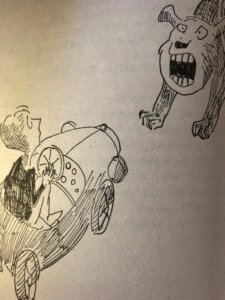 Here are 20 questions to get your student chatting up a storm (of course the student must have read the book closely in order to answer them, so you’ll find that out too.)
To read a review of THE PHANTOM TOLLBOOTH, click here
To order THE PHANTOM TOLLBOOTH, click here.
- What is Milo like in Chapter 1. How would you describe him?
- Would you want to be Milo’s friend, the Milo of Chapter 1? Why or Why not?
- When Milo sees the mysterious gift, he makes a big effort to put it together (the tollbooth) and then decides to use it. Does this surprise you? Why or Why not? Would you make that effort if you were in Milo’s place? Why or why not?
- In Milo’s initial travels, he gets stuck in the Doldrums. Who helps him get out? What does Milo have to do to get his car moving again?
- How would you describe Dictionopolis?
- In chapter 6, we learn about two Princesses. What are their names and how did they get banished?
- Milo starts thinking about the idea that he will rescue the Princesses. Where are the Princesses being held and what hardships will Milo face if he tries to rescue them?
- How would you describe the banquet in Dictionopolis? Did any of the foods make you laugh? Which one(s)?
- Chapter 9 introduces us to a boy called Alec and the idea of Point of View…How would you define “point of view” based on the discussion Alec and Milo have?
- In Chapter 10, the chapter that features Reality, Milo realizes “…the many times he’d done the very same thing; and, as hard as he tried, there were even things on his own street that he couldn’t remember…” What was Milo’s mistake? How has he made the same mistake people in Reality made long ago?
- Alec tells Milo in Chapter 11: There’s a lot to see everywhere, if only you keep your eyes open. What do you think Alec means when he says this to Milo? What is Milo supposed to see?
- Are noises and sounds important to you? Which ones and why? What do you think it would be like to live in a place where there was no sound?
- Milo steals a sound from the Soundkeeper…How does he do it and what are the results?
- Is the Island of Conclusions a good place to jump to? Why or why not?
- Who helps Milo reaches Digitopolis (see Chapter 14)?
- How does Milo outsmart the Mathemagician?
- What does the Demon of Petty Tasks and Worthless Jobs, Ogre of Wasted Effort and Monster of Habit ask Milo, Humbug and Tock to do?
- What are the demons that protect Ignorance? Come up with a list of the demons in this book, to the best of your ability (hint…end of Chapter 16 to middle of chapter 19)
- Which demon scares you the most and why?
- Look back to your Chapter 1 answer…How has Milo learned from his adventure? How would you describe him now? Would you want to be Milo’s friend, the Milo of Chapter 20?
The Phantom Tollbooth, A Review for Parents and Educators (with a few spoilers)
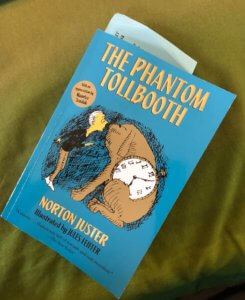
THE PHANTOM TOLLBOOTH is a Gateway Book for Digging into a Values Discussion with your Children or Students
To order this classic, click here.
To access 20 questions on the book, click here
This post is especially (but not only) for folks who have kids or teach kids. I loved my re-read of THE PHANTOM TOLLBOOTH. Here are four reasons why you ought to read this book with a child today (or tomorrow if the child is already asleep). And, for the record, this story does NOT fall into the category of sci-fi…more aligning with fantasy than science fiction.
- The story introduces ideas that unearth values we have (or need) about education and learning.
- The main kid character starts out flat and plain, but makes simple choices that thrust him into hero status…In many respects, he reacts to problems in a childlike way…he is very relatable…he also wants to do what is right. He discovers that doing what is right will require courage. He relies on his friends to accomplish the heroic task. These are all important values put forward by THE PHANTOM TOLLBOOTH.
- Imaginative characters, whose names reflect an aspect of their character, that you can discuss with your child, thus leading to more thorough discussions on everything from friendship to politics. This is a timely story for our kids. (No, really…you CAN talk with your kids about politics after reading this book…In fact, you should!)
- Lovely illustrations by Jules Feiffer scattered throughout.
Now for the longer review and musings about stories that provoke discussions…which is a very old way to teach deep lessons.
How does one discuss serious real-time issues with kids? Stories help a lot. I remember showing our children (and at a pretty young age) the Star Wars trilogy…at the time it was episode 4, 5 and 6. Star Wars is an archetypal good versus evil narrative. It features a character, Darth Vader, who though evil, still has the potential for redemption. This was an idea my husband and I wanted our 6 and 8-year-old kids to understand. The story raises the issues: What is evil? The Empire shows what evil looks like in a variety of ways. What is good? The rebellion shows us good and what it’s like when good battles evil. The force is a neutral entity in the universe, but seems to be used most powerfully (ultimately) by those who are good. Star Wars also raises this important question: Can a person be pure evil without the possibility for reform? This story tells us about Luke, Darth Vader and the deep power of love (sometimes love that costs us our lives, as it did for Anakin, Darth Vader) and how that love counters evil…(not to mention the sacrificial love of the friends, Han, Leah, R2-D2, C-3PO and Chewie.) This is a friendship story as much as it is a family story.
For me and my husband, the above ideas were important to us in particular because of our values that also have to do with our faith. We wanted to discuss the reality of evil with our kids, but also help them understand that people ALWAYS have the possibility of breaking free from the evil that grips them and as they do so, help themselves and others achieve goodness…much as (spoiler alert) Darth Vader does at the end of Return of the Jedi.
THE PHANTOM TOLLBOOTH is definitely less scary than Star Wars, but the reader still finds a good versus evil narrative. Milo, a boy, disinterested in life and education is our protagonist. This is how the reader sees him in Chapter 1.
“It seems to me that almost everything is a waste of time,” he remarked one day as he walked dejectedly home from school. “I can’t see the point in learning to solve useless problems, or subtracting turnips from turnips, or knowing where Ethiopia is or how to spell February.” And since no one bothered to explain otherwise, he regarded the process of seeking knowledge as the greatest waste of time of all.
Milo is given the gift of a magic tollbooth that takes him into an imaginary world, a place that will transform him. While there, begins to develop curiosity and engages with the strange world around him. He learns that words sustain life. He learns that numbers are essential to life and he learns that the conflict between two brothers (the king of words and ruler of numbers or the Mathmagician) cannot be solved until he helps them bring back their sisters from banishment. They are the Princesses Rhyme and Reason. In the world Milo is visiting, there is currently no rhyme nor reason to anything that takes place and it that has caused much misery across both kingdoms.
Milo isn’t a bad kid…initially, he’s just bored and disengaged…In today’s world…Milo might be a tv junkie or video game addict, but in the 60s…he was simply lethargic, lying around and doing nothing because nothing seemed interesting to him. In the new world where he travels, he is confronted with an adventure that captures his passion. Milo then begins to appreciate and notice the world around him, including the importance of education and learning. Milo’s transformation is an example of a child who decides to be curious and walks toward/into an adventure. That little step opens him to a world of learning. He even gains friends along the way.
A key for Milo is that he figures out his purpose. He decides to rescue the two princesses. He persists until he achieves the goal, despite many challenges.
The evil characters (Juster calls them demons) in this story resonate with today’s evils and dare I say…some of our current events. The demons live on the Mountain of Ignorance and include monsters such as Compromise, Hopping Hindsight, the Gorgons of Hate and Malice, Overbearing Know-It-All, Gross Exaggeration and Threadbare Excuse. Each creature described on the mountain could spur a conversation about values. Parents, consider yourself primed for a discussion of politicians, ad agencies, media or news organizations and grownups, in general…We adults could all use a refresher course on the “demons” that dull our wits in postmodern society. Good lessons for all.
Milo is a relatable kid character, even for kids today. He starts out bored and boring until he accepts the invitation to enter the tollbooth. His curiosity spurs him. He emerges into the new world and continues to wonder about its strangeness. He learns along the way that he must engage his senses and make friends. He slowly grows in appreciation of beauty around him and all the goofy characters he meets who are passionate about one thing or another. However, Milo’s own passion is not fully engaged until he decides to rescue the princesses. Then, his journey takes on a new vitality and without being fully conscious of it, he has stepped into the hero’s journey. His purpose, which has become his passion enables him to persist.
Through his determination and action, Milo is healed of his boredom…At the close of the story, Milo grieves that he (spoiler alert) no longer has access to the tollbooth, but he notices that
…the sky was a lovely shade of blue and that one cloud had the shape of a sailing ship. The tips of the trees held pale, young buds and the leaves were a rich deep green. Outside the window, there was so much to see, and hear, and touch–walks to take, hills to climb, caterpillars to watch as they strolled through the garden. There were voices to hear and conversations to listen to in wonder, and the special smell of each day.
*For a suggested list of questions for teachers, see my post on THE PHANTOM TOLLBOOTH, discussion questions for educators.
ANNIHILATION, Book Review

Book 1 of the Southern Reach Trilogy
ANNIHILATION, Review of the novel
By Jeff VanderMeer
“When you see beauty in desolation it changes something in you. Desolation tries to colonize you.”
The above observation comes to the reader early in ANNIHILATION and is a good representation of the reflective narration of this creepy science fiction novel, a book I highly recommend to the scifi lover.
Here’s the short review on why I recommend the novel. If you want to read the longer review…it follows immediately after the list.
To buy this book, click here.
- This is an all-female cast for a change
- A Biology-centric alien mystery
- Eloquent narrator/main character. Gorgeous writing overall.
- Very creepy vibe and tension all the way through to keep you reading
- Short and sweet, but not too short. (Plus, if you love it, there are two novels that follow. See The Southern Reach Trilogy).
ANNIHILATION tells the story of an all-female expedition into an alien eco-system that has planted itself on a stretch of coastal Northeastern US. The reader learns quickly that most of the people within previous expeditions have disappeared into this anomaly, a place labeled by the government as Area X. Only a few have returned, including the protagonist’s husband, who was on the 11th expedition and died from cancer soon after his return.
The primary narrator, also the protagonist of the story, writes the account in her journal. She is the biologist and is never named. None of the primary characters are named, but exist in the story via their function. We see all of Area X through the biologist’s eyes. In addition to her, this 12th expedition into Area X is made up of a psychologist, a surveyor (former military) and an anthropologist. The story opens with the expedition already underway. The four women are hiking to a basecamp that had been established by previous expeditions.
There are two prominent story-lines woven together artfully by author, Jeff VanderMeer.
One is the slow-building and always tense journey into the center of Area X, where a tunnel (or as our protagonist insists on calling it, a tower) and a lighthouse need to be explored. Discoveries are made about both, as well as the environment which is filled with strange hybrid vegetation and creatures. Those discoveries deepen the mystery.
The second storyline, which gave me much pleasure, was the unveiling of the main character. As a narrator, the biologist’s observations are keen, and her attempt to understand what happened to her husband lends itself to a natural telling of her backstory. There is a love tale here, subtle, but steady. It progresses with the first storyline, marching toward the climax and a revelation on par with a religious epiphany.
In writing this review, I did want to understand the word itself, Annihilation. In part I kept looking it up because I was always misspelling it. (I was forgetting that second “n”).
Annihilate comes from two Latin roots: an and nihil, annihilare means: to bring to nothing. In Middle English and later within the church, you find the same roots in the word annulment. An annulment was a legal/religious term that ended a marriage (in essence, turned the marriage into nothing, as if it never existed).
However, the coolest definition of the word is found in physics. Annihilation is the reaction in which a particle and its antiparticle collide and disappear. Energy is then released. I’m not a physicist, so when I started reading articles on annihilation and saw the terms Higgs Boson and Quarks…I realized I was out of my league. However, it would be safe to say…that when the process of annihilation takes place there is destruction and creation. I’m assuming VanderMeer, the author of ANNIHILATION, knows exactly how this definition frames the narrative.
THE THREE BODY PROBLEM: For Educators
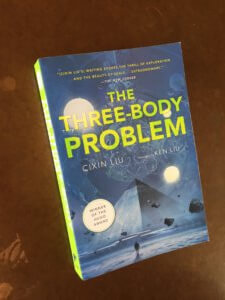
by Cixin Liu
Worthy of a Physics/Calculus Teacher’s Attention particularly high school and particularly for AP or IB Physics students
ALSO instructive for discussions in philosophy and ethics (see bottom paragraph)
High school physics instructors or calculus instructors…this novel would make a great summer reading assignment before your class begins in the Fall. One, the story is entertaining. Two, the story portrays historically some of the greatest physicists to walk planet Earth. Three, The Three Body Problem itself, the actual physics problem, this engages the physicist’s and the mathematician’s mind, Newtonian physics and all that jazz…Not that I understand it all, but I believe these the guys who write on the website: askamathematician.com. The excerpt below is from their website
The Three Body Problem is to exactly solve for the motions of three (or more) bodies interacting through an inverse square force (which includes gravitational and electrical attraction).
The problem with the 3-body problem is that it can’t be done, except in a very small set of frankly goofy scenarios (like identical planets following identical orbits).
The unsolvability of the 3-body problem, rather than being an embarrassing hole in physics, an obvious but unsolved problem, is actually the norm. In physics, the number of not-baby-simple, exactly solvable problems can be counted on the fingers of one hand (that’s missing some fingers), and that includes the 2-body problem.
The dynamics of one body is pretty straight forward, in as much as it travels straight forward.
The dynamics of two bodies, while not trivial, can be reduced by pretending that one body is sitting still, and then restricting all of your attention to the other body. Using that technique, you find (or, at least, Newton found) that the motion of a body under gravity is an ellipse. The same idea can be applied to the quantum mechanics of electrons and protons to find the exact structure of the electron shells in hydrogen (1 proton + 1 electron = 2 bodies). In that case you’re not talking about actual orbits, but the idea is similar.
But, for three bodies, there doesn’t seem to be a fancy trick for finding solutions. As a result, the exact behavior of 3 or more bodies can’t be written down. The exact energy levels and orbital shell shapes in anything other than hydrogen is impossible to find. Even deuterium (hydrogen with one extra neutron)! Can’t be done.
Despite that, we do alright, and happily, reality doesn’t concern itself with doing math, it just kinda “does”. For example, quantum field theory, despite being the most accurate theory that ever there was, never involves exactly solving anything. Once a physicist gets a hold of all the appropriate equations and a big computer, they can start approximating things. With enough computing power and time, these approximations can be made amazingly good. Computer simulation and approximation is a whole science unto itself.
The main actors in THE THREE BODY PROBLEM are almost all physicists and/or mathematicians and they’re nerdy, but not dweebs. Read chapter 5, A Game of Pool if you want a taste of what the novel offers. Then, there is the virtual reality, which unfolds as a puzzle/game and is played often by nanotechnology researcher, Wang Miao. Wang is compelled to understand the mystery introduced in the early chapters of the novel and realizes that the game is key to the revelation he seeks. In the game world, Wang walks through the history of physics with virtual characters like Confucius (our earliest physicists were primarily philosophers…a helpful connection for students to make), Newton and Einstein. Trisolara happens to be grappling with the three body problem. It is a planet in a solar system where there are three suns. The game players, along with the philosophers and physicists throughout history try again and again, in a systematic way, to solve the problem of the planet’s impending destruction. To go through each game level, Wang encounters physicists who have furthered the thinking regarding the problem. It’s like taking a course called The Intro to Physics…all this learning while the reader hurtles toward the big reveal at the end of the novel. Ah…to be entertained while learning…tis a wonderful thing. At the very least, THE THREE BODY PROBLEM ought to raise the curiosity level of your students and give them a glimpse of the relevance of physics and math to their everyday lives.
For the ethicist/philosopher, THE THREE BODY PROBLEM raises interesting issues about elites thinking they know best for all. The Cultural Revolution in China drives the narrative in the early chapters. Many elites are driven out of their positions of authority, killed or exiled by the communist party as it takes power. The author calls this a madness. (Chapter 1’s title is: The Madness Years). However, within the communist party, a new breed of elites rise to the top. Later, toward the final chapters of the novel, a group of environmental activists, along with men and women Liu specifies as elites across the globe, use their power to set in motion what they hope will be Earth’s salvation (knowing that saving the planet may come at the expense of most or all human lives). This small group of people have become judge, jury and executioner for humanity. Moreover, their hope for saving the Earth might not evolve the way they imagine. The stage is set for a discussion about power, elitism, environmental degradation and what might be ways to stem our self-destructive/planet-destroying tendencies.
To read a No-Spoiler review of this novel, click THREE BODY PROBLEM, Book Review
To buy THE THREE BODY PROBLEM, click here.