Posts Tagged ‘writing’
ARRIVAL, Film Review Without Spoilers
 I recently watched ARRIVAL for a second time through Amazon Prime. In my first viewing, I was in a theater and I loved it. This second go-around, I was not disappointed. I watched with a group of my cousins who are all film/scifi nuts. The viewing was free for Prime members.
ARRIVAL is rated PG 13…it’s somewhat creepy and suspenseful, but a middle school child or a sensitive viewer could probably handle the production. I’m not sure why it did not receive the PG rating. It unfolds without graphic violence and there is no explicit sexual content. One might call ARRIVAL a quiet film, but the subject matter takes it from the quiet realm into the epic and deeply thoughtful.
ARRIVAL was released in theaters to much acclaim in 2016. The film is based on a short story by Ted Chiang. Eric Heisserer wrote the screenplay. I hope to read and review Chiang’s short story in a future post.
The film unfolds with slow intensity primarily around one character, Louise Banks, played wonderfully by Amy Adams. Banks is a linguist recruited by the US government to learn the language spoken by aliens who have alighted in giant oblong space ships in twelve locations around the globe.
The story is a linguist’s dream and as a science fiction fan, I recall a number of novels that view first contact in light of language and communication. China Miéville’s Embassy Town is a good example. In a story such as this, violence is often threatened, but not center stage. Mysteries and the push to understand the other dominate the narrative.
Five quotes from the screenplay to pique your interest:
- “If this is some sort of peaceful first contact, why send twelve? Why not just send one?”
- “Language is the first weapon drawn in a conflict…”
- “Are they scientists or tourists? If they’re scientist, they don’t seem to ask a lot of questions…”
- “If you could see your life from start to finish, would you change things?”
- “Meeting you…was more important that seeing the stars…”
Five reasons to watch this film.

- It’s free if you’re an Amazon Prime member.
- If your family is into science fiction, ARRIVAL is a crowd pleaser which you can show to your kids with a clear conscience.
- Lots to ponder about language and linguistics, language and meaning, the puzzle and the importance of communication.
- Female hero with lots of brains and only a few characters to keep track of.
- Potentially leads to fruitful discussion about love, suffering, beauty, grace, even religion.
To buy this DVD, click here.
The Many Colored Land, Book Review
 Short Book Review with No Spoilers…
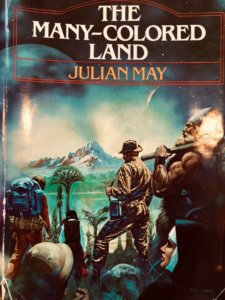
Julian May’s THE MANY COLORED LAND is an exceptional adventure that takes place in Pliocene Europe, think Tolkien meets Jules Verne. This is the first story in a trilogy, involving time travel and aliens. The world created by May is so imaginative, while being true to fossil record and prehistoric science. It’s like taking a course in geology, mammalian evolution and ancient flora all in one.
Three Reasons to Read this Great Book
- Superior world building and vibrant descriptive passages that will delight most scifi lovers.
- A humanoid alien race with a distinctive culture, a compelling ally or enemy?
- A complicated conflict between humans and aliens that drives the narrative
- A female author with mad writing skills. Julian May was unknown to many of my scifi-reading friends until a woman in my scifi book group introduced us to THE MANY COLORED LAND.
To buy this book, click here.
The Longer Review…With a Few Spoilers
The novel opens with a prologue, three essential scenes that set the adventure in motion. I needed to go back and re-read the first two to realize their relevance because there’s no context at that point for the reader to get them. Therefore, I promptly forget them. (Maybe in my younger years I would have recalled them at the right moment, much later in the story…or maybe not!)
The third scene remains memorable. It introduces the reader to a time travel machine and the human scientist who created it. A broader picture of current human existence becomes evident in this scene as scientists from many planets and many species gather to see the machine in operation. Earth’s children have become a part of a larger galactic cooperative, called the Galactic Milieu. The time machine is tested and its limitations are explained. The machine can only send beings back in history, only into Pliocene Europe. No messages can be sent back the other way, none of the beings who travel back in time will be able to return.
The scientist dies, his wife, Madame Guderian, contemplates what to do with the time machine. She begins to hear from various members of her species. Many feel a desire to leave their current situations. They want adventure or purity, something other than what they are experiencing. Many are lost souls, but others desire a simpler existence. She begins sending groups of people back to the Pliocene as a money-making scheme. There are rules, of course, to avoid messing up human evolution, so all females are sterilized before departing. The assumption is that the great ice age and the inability to procreate will bring an ultimate end to whatever societies form in this prehistoric exile. There are also limits to the kind of technology they bring.
The story proceeds to describe a number of human individuals currently living in the Galactic Milieu, all of whom find themselves dissatisfied with their lives in various ways and make the decision to go back in time. Each person has about a chapter of backstory before they come together. They are the characters the reader follows into the Pliocene, landing in the past about 1/4 of the way into the novel.
What follows is an experience in pre-history Europa, with a few good twists. This is scifi, yet fantasy-like, in that the world of the past is a place not unlike medieval Europe, given the absence of technology and another twist…aliens…who have crash-landed on Pliocene Earth. I really cannot say more without giving too much away.
However, here is a taste of May’s lovely writing, a descriptive passage of the Pliocene Black Forest
“The understorey of this evergreen expanse received very little sun. Its plants–only saprophytes nourished by the detritus of the great trees. Some of the things that battened on decomposition were degenerate flowering plants, pale stalks with nodding ghostly blooms of livid white, maroon, or speckled yellow; but paramount among the eaters of the dead were the myxomycetes and the fungi. To the five humans traveling through the Pliocene Black Forest it seemed that these, and not the towering conifers, were the dominant form of life.
They were quivering sheets of orange or white or dusty translucent jelly that crept slowly over the duff of needles and decaying wood like giant amebae. There were bracket fungi–from delicate pink ones resembling baby ears to stiff jumbos that jutted from the trunks like stair treads and were capable of bearing a man’s weight. There were spongy masses of mottled black and white that enveloped several square meters of forest floor as though veiling some unspeakable atrocity. There were airy filaments, pale blue and ivory and scarlet, that hung from rotting limbs like tattered lacework. The forest harbored puffball globes two and a half meters in diameter, and others as small as pearls from a broken string. One variety of fungus cloaked decaying shapes in brittle husks resembling colored popcorn. There were obscene things resembling cancerous organs; graceful ranks of upright fans; counterfeit slabs of raw meat; handsome polished shapes like ebony stars; oozing diseased purple phalluses; faerie parasols blown inside out; furry sausages; and mushrooms and toadstools in varieties the seemed to be without number. At night, they were phosphorescent.”
Another aspect of this novel that I want to write about another time (because this post is getting exceedingly long!) is the way May turns Tolkien ideals on their head. Elves, Humans, Goblins and Orcs? Who are the good guys and who are the bad guys? May’s novel upends the notions set forth in the Tolkien universe and I appreciate how she does it. Julian May died about one year ago, October 17, 2017. I think it’s time to bring this book back into the scifi mainstream and celebrate her for being an imaginative storyteller.
The House of the Scorpion, An Audiobook Review
Roadtrip Listen
Audiobook Rating
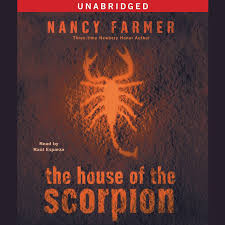
THE HOUSE OF THE SCORPION
by Nancy Farmer
read by Raúl Esparza
8 out of 10
Highly Recommend! This listen is perfect for a family road trip because the novel is well written and engaging enough to capture the interest of a variety of story-lovers, young and old. The audio voices are well-performed by actor, Raúl Esparza (Ferdinand, Law & Order: Special Victim’s unit) and the story lends itself easily to the listening ear.
5 Reasons for such a strong review:
1. Initially, there are few characters to follow and as new ones are introduced, the listener can maintain a grip on who everyone is…including, there are a number of characters with accents and very distinct voices (performed well by Esparza).
2. The point of view is third person, it stays close to Matt. It does not jump around from character to character.
3. The repetition of little stories told mostly by El Patrón, work like anchors for the listening brain. I write about this in my review of the novel, THE HOUSE OF THE SCORPION Repetition is a common story-telling technique, much like songwriters or poets will use a chorus or a repeated stanza to drive a point home.
4. The writing is top notch, which means, the dialogue is well written. The dialogue feels authentic, like real people talking.
5. Description of Opium takes place slowly and organically. The listener doesn’t have to absorb a huge amount of exposition, the describing of places, houses, rooms, plants, animals, people etc..takes place incrementally. Matt’s life starts out small and his view of Opium is narrow, but little by little, as he learns, the listener learns. Details are added that are important, but not all at once. It makes the audio format easy to follow.
For more on how to choose a good audiobook, see Part II The Rise of the Audio Book
The Rise of the Audio Book. Part II
A Tale Worthy of a Listen
What to look for when choosing a book, especially if you’re a novice audiobook consumer…
Today, as I was having my teeth cleaned, my dental hygienist told me she is NOT a reader these days because of having two little girls to whom she reads all the time (a 4-year-old and a 2-year-old), but has found herself addicted to Audible when she drives, cooks and does other chores. She tells me while I am flat on my back, my mouth opened as wide as it will go,
“I fall asleep when I pick up a book to read right before bed, but during the day, I’m finding it so much fun to listen to a romance novel. I’m a sucker for a good love story.”
Audiobook listeners are coming out of the woodwork to talk to me when I indicate that I am writing this post. I don’t have enough data to know if this is a true cultural phenomena, but something is definitely percolating among us.
Like our ancestors of old, we still LOVE listening to stories. If you’re not an audio book-o-phile, consider this…
- More and more, writers and publishers are thinking about the audio platform and their customers who like to hear a story. They are organizing books to cater to our ear, for example, making chapter titles to anchor the listening ear and investing in professional actors as readers.
- You can download many audiobooks from your library for free…right at your fingertips, no subscription necessary…just a library card.
- If you need more choice, try Scribd’s free 30-day trial.
- You can do the same with Audible.
But, how will you know what will be a satisfying listening experience? Here are a few tips, my opinions on the best audio books and the ones to be wary of…
Say YES to these audiobooks…
- Theatrical Productions. Great if you’re listening to a play and can be fun for multi-character stories. Back in the cassette tape era, our family listened to a version of THE HOBBIT, produced by a company of actors under the label Mindspring. The production was originally done for radio and I say version of THE HOBBIT because I believe they edited out/streamlined some of the longer descriptive portions of the novel. My children often listened while they took baths (sometimes for an hour or more…getting extra clean). They begged to hear and re-hear the Bilbo/Gollum dialogue and the Smaug/Bilbo interactions. The varied voices captivated their imaginations.
- Well-reviewed Professional Actors Reading Fiction…Those able to perform the various voices are sought after. The best are employed to read best sellers…like…Harry Potter. There exists (believe me…I found out as I wrote this post…the debate is rabid) an epic debate about who voiced the characters better between two readers, Stephen Fry or Jim Vale…both brilliant in their own right, Fry reads the British version of HP and Dale reads the American version. I am not picky! I recommend both versions! This link to the very real debate reveals how nerdy the listening audience can be…and how nerdy Harry Potter fans often are:
- Any Compelling Story told in First Person. This means, as a listener, you get to stick with one point of view for all of the tale (or, at least most of the tale). HUCKLEBERRY FINN is a good example, so is HUNGER GAMES and one of my recent favs, ANNIHILATION. The first person narration puts the listener in the head of one person, usually the main character, and the main character only. Many find it easier to follow one voice as a listener because you become acquainted with that narrator, the sound, mood and tone of the voice, the opinions held by him/her. You don’t always have to trust the narrator’s opinions, but at least you know him/her and maintain that point of view as an anchor when navigating the story universe in your imagination. At the end of this article I will post a few more science fiction first person narrations I recommend.
- Tried and Tested Non Fiction Authors. Writers like Malcolm Gladwell and Michael Lewis are a great fit for the beginner audio consumer simply because they are such great communicators in writing and in speaking (they read their own audio versions). And, as always, you can also read reviews at Audible or ScribD’s online stores or google the information like the bestselling non-fiction audio books A list like this will point you in the right direction.
What to avoid if you’re unused to listening to stories…
- A Novel with Many Characters and Storylines. I enjoyed the novel, THE THREE BODY PROBLEM, but there were two things made that book a challenging listen…one was the vast number of character, some with semi-similar names. Since the book was originally written in Mandarin Chinese and my ear is not used to listening to the sounds and hearing the distinction regarding names, I was mixing up characters for a while before I got them straight. If I had had the physical book in front of me, I could have used the handy character list at the beginning of the book to keep myself straight. This story also jumps point of view, so anchoring in one mind and one voice were not an option.
- A Novel with Long Descriptive Passages. Tolkien fits into this mold. It’s not that you can’t listen to his books, but they might be challenging for beginners. I’m an audio learner and even my mind wanders when listening to Tolkien, especially portions of THE TWO TOWERS, as the vast landscape around Rohan is described for page after page.
- Poorly Written Anything with Poorly Constructed Characters. I might be a snob here, but certain novels that are written by men in particular who write “their fantasy” of a man (a super brilliant spy or detective, for example) and stereotype women as needy or pseudo-independent, but are really dependent on the super spy dude and the writer denigrates all the main character’s rivals and writes dialogue that is cliché or just terrible to listen to…um…I don’t like those books in any form, not in audio, not in print, not on the screen. My husband and I listened to a book like this for a few hours until I could stomach it no further. We never finished it.
- Beware of the Textbook. Unless that textbook writer is a master storyteller, don’t start with this genre. Not that you can’t work your way up to it, but the kind of info that is dumped onto the page of a textbook is often so dense, it’s better to read with highlighter in hand and in shorter spurts.
And now for THE LIST
Recent audiobooks I loved:
ANNIHILATION by Jeff Vandermeer (scifi), first person narration
EMBASSY TOWN by China Miéville (scifi), first person narration
THE MARTIAN by Andy Weir (scifi), mostly first person narration
The first ¾ of THE POWER OF HABIT by Charles Duhigg (non fiction) compelling subject matter for anyone
THE HOUSE OF THE SCORPION by Nancy Farmer (YA speculative fiction), great story, few characters
Audiobooks that were a challenge to listen to:
THE THREE BODY PROBLEM, by Liu Cixin (scifi) for me, too many storylines and characters
the last ¼ of THE POWER OF HABIT by Charles Duhigg (non fiction)…it felt redundant and repetitive by the end. I quit before finishing, but I’m glad I listened to the first ¾.
THE GANGSTER by Clive Cussler, Okay…he’s a NYTimes bestseller, but I found it difficult to stomach the characters and dialogue, dominated by cliché speeches and stereotypical males/females…maybe his other writing is better?
THREE BODY PROBLEM, Book Review
The Three-Body Problem by Cixin Liu
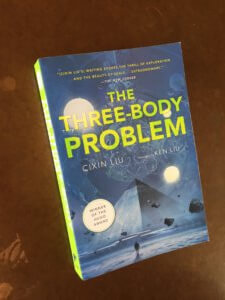
The Three Body Problem
By Cixin Liu, Translated by Ken Liu
Last month, my science fiction book group tackled THE THREE BODY PROBLEM. We used our 1.5 hours of group time discussing story-telling and physics. (We’re lucky to have a physics PhD in our midst. We’re luckier still that he makes a mean brew and brings us amazing pints of his beer creations each month.) Next time we meet, I’ll post a photo.
Short Review…
5 Reasons To Read THE THREE BODY PROBLEM
- Fascinating view into 20th century Chinese history
- Interesting and well-drawn characters
- A story with tension
- Physics, math problems, a virtual reality problem-solving game (nerd meter is tapped here!)
- A chance to read a Non-Western narrative
What ought I say about this epic tale? THE THREE BODY PROBLEM portrays a number of characters, most of them well-drawn. The story unfolds with tension, there is a mystery to be solved and the complicated physics concepts embedded in the tale are true science. A virtual reality in the form of a game played by one of the main characters, becomes a key to solving the mystery. The world the game introduces is imaginative and entertaining.
The characters do not look like white westerners, nor do they think like white westerners. I see that as a plus for the western reader. The characters are primarily Chinese Nationals, with a handful of others thrown into the story stew. (See the handy List of Characters page at the beginning of the book and refer to it when needed).
This novel is originally written in Mandarin Chinese, which means (unless you’re a fluent reader of Mandarin) you will read a translation of the original. Welcome to the 21st century, where story-telling centered around the English language will likely diminish, but not to our detriment. As story consumers, we’re living in the best of times.
And, in case you wonder about this tale’s place in the science fiction universe, THE THREE BODY PROBLEM won the Hugo Award in 2015. Moreover, Amazon has recently purchased the rights for adapting this novel for the screen (and the two that follow it) for 1 BILLION dollars. Yes…you heard me, 1 BILLION dollars and yes, this is the first of a trilogy (so far). Here is the link that tells the tale of the Amazon deal for those of you interested.
According to various entertainment news sites, Amazon is looking for the next Stranger Things or Game of Thrones that will add them to the mix of superior content providers. They are competing with Netflix, Hulu, HBO and now Disney Plus et al. for content. THE THREE BODY PROBLEM and its subsequent novels define superior content. Moreover, the trilogy so far (maybe it will expand as GOT did?) maintains a devoted fan following in China and across the globe, many, many millions of potential viewers who might become Amazon Prime members. You can begin to see the appeal to Amazon’s dealmakers.
So…with all that hype…what is my review of this story?
The Storytelling and Teasing out Who is the Main Character:
First, I will say that most of the members in our book group loved the novel overall. Some liked the story-telling, others did not like the style. The narrator is omniscient in a way that is sometimes disorienting, at least for the western reader. There are jump around moments when the point of view shifts somewhat abruptly from one character to another, from one time period to another, even to one solar system to another…I consumed the book on audio while on a road trip, so it’s possible I was more disoriented than if I had had the book in hand. The chapters often mark the dramatic scene/world/time changes. I was hearing them and not seeing them. There is something stark about viewing the blank page and a chapter heading. It triggers the eye, therefore the brain to prepare for the change. In the free-flow of audio, I don’t think my brain was always cluing in. I hope to write a post about audio books and their rise in our book consumption in the coming days.
Here is an example of the point of view shifts that will take place in this story. At the end of chapter 12, the reader moves from Red Coast Project site 1970s to chapter 13, where a series of selected documents are flatly divulged to the reader at a time in the future, as if the story-teller is showing us files, giving information about Red Coast Project, previously top secret…then, back to chapter 14, present day novel time, when a main character Wang Miao interacts with Professor Winjie, someone who worked for many years at Red Coast Project.
Wang Miao, a nano-tech researcher, is caught up in the mystery and trying to understand a complicated tangle of events taking place in the scientific community around him, including a number of prominent physicists committing suicide. He interfaces often with Ye Winjie throughout the novel, a retired physics professor, whose daughter is one of the physicists who has committed suicide. Ye and Miao are both primary characters. Miao is the most relatable character. He is trying to solve the mystery. I won’t call him THE main character only because from a story standpoint I understood Professor Ye Winjie to be the main character. The book begins and ends with scenes that involve her and/or her family, but Wang Miao is central to the unfurling of the mystery. He performs many acts that are crucial to the plot development, including, he plays the virtual reality game. The reader sees the game world and game characters through his eyes. So, who is the main character? It’s debatable…but between these two, I think it is Ye Winjie.
The main actors in THE THREE BODY PROBLEM are almost all physicists and/or mathematicians and they’re nerdy, but not dweebs. Read chapter 5, A Game of Pool if you want a taste of what the novel offers. The virtual reality world and the three body problem puzzle played often by Wang Miao make known the game planet of Trisolara. In the game, the reader walks through the history of physics because Trisolara has three suns and has to solve that problem or else, face destruction (which happens a number of times as Miao plays the game). The game players, along with physicists throughout history try again and again, in a systematic way, to solve the problem. Regarding the game and how it serves the story, I will leave that for your discovery.
Another aspect of storytelling that might disorient or bother the reader is the information dump that seems to happen periodically, like in chapter 13 as I mentioned above…also in chapter 25. An interrogation of professor Ye in this portion of the narrative ends up explaining a whole lot of back story. It’s not an awful dramatization, but so much information is divulged in one convenient scene, it would likely be deemed sloppy writing by many authors/literary critics…but hey, the question is…will you quit reading because of the way the information is delivered to you? I’m guessing the answer is no, you won’t quit. These info dumps happen throughout the novel and answer pieces of the mystery. The style of writing is probably not enough to stop the average reader, though one may be tempted to skim these sections.
Overall, THREE BODY PROBLEM is an entertaining and important read for the science fiction consumer, with a few new twists on an old scifi story that surprises and deepens the global tome that tries to envision humanity’s future.
For ideas on how to use this novel in class with students of math, science, philosophy or ethics, see my post: THE THREE BODY PROBLEM, For Educators or click here.
To buy THE THREE BODY PROBLEM, click here.
To buy the second book in the trilogy: THE DARK FOREST, Remembrance of Earth, click here.
To buy the third book in the trilogy: DEATH’S END, click here.
To buy the paperback boxed trilogy, click here.
To save yourself a bundle of dollars and shelf space, buy the trilogy on Kindle here.