Posts Tagged ‘technology and ethics’
DESCENDER by Jeff Lemire and Dustin Nguyen, A Review of Volume 2, MACHINE MOON

Cover Art DESCENDER, Volume 2, MACHINE MOON
Yes! Read this second volume and you might want to order the rest of the series now because if you’re like me, you’re pretty much hooked. This review of volume 2 will have a few spoilers if you haven’t already read volume 1.
MACHINE MOON did not disappoint. The stage is set, the key characters are on that stage (although I’m sure there will be a few new faces in coming volumes) and the heat is cranking up for an epic conflict. In volume 1, the reader is introduced to Tim-21, an A.I. of extraordinary talent, intelligence and empathy. Tim-21 was created by scientist, Dr. Jin Quon, as a companion for humans. The hero, depicted as a gentle-spirited little boy, wakes after 10 years of sleep. He had been companion to a human child and living with him as a brother on a remote mining colony. He wakes to find hundreds of corpses of human miners, dead now for 10 years, and two other robots, lesser A.I. models still active. Following Tim-21’s awakening, the Megacosm made up of nine planets, becomes aware of his presence. His particular intelligence chip is perceived as having brought about a disaster which has wiped out much of civilization. As a result, Tim-21 is targeted by a number of powerful factions who want to destroy him or use him to gain power. He has few human allies, though a couple seem to be emerging. Moreover, his relationship with robotkind turns complicated in this second volume. The reader roots for Tim-21 knowing he is a pawn for nearly every other character, which adds to the tension and the page-turning nature of the story.
I need to take this opportunity to comment further on the gorgeous art of Dustin Nguyen in this series. You too can actually hold this artwork in your hands and it is amazing, worthy of your hard-earned cash.


On Voyage
The colors are intense when the story requires it and muted at other times. For example, backstory and memory are mostly color-less. There are precise pen drawing-style features of characters, with water-color wash to add to the texture and the dreamy quality of the world.
To purchase this comic, click DESCENDER, Volume 2, you won’t regret it. The rest of the series is below.
DESCENDER, vol. 3 Singularities
DESCENDER, vol. 4 Orbital Mechanics
DESCENDER by Jeff Lemire and Dustin Nguyen, A Review of Volume 1, TIN STARS
 If you’re looking for an epic science fiction graphic novel and vibrant reading experience overall, the DESCENDER series is for you. I will be reviewing each volume, 6 in 6 days, without spoilers.
Here’s the review of VOLUME 1: TIN STARS
First, my pure recommendation…YES! You ought to read TIN STARS. Here’s why:
- The Story is Fantastic (and volume 1 is a great set up for more drama)
- The Art is to Die For
- The Characters Feel True and Interesting
- The World is Fantastically Drawn (in the art and in the narrative)
Jeff Lemire and Dustin Nguyen team up to create a beautiful and gripping story. Due to language and some graphic violence, I rate the novel overall PG-13.
If you hunger for A.I. and space and aliens of various types, shapes and forms, they all inhabit this place. Also, the graphic novel format feels like a window into the future. What the author does not describe in words, we see on the page, beautifully drawn and colored by Nguyen (what a talent!). The graphic novel genre lends itself well to the world of a future civilization, something beyond our imagination and fantastical. The author, Lemire, also knows how to build tension and keep his audience gripped and turning pages.
Speaking of turning pages, I found (after I had read the first volume) this handy reference page, called: Atlas of the Core Planets of the the United Galactic Council. The world imagined by Lemire is complex physically and politically. Each planet has a unique character, so I can see why the author saw the value in adding it.
This page was not present in volume 5, perhaps Lemire assumes we know the world by then, but it is at the end of 1-4. It’s helpful, especially if you’re the type who likes to know the world well before you read the story, flip to the back right away to orient yourself.
Don’t be surprised to see this series come to the screen sometime in the near future. When that happens, you can breathe on your fingertips, wipe them on your cuff and brag…Oh yes, I read the graphic novels, back in 2019.
To order your copy, click here: DESCENDER, Volume 1, Tin Stars
To order your copy of
An Excess Male, The Educator’s Guide
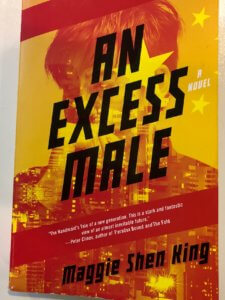
Maggie Shen King
The Perfect Discussion Starter for Public Policy 101
AN EXCESS MALE showcases governmental abuse of big data, but also, the one child policy…perhaps the most disastrous public policy of the modern era.
Warning: this book contains sexual content. I do not recommend it for the Middle Grade Reader<
Do your students know the term public policy?
A societal problem presents itself and a governmental entity decides on laws, regulations or funding priorities to solve the problem…you know, make a policy, for the public. You can find a number of sites that attempt to give a definition of public policy. I appreciated this Audiopedia presentation:
A basic introduction to public policy
Even with the above intro, public policy is still a complicated concept for the average youth who has not paid great attention to politics.
Shen King’s, AN EXCESS MALE tells the story that will enable a reader to study public policy through a microscope, by getting to know a fictional family and the impact a few particular policies have had and will have on them.
For background and history, have your student read one or two articles on China’s One Child Policy. This piece from National Geographic is a good one.
The summary: China feared overpopulation. China had historically been unable to grow enough food to feed their entire population. Their solution to this immediate societal problem was to institute a public policy (a law that went into effect in 1979) that rewarded those who limited their families to one child. Public pressure kept some couples from giving birth more than once, but there were also incentives given, like tax breaks for those who chose to abide by the law. Unfortunately, those who did not conform were sometimes forced to have abortions or to hide their second or third child. Some women were forcibly sterilized. Families, when forced to choose between a girl or a boy child, wanted boys. Boys were prized more highly for their earning potential and for other cultural reasons. Girl babies were given up for adoption, abandoned or hidden away. Unborn girls were also aborted at a higher rate…all because of a public policy. The current problem facing China now (as written about in the article above) is that by 2030, more than 25 percent of men in their late thirties will not have a family of their own. There are not enough brides in China to match up with these excess males.
Starting points for discussion around the novel…
Read chapter 1 most carefully, then continue through the book to the end. The public policy instigated by the Chinese government to solve the problem resulting from the One Child Policy (too many men, not enough women) is presented most concisely in the early scenes of the novel.
- How are the various characters related to Wei-guo? Go down the list and describe the relationships in short sentences or if you prefer draw a family/relationship diagram using Wei-guo as the center. In your diagram and/or description include Big Dad, Dad, May-Ling, Hero, Husband One, Husband Two, MaMa.
- Based on your diagram, what constitutes a family?
- If you were to summarize this first scene, how would you describe what is taking place?
- There is a point of discussion early on around Advanced Families and China First along with a reference to patriotism. How would you summarize what it means to be patriotic in the eyes of Wei-guo’s dads?
- “Every man is allowed one child…” Why do you think that is?
- There are rules and expectations that order these unusual families that are forming as a result of public policy, some rules are dictated by the government, others emerge out of necessity. Begin a list of these rules as you read through the book. Some rules are subtle, not easy to pick up on. Others are more obvious, like “Every man is allowed one child…”
- In chapter one, the term Willfully Sterile is used to describe Hero. What do you think this means?
- Big Dad calls Husband Two a Lost Boy? What do you think that means? How does Hero, the matchmaker defend Husband Two?
- What are the Strategic Games?
- Why might they exist?
- What does Major Jung want from Wei-guo and his band of Strategic Games men?
- He states a statistic. What is the statistic? Doc tries to protest…but clearly, the government official is giving the orders and not allowing for any discussion. Why do you think that is?
- There is a reference in the book periodically to going the max. The meaning is not precisely spelled out. What do you think it means?
- What do you think the government would do to May-ling, Hann and XX if they declared in all honesty who they are and what they want?
- How do you think a government gets this kind of power over individuals…the power to determine what it means to be a man, a woman, a family, a patriot and control those definitions for an entire society?
- The idea of government power through censorship and spying on (keeping track of) their own citizens emerges as a theme and becomes prominent by the final chapters of the book. Do you believe that the government should be able to track you, trace you, know your habits, what you buy and eat and drink? In the name of keeping society safe, is their intrusion into your privacy something you would be okay with?
This is such an important discussion and not just for those living in places like China (where citizens have little say in what their government does)…but in the US and Western Europe and among other “free people”…how much power in the form of data do you want your government to have?
Wired has a great article on the intersection between Big Brother and Big Data This reality is nothing new for the scifi world…but in the past it’s all been make believe. Now science fiction is becoming reality…our reality. What kind of checks on Big Data in the hands of government ought to be put into place now, to avert the kind of situation the reader sees in AN EXCESS MALE?
This ought to be a large public policy debate and a topic discussed by citizens everywhere. How much privacy will we give up for safety and what if our governments turn on us and decide that watching us is a part of creating a better society, more order?
There is much to read and discuss on this topic.
This article from business insider gives another angle and more will be written in the coming years as the technology outruns our ability to debate every new policy.
Enjoy Maggie Shen King’s book. Read it for the love story and the thrilling climax, but pay attention to the under-carriage of this story. A sinister government maintains tremendous power over how society defines everything from sexuality, family and mental illness to patriotism…now that is a scary story…something dreamed up by writer…or something at our doorstep.
To buy AN EXCESS MALE, click here.
An Excess Male, A Book Review Without Spoilers
Author, Maggie Shen King
“Science fiction is any idea that occurs in the head, but doesn’t exist yet, but soon will, and will change everything for everybody, and nothing will ever be the same again.”
Ray Bradbury
The Short Review
Three Reasons I Recommend you read AN EXCESS MALE…
- Learn about China, a rising power with imperial roots and aspirations. Let this novel wake us up to the reality of Big Data meeting Big Brother
- Fall in love with the characters put forward by Maggie Shen King
- Enjoy a good old fashioned love story/thriller. Actually….NO…the love story is unlike anything you have probably read, but the tale will thrill. Love, loyalty, duty are on display, nearly every page.
To buy AN EXCESS MALE, click here.
The Long Review, Also Without Spoilers
I recommend this novel with a few reservations. AN EXCESS MALE falls into the category of speculative fiction, though it bleeds into the scifi genre and would likely be enjoyed by anyone who loves “surveillance stories”, like Minority Report and The Net. This novel has a few PG-13 scenes, and some adult themes that might bore a young adult reader, but many young adults and those older who read speculative fiction will love the book. I would not recommend it for Middle Grade or younger.
Shen King’s story belongs in the future, and yet the reality she portrays is around the bend…How many years away? Maybe ten.
The premise of the novel addresses the terrible truth China is now grappling with…that their one-child policy has resulted in 40 million unmarriageable men. By the year 2030, more than 25% of men in their late thirties will have no family of their own. What are the options for Chinese society? Here are three possibilities…
- Import wives from neighboring Asian nations or elsewhere. The problem…the Chinese, especially the government values a pure and loyal race. They elevate the Han Chinese culture and importing wives will dilute Han Chinese blood.
- Send those extra men to battle. Society does not need them for child-bearing, so let them win honor in fighting to extend China’s influence around Asia and the globe. The problem…many of these men are the only children, the beloved one child of their parents. Who will take care of the parents, those elderly loyal citizens of China who have lived and suffered under this oppressive law to bear only one child? What does it mean if the government plucks away and sacrifices their one and only on the battle field?
- Require that women in China take more than one husband. Most will take two…some will even take three husbands. A new family system will evolve around this patriotic duty. The problems that may result…READ THE NOVEL TO FIND OUT.
Maggie Shen King writes a story that assumes the third possibility. Women marry more than one spouse, all for the good of China. In a spirit and tone that celebrates her Taiwanese/Chinese heritage, Shen King imagines a world where men pay dowries, women of child-bearing age are precious and coveted, and single men bear a painful stigma. Shen King tells the story in the third person, changing the close narrator’s viewpoint chapter by chapter. She signals the shift by titling her chapters with the character’s first name. Two husbands, one wife and one potential husband…these are the characters the reader follows into a labyrinth of love, politics, corruption and societal rules that do not bend for individual freedoms.
I have only one complaint about the novel, that the ending felt rushed and a bit predictable, somewhat contrived. Pacing did not match the earlier portion of the story. It’s an issue that can happen when writing from multiple characters’ perspectives. In this case, the main character and to some extent the heart of the story got somewhat lost in the milieu. However, even with a few flaws, I found the book fascinating and worthwhile. It’s a fun quick read and will immediately get you thinking and feeling.
The House of the Scorpion, Contemplating Human Cloning, For Educators
 Educators, THE HOUSE OF THE SCORPION provides a valuable and sensitive context for a discussion on genetics and cloning. To begin the journey, read the novel alongside your student(s). Next, discuss the science. There are a number of kid-friendly articles on cloning, I liked this one from Science News For Students
Finally, with an understanding of what cloning is, dig deep into the human story presented by Nancy Farmer in her deftly written account of a boy clone, Matt Alacrán.
I reviewed THE HOUSE OF THE SCORPION on another post on this website. If you continue reading this post, you’ll encounter more than a few spoilers, so beware, click here if you’re interested in reading the novel review before continuing.
To order HOUSE OF THE SCORPION, click here.
Here are a few questions to get the discussion flowing.
- Who is Matt? How would you describe him?
- Why do you think others often treat him cruelly?
- How would you describe Celia?
- What does Celia feel about Matt?
- What does El Patrón feel about Matt? Why do you think he calls Matt “mi vida”?
- What does it mean to be owned by a person? (Tam Lin, Matt, Celia, and even Felicia…all of them tell stories that indicate they are owned and not free…owned by El Patrón.) How is it that El Patrón owns them?
- What is an eejit?
- How is an eejit similar or different than Matt?
- How would you describe Matt’s struggle with being a clone? Does it make sense to you? Why or Why not?
- Matt’s life makes a positive difference in the lives of many others in the novel. Make a list of those people.
- Do you believe the cloning of people will take place in our future? If no, why not?
- If yes, How should clones be viewed by the society that creates them?
- Can you imagine a situation where you would choose to have a clone of yourself?
Synopsis of the Cloning Story:
THE HOUSE OF THE SCORPION is a Middle Grade/YA novel that follows the story of Matt Alacrán, one soul and his battle to find meaning and love in the midst of his genetic reality. El Patrón, a powerful drug lord who has an appetite for eternal life, has allowed Matt to be created as his clone, but the assumption is that Matt will not to live much past his adolescence. El Patrón’s long-term plans are to harvest the boy’s organs for himself. Neither the reader nor Matt know all of this initially. The reveal happens little by little. This is not a horror story in essence, though there are horrific issues to grapple with…Primarily, this story is about a young person figuring out who he is, learning day by day what it means to be human.
The House of the Scorpion, An Audiobook Review
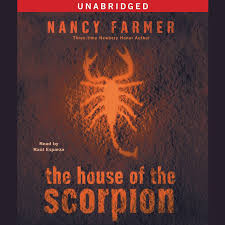
Roadtrip Listen
Audiobook Rating
THE HOUSE OF THE SCORPION
by Nancy Farmer
read by Raúl Esparza
8 out of 10
Highly Recommend! This listen is perfect for a family road trip because the novel is well written and engaging enough to capture the interest of a variety of story-lovers, young and old. The audio voices are well-performed by actor, Raúl Esparza (Ferdinand, Law & Order: Special Victim’s unit) and the story lends itself easily to the listening ear.
5 Reasons for such a strong review:
1. Initially, there are few characters to follow and as new ones are introduced, the listener can maintain a grip on who everyone is…including, there are a number of characters with accents and very distinct voices (performed well by Esparza).
2. The point of view is third person, it stays close to Matt. It does not jump around from character to character.
3. The repetition of little stories told mostly by El Patrón, work like anchors for the listening brain. I write about this in my review of the novel, THE HOUSE OF THE SCORPION Repetition is a common story-telling technique, much like songwriters or poets will use a chorus or a repeated stanza to drive a point home.
4. The writing is top notch, which means, the dialogue is well written. The dialogue feels authentic, like real people talking.
5. Description of Opium takes place slowly and organically. The listener doesn’t have to absorb a huge amount of exposition, the describing of places, houses, rooms, plants, animals, people etc..takes place incrementally. Matt’s life starts out small and his view of Opium is narrow, but little by little, as he learns, the listener learns. Details are added that are important, but not all at once. It makes the audio format easy to follow.
For more on how to choose a good audiobook, see Part II The Rise of the Audio Book
The House of the Scorpion, A Novel Review With a Few Spoilers

THE HOUSE OF THE SCORPION by Nancy Farmer
Nancy Farmer’s first of of three novels, following the life of Matteo (Matt) Alacrán, is a story worth reading to or with your kids. The primary moral challenge centers around cloning, but there are many other ethical questions that will arise in the reading. Farmer’s writing creates real characters, despite the fantastical nature of the world. She takes on complicated relationships, power dynamics, and even religion as she draws the readers toward an inevitable reckoning. She stays close to the child, Matt, who grows up in the oddly luxurious world that is Opium. Matt is a young child at the start of the narrative, a teenager by the end. The story is told in close third person. (Next paragraph contains spoilers).
Matt is a clone of the wealthiest drug Lord in the world, an elderly Mexican man who dragged himself out of poverty to become one of the wealthiest men in the world. He is known as El Patrón. El Patrón is well over 100 years old. He rules his nation through fear and raw power and on its land he produces enough Opium, legal and illegal, for those who need the product. The land of Opium is both a place of horrors and an ecological oasis. Nothing is simple in Opium, as the reader will slowly discover.
THE HOUSE OF THE SCORPION deals with extreme wealth versus extreme poverty as well as power, ecological degradation, leadership, friendship, loyalty, religion and meaning. All of this subject matter is delivered in an impactful way to the young reader through relatable characters.
Farmer uses a style of writing that does not explain too much too early, but for those details that are difficult to fathom, they get repeated many times throughout the book, almost like a chorus. For example, the story of how El Patrón’s siblings perished, is told and retold. The story reveals the condition of poverty endured by his family, his town, his people and how desperately powerless he had been at one time. El Patrón is an old man…of course he would repeat himself, but the repetition reveals character as well. The tale is part of El Patrón’s mythos and a defining trauma in the life of the old man. The story also reminds the reader that Matt, though he is an exact replica of El Patrón on a cellular level, has life his own unique life experiences. That memory of losing his family is El Patrón’s, but not Matt’s. The nature versus nurture debate looms in the background of this narrative and is worthy of a hearty discussion with your child.
Many other issues are introduced in THE HOUSE OF THE SCORPION There is more great storytelling and ethics to unearth as the narrative progresses. Nothing is black and white in Matt’s world, but this is why I would recommend the book. Farmer has put forward a character and a world with the kind of complexity that leads to memorable discussions. My next post will cover a short audiobook review of THE HOUSE OF THE SCORPION.
To buy THE HOUSE OF THE SCORPION, click here.
The Phantom Tollbooth, A Review for Parents and Educators (with a few spoilers)
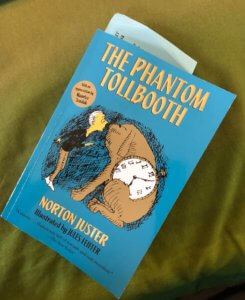
THE PHANTOM TOLLBOOTH is a Gateway Book for Digging into a Values Discussion with your Children or Students
To order this classic, click here.
To access 20 questions on the book, click here
This post is especially (but not only) for folks who have kids or teach kids. I loved my re-read of THE PHANTOM TOLLBOOTH. Here are four reasons why you ought to read this book with a child today (or tomorrow if the child is already asleep). And, for the record, this story does NOT fall into the category of sci-fi…more aligning with fantasy than science fiction.
- The story introduces ideas that unearth values we have (or need) about education and learning.
- The main kid character starts out flat and plain, but makes simple choices that thrust him into hero status…In many respects, he reacts to problems in a childlike way…he is very relatable…he also wants to do what is right. He discovers that doing what is right will require courage. He relies on his friends to accomplish the heroic task. These are all important values put forward by THE PHANTOM TOLLBOOTH.
- Imaginative characters, whose names reflect an aspect of their character, that you can discuss with your child, thus leading to more thorough discussions on everything from friendship to politics. This is a timely story for our kids. (No, really…you CAN talk with your kids about politics after reading this book…In fact, you should!)
- Lovely illustrations by Jules Feiffer scattered throughout.
Now for the longer review and musings about stories that provoke discussions…which is a very old way to teach deep lessons.
How does one discuss serious real-time issues with kids? Stories help a lot. I remember showing our children (and at a pretty young age) the Star Wars trilogy…at the time it was episode 4, 5 and 6. Star Wars is an archetypal good versus evil narrative. It features a character, Darth Vader, who though evil, still has the potential for redemption. This was an idea my husband and I wanted our 6 and 8-year-old kids to understand. The story raises the issues: What is evil? The Empire shows what evil looks like in a variety of ways. What is good? The rebellion shows us good and what it’s like when good battles evil. The force is a neutral entity in the universe, but seems to be used most powerfully (ultimately) by those who are good. Star Wars also raises this important question: Can a person be pure evil without the possibility for reform? This story tells us about Luke, Darth Vader and the deep power of love (sometimes love that costs us our lives, as it did for Anakin, Darth Vader) and how that love counters evil…(not to mention the sacrificial love of the friends, Han, Leah, R2-D2, C-3PO and Chewie.) This is a friendship story as much as it is a family story.
For me and my husband, the above ideas were important to us in particular because of our values that also have to do with our faith. We wanted to discuss the reality of evil with our kids, but also help them understand that people ALWAYS have the possibility of breaking free from the evil that grips them and as they do so, help themselves and others achieve goodness…much as (spoiler alert) Darth Vader does at the end of Return of the Jedi.
THE PHANTOM TOLLBOOTH is definitely less scary than Star Wars, but the reader still finds a good versus evil narrative. Milo, a boy, disinterested in life and education is our protagonist. This is how the reader sees him in Chapter 1.
“It seems to me that almost everything is a waste of time,” he remarked one day as he walked dejectedly home from school. “I can’t see the point in learning to solve useless problems, or subtracting turnips from turnips, or knowing where Ethiopia is or how to spell February.” And since no one bothered to explain otherwise, he regarded the process of seeking knowledge as the greatest waste of time of all.
Milo is given the gift of a magic tollbooth that takes him into an imaginary world, a place that will transform him. While there, begins to develop curiosity and engages with the strange world around him. He learns that words sustain life. He learns that numbers are essential to life and he learns that the conflict between two brothers (the king of words and ruler of numbers or the Mathmagician) cannot be solved until he helps them bring back their sisters from banishment. They are the Princesses Rhyme and Reason. In the world Milo is visiting, there is currently no rhyme nor reason to anything that takes place and it that has caused much misery across both kingdoms.
Milo isn’t a bad kid…initially, he’s just bored and disengaged…In today’s world…Milo might be a tv junkie or video game addict, but in the 60s…he was simply lethargic, lying around and doing nothing because nothing seemed interesting to him. In the new world where he travels, he is confronted with an adventure that captures his passion. Milo then begins to appreciate and notice the world around him, including the importance of education and learning. Milo’s transformation is an example of a child who decides to be curious and walks toward/into an adventure. That little step opens him to a world of learning. He even gains friends along the way.
A key for Milo is that he figures out his purpose. He decides to rescue the two princesses. He persists until he achieves the goal, despite many challenges.
The evil characters (Juster calls them demons) in this story resonate with today’s evils and dare I say…some of our current events. The demons live on the Mountain of Ignorance and include monsters such as Compromise, Hopping Hindsight, the Gorgons of Hate and Malice, Overbearing Know-It-All, Gross Exaggeration and Threadbare Excuse. Each creature described on the mountain could spur a conversation about values. Parents, consider yourself primed for a discussion of politicians, ad agencies, media or news organizations and grownups, in general…We adults could all use a refresher course on the “demons” that dull our wits in postmodern society. Good lessons for all.
Milo is a relatable kid character, even for kids today. He starts out bored and boring until he accepts the invitation to enter the tollbooth. His curiosity spurs him. He emerges into the new world and continues to wonder about its strangeness. He learns along the way that he must engage his senses and make friends. He slowly grows in appreciation of beauty around him and all the goofy characters he meets who are passionate about one thing or another. However, Milo’s own passion is not fully engaged until he decides to rescue the princesses. Then, his journey takes on a new vitality and without being fully conscious of it, he has stepped into the hero’s journey. His purpose, which has become his passion enables him to persist.
Through his determination and action, Milo is healed of his boredom…At the close of the story, Milo grieves that he (spoiler alert) no longer has access to the tollbooth, but he notices that
…the sky was a lovely shade of blue and that one cloud had the shape of a sailing ship. The tips of the trees held pale, young buds and the leaves were a rich deep green. Outside the window, there was so much to see, and hear, and touch–walks to take, hills to climb, caterpillars to watch as they strolled through the garden. There were voices to hear and conversations to listen to in wonder, and the special smell of each day.
*For a suggested list of questions for teachers, see my post on THE PHANTOM TOLLBOOTH, discussion questions for educators.
THE THREE BODY PROBLEM: For Educators
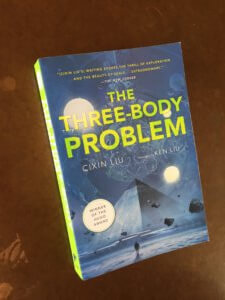
by Cixin Liu
Worthy of a Physics/Calculus Teacher’s Attention particularly high school and particularly for AP or IB Physics students
ALSO instructive for discussions in philosophy and ethics (see bottom paragraph)
High school physics instructors or calculus instructors…this novel would make a great summer reading assignment before your class begins in the Fall. One, the story is entertaining. Two, the story portrays historically some of the greatest physicists to walk planet Earth. Three, The Three Body Problem itself, the actual physics problem, this engages the physicist’s and the mathematician’s mind, Newtonian physics and all that jazz…Not that I understand it all, but I believe these the guys who write on the website: askamathematician.com. The excerpt below is from their website
The Three Body Problem is to exactly solve for the motions of three (or more) bodies interacting through an inverse square force (which includes gravitational and electrical attraction).
The problem with the 3-body problem is that it can’t be done, except in a very small set of frankly goofy scenarios (like identical planets following identical orbits).
The unsolvability of the 3-body problem, rather than being an embarrassing hole in physics, an obvious but unsolved problem, is actually the norm. In physics, the number of not-baby-simple, exactly solvable problems can be counted on the fingers of one hand (that’s missing some fingers), and that includes the 2-body problem.
The dynamics of one body is pretty straight forward, in as much as it travels straight forward.
The dynamics of two bodies, while not trivial, can be reduced by pretending that one body is sitting still, and then restricting all of your attention to the other body. Using that technique, you find (or, at least, Newton found) that the motion of a body under gravity is an ellipse. The same idea can be applied to the quantum mechanics of electrons and protons to find the exact structure of the electron shells in hydrogen (1 proton + 1 electron = 2 bodies). In that case you’re not talking about actual orbits, but the idea is similar.
But, for three bodies, there doesn’t seem to be a fancy trick for finding solutions. As a result, the exact behavior of 3 or more bodies can’t be written down. The exact energy levels and orbital shell shapes in anything other than hydrogen is impossible to find. Even deuterium (hydrogen with one extra neutron)! Can’t be done.
Despite that, we do alright, and happily, reality doesn’t concern itself with doing math, it just kinda “does”. For example, quantum field theory, despite being the most accurate theory that ever there was, never involves exactly solving anything. Once a physicist gets a hold of all the appropriate equations and a big computer, they can start approximating things. With enough computing power and time, these approximations can be made amazingly good. Computer simulation and approximation is a whole science unto itself.
The main actors in THE THREE BODY PROBLEM are almost all physicists and/or mathematicians and they’re nerdy, but not dweebs. Read chapter 5, A Game of Pool if you want a taste of what the novel offers. Then, there is the virtual reality, which unfolds as a puzzle/game and is played often by nanotechnology researcher, Wang Miao. Wang is compelled to understand the mystery introduced in the early chapters of the novel and realizes that the game is key to the revelation he seeks. In the game world, Wang walks through the history of physics with virtual characters like Confucius (our earliest physicists were primarily philosophers…a helpful connection for students to make), Newton and Einstein. Trisolara happens to be grappling with the three body problem. It is a planet in a solar system where there are three suns. The game players, along with the philosophers and physicists throughout history try again and again, in a systematic way, to solve the problem of the planet’s impending destruction. To go through each game level, Wang encounters physicists who have furthered the thinking regarding the problem. It’s like taking a course called The Intro to Physics…all this learning while the reader hurtles toward the big reveal at the end of the novel. Ah…to be entertained while learning…tis a wonderful thing. At the very least, THE THREE BODY PROBLEM ought to raise the curiosity level of your students and give them a glimpse of the relevance of physics and math to their everyday lives.
For the ethicist/philosopher, THE THREE BODY PROBLEM raises interesting issues about elites thinking they know best for all. The Cultural Revolution in China drives the narrative in the early chapters. Many elites are driven out of their positions of authority, killed or exiled by the communist party as it takes power. The author calls this a madness. (Chapter 1’s title is: The Madness Years). However, within the communist party, a new breed of elites rise to the top. Later, toward the final chapters of the novel, a group of environmental activists, along with men and women Liu specifies as elites across the globe, use their power to set in motion what they hope will be Earth’s salvation (knowing that saving the planet may come at the expense of most or all human lives). This small group of people have become judge, jury and executioner for humanity. Moreover, their hope for saving the Earth might not evolve the way they imagine. The stage is set for a discussion about power, elitism, environmental degradation and what might be ways to stem our self-destructive/planet-destroying tendencies.
To read a No-Spoiler review of this novel, click THREE BODY PROBLEM, Book Review
To buy THE THREE BODY PROBLEM, click here.
FEED, For Educators
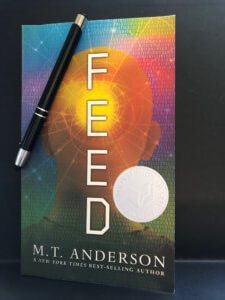
Discussion Questions for Educators
Appropriate for Middle Schoolers and High Schoolers
What a potent book and an important topic. If you are an educator, please assign this short novel to your kids. I have tested it on more than a few middle and high schoolers and they liked it, even felt captivated by it and knew there was truth in the story that they needed to pay attention to.
Five discussion questions for your students
- How is the feed similar to the way we connect to our devices?
- How is the feed different from the way we connect to our devices?
- How would you describe Titus and his friends?
- How would you describe Violet?
- Who is more of a hero? Violet or Titus? Explain why…
To read a no spoiler review of the novel, click here.
To buy, FEED, click here.